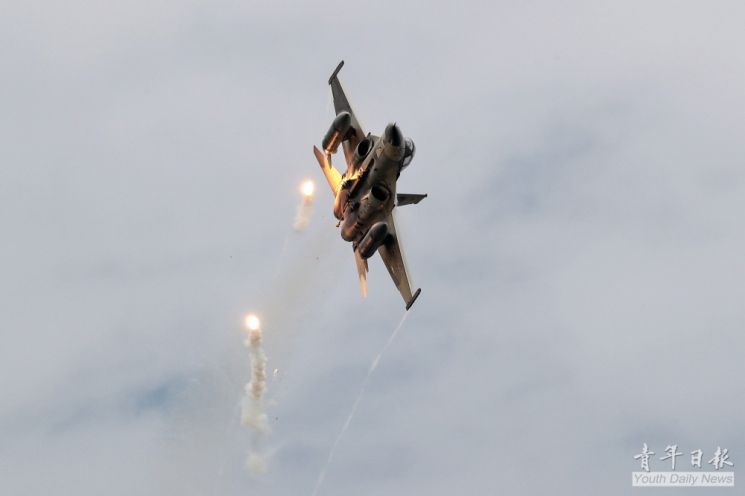
 The IDF Ching-Kuo fighter jet, developed independently by Taiwan, is the second most numerous aircraft in the Taiwanese Air Force after the F-16. Photo by Taiwan Ministry of National Defense
[Military Analyst Kim Daeyoung] Amid rising tensions between China and Taiwan over the Taiwan Strait, Taiwan's President Tsai Ing-wen visited the Penghu Islands on September 22. Arriving at the Penghu Islands aboard Air Force One, President Tsai encouraged the stationed personnel of Taiwan's army, navy, and air force.
Although the visit was officially to boost the morale of military personnel ahead of the Mid-Autumn Festival (Chuseok), local analysis suggests it also carried a strong warning against the recent frequent incursions of Chinese military aircraft into Taiwan's Air Defense Identification Zone. One indication of this intent was her visit to the Taiwanese Air Force's Tianju (天駒) unit located at Magong Air Base on the Penghu Islands. The Penghu Islands are situated in the Taiwan Strait and serve as a strategic key point capable of blocking a Chinese invasion of Taiwan in the event of an emergency.
The Tianju unit is known as the only fighter squadron of the Taiwanese Air Force stationed on the Penghu Islands. Rotated on a multi-month basis, the Tianju unit operates the domestically developed IDF Jingguohao (IDF 經國號) fighter jets. Notably, during Tsai Ing-wen’s visit, alongside the IDF Jingguohao fighters, the ‘Wanjen (萬劍)’ long-range air-to-ground missile with a range of 200 km, developed and deployed by Taiwan’s National Chung-Shan Institute of Science and Technology, was also unveiled.
If an IDF Jingguohao fighter jet taking off from Magong Air Base employs the Wanjen missile, it can precisely strike major Chinese military facilities located along the coast and inland on the opposite side of the Taiwan Strait. Taiwan produced over 130 IDF Jingguohao fighters, including six prototypes. The IDF Jingguohao successfully completed its maiden flight on May 28, 1989, and was first deployed in January 1994 at the Qingquangang (?泉崗) base in central Taiwan.
Ranking second in number after the F-16 in the Taiwanese Air Force, the IDF Jingguohao is a domestically produced fighter developed under the Taiwan Relations Act following the severance of diplomatic ties with the United States. After the normalization of US-China relations in the late 1970s, Taiwan found it increasingly difficult to acquire the latest fighter jets from the US. Consequently, Taiwan decided to develop its own fighter jets and, under the Taiwan Relations Act?which provides defensive weapons to Taiwan?collaborated with American aerospace and defense companies to piece together the development of the IDF Jingguohao.
Notably, the IDF Jingguohao is virtually unique among domestically produced fighters in China, Japan, and Taiwan in that it undertook the development of not only the airframe but also radar, avionics, engines, and armaments. Considering Taiwan’s operational environment, where engagement distances with adversaries are short, the aircraft was designed to be ready for sortie within five minutes of mission assignment. It is also capable of beyond-visual-range air combat using the domestically produced medium-range air-to-air missile ‘Tianjian-2’ (天劍-2). The name ‘Jingguo’ in IDF Jingguohao honors former Taiwanese President Chiang Ching-kuo (蔣經國), who ordered the development of the indigenous fighter. Since 2010, the IDF Jingguohao has undergone significant performance upgrades under the Xiangzhan (翔展) program.
© The Asia Business Daily(www.asiae.co.kr). All rights reserved.
![Clutching a Stolen Dior Bag, Saying "I Hate Being Poor but Real"... The Grotesque Con of a "Human Knockoff" [Slate]](https://cwcontent.asiae.co.kr/asiaresize/183/2026021902243444107_1771435474.jpg)
















