"Please Don't Call Me President... Considering Closing the Business"
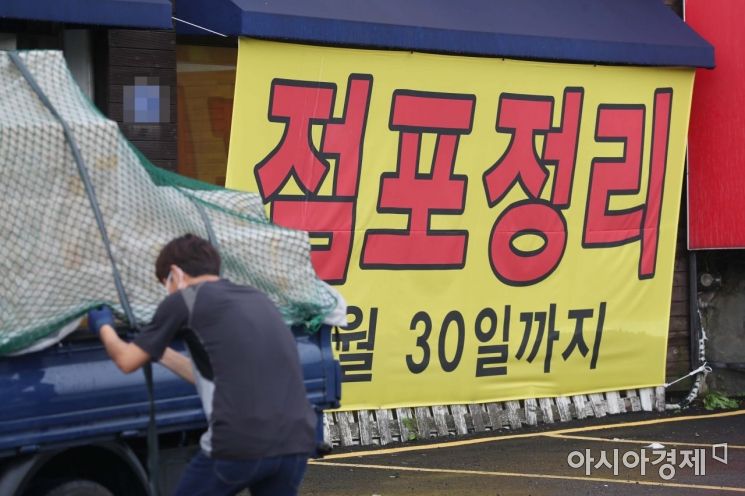 The resurgence of the novel coronavirus infection (COVID-19) is increasing difficulties for small business owners. A merchant is organizing goods in a residential complex in the metropolitan area.
 [Photo by Moon Ho-nam]
[Asia Economy Reporter Kim Jong-hwa] "Don't even call me president. What kind of president am I when I'm worse off than a salaried worker?"
This Chuseok holiday is more depressing than ever for small business owners. Lee Jae-seung (alias, 48), who closed a 20-year career three years ago and opened a small cafe in Haebangchon (Yongsan 2-ga-dong), Yongsan-gu, was surprised when called "boss" and responded like this. Lee said, "The first year after opening was somewhat okay, but it got harder due to COVID-19, and this year I can't even pay the rent," adding, "I'm seriously considering closing down."
Although New Hope Fund support exists, fairness controversy arises; payments made if sales decrease regardless of assets
Many small business owners like Lee are having an especially hard time this Chuseok due to the COVID-19 pandemic. Although the government has released emergency funds and is trying to reduce rents through legal amendments, not all small business owners receive benefits.
Complaints about the fairness of the New Hope Fund support have emerged. Kim Jeong-soon (alias, 55), who runs a restaurant in Yeongdeungpo, said, "Even people who own five-story buildings receive support funds, but those of us who are really struggling did not," raising her voice, "Isn't it wrong that people whose livelihoods are threatened don't get support, while those who can manage without it do?"
The controversy arises because eligibility for the New Hope Fund support is based on sales decrease, not on the presence of assets. Upon investigation, the five-story building owner has assets but received support because the sales of the operated store decreased compared to last year, while Kim, who opened this year, finds it difficult to prove sales decline and is scheduled to receive support after verification following Chuseok. Kim is upset not because she won't receive support, but because she will receive it late.
Received re-challenge encouragement grant as a job seeker but rushed closure report, resulting in partial benefits only
Jeong Soon-young (42), who closed her clothing store in July due to unpaid rent, said, "If I had held on just one more month, I could have received the re-challenge encouragement grant, but I rushed the closure report and couldn't get full benefits," expressing regret, "Government support policies often feel like a lottery."
The government pays the re-challenge encouragement grant to small business owners who report closure between August 16 and September 16 before Chuseok.
On the other hand, Choi Yoon-gyu (alias, 45), who closed his restaurant last month and is preparing for reemployment, received government support by consulting the 'Hope Return Package Re-start Education' operated by the Small Enterprise and Market Service. Choi received 500,000 won as a re-challenge encouragement grant and 2 million won for facility removal costs upon closing his restaurant last month.
Since September, he has been receiving 200,000 won for transportation expenses from the Ministry of Employment and Labor while attending the 'Employment Success Package' education. After completing the education, he will receive 400,000 won in reemployment preparation funds from the Small Enterprise and Market Service and plans to do his best for reemployment. Choi expressed gratitude, saying, "If I succeed in employment and work for three months, I can receive an additional 600,000 won. Reemployment is not easy, but government support is a great help."
Since the passage of the 'Commercial Building Lease Protection Act Amendment,' which grants tenants the right to request rent reduction, on the 24th, many small business owners who asked landlords to reduce rent have been rebuffed.
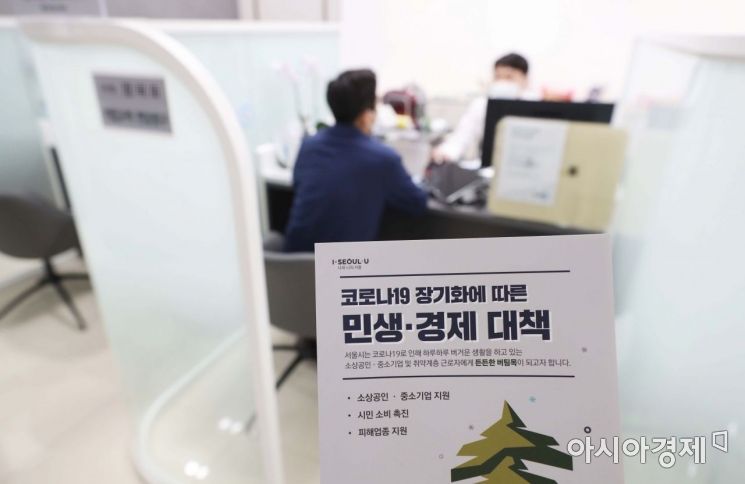 A small business owner struggling due to the COVID-19 pandemic receiving loan consultation at Shinhan Bank in Seoul.
 [Photo by Moon Ho-nam]
Rent reduction request right also ineffective on the ground
Park Young-gwan (alias, 53), who operates real estate in Tongyeong, Gyeongnam, said, "Business is so bad that I asked the landlord to reduce rent, but he said he uses the rent for living expenses and asked how he would survive if he reduced it," adding, "He said he is struggling more, so I couldn't say anything more. There are many people like me around."
Since landlords are not obligated to accept rent reductions, disputes must be resolved through the court's dispute mediation committee, but even the committee's mediation results are not binding. If landlords complain "I'm struggling too" or ignore the requests like Park, there is no option other than litigation.
An official from the Small Business Federation said, "Institutional improvements should be expedited not only for the New Hope Fund support system but also for the rent reduction request right," adding, "Most small business owners barely maintain their shops with severance pay, so social consideration is needed to prevent them from losing hope."
Meanwhile, according to the 'COVID-19 Crisis Response Small Business and Micro Business Management Status Survey' recently conducted by the Seoul Regional Headquarters of the Korea Federation of SMEs in cooperation with the Seoul Small Business and Micro Business Federation targeting 1,021 small business owners in Seoul, nine out of ten small business owners reported decreased sales in the first half of the year and expect further decreases in the second half.
The response indicating sales decline compared to the first half of last year reached 89.2%, and the sales outlook for the second half compared to last year was 87.4% expecting a decrease. Only 1.1% expected an increase. Small business owners with sales under 100 million won felt the impact more acutely.
© The Asia Business Daily(www.asiae.co.kr). All rights reserved.
![User Who Sold Erroneously Deposited Bitcoins to Repay Debt and Fund Entertainment... What Did the Supreme Court Decide in 2021? [Legal Issue Check]](https://cwcontent.asiae.co.kr/asiaresize/183/2026020910431234020_1770601391.png)
















