Minister Kang Kyung-hwa Emphasizes Facilitating Essential Personnel Movement Between Korea and Mekong Countries... Requests Support for Korean Peninsula Peace Process
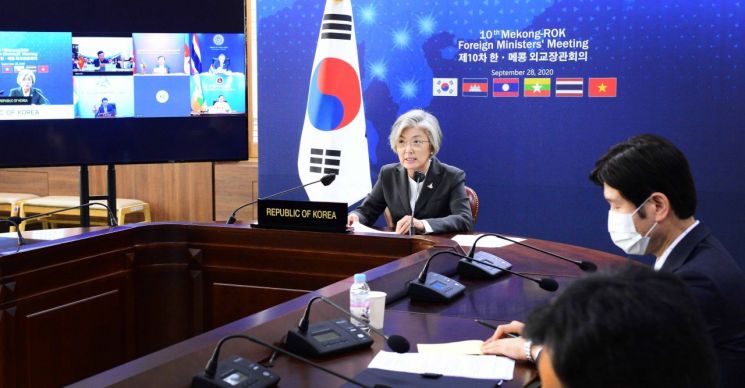
[Asia Economy Reporter Lim Cheol-young] On the afternoon of the 28th, Foreign Minister Kang Kyung-wha presided over the 10th Korea-Mekong Foreign Ministers' Meeting held via video conference together with Pham Binh Minh, Deputy Prime Minister and Foreign Minister of Vietnam. Minister Kang concluded the schedule of the 10 rounds of Korea-ASEAN and Korea-Mekong ministerial consultations with this meeting.
In this meeting, the outcomes of the 1st Korea-Mekong Summit held in November 2019 were reviewed, and the future direction of Korea-Mekong cooperation was examined. In addition, comprehensive and in-depth consultations were held on major regional and international situations.
In her opening remarks, Minister Kang evaluated the adoption of the "Han River-Mekong River Declaration" following the 1st Korea-Mekong Summit last year, which agreed on the joint vision of "building a partnership of people, mutual prosperity, and peace," reaffirming her commitment to further strengthening Korea-Mekong cooperation. She also introduced that the Korean government increased the "Korea-Mekong Cooperation Fund" to 3 million USD this year and stated that the annual contribution to this fund will continue to be expanded in the future.
The ministers of the five Mekong countries agreed that considering the geographical and cultural similarities and economic complementarities between Korea and the Mekong region, there is great potential to further expand cooperation in the future, and they expressed their intention to actively cooperate to strengthen Korea-Mekong cooperation.
Minister Kang emphasized the need to further strengthen Korea-Mekong cooperation in health (including cooperation related to COVID-19 vaccines), economic recovery, and environmental fields to enhance the relevance and effectiveness of Korea-Mekong cooperation amid the rapidly changing international environment.
In the health sector, she first evaluated the close cooperation between Korea and the five Mekong countries in supporting quarantine supplies and repatriating overseas nationals related to COVID-19, and called for continued strengthening of solidarity and cooperation against COVID-19.
In particular, Minister Kang stressed the importance of international cooperation to develop COVID-19 vaccines and therapeutics and to ensure universal and equitable access to them, urging active solidarity with the international community, including the World Health Organization (WHO), GAVI, the Vaccine Alliance, and the International Vaccine Institute (IVI).
Regarding economic recovery, she stated that efforts must be made to achieve the two goals of quarantine and economy simultaneously. To this end, she emphasized the need to promote regional multilateralism and trade based on norms, revitalize economic activities of small and medium-sized enterprises and small business owners, and institutionalize a fast-track system for the entry of essential personnel such as businesspeople between Korea and the Mekong countries.
In the environmental sector, she emphasized that the 60 million people who depend on the Mekong River for their livelihoods are facing socio-economic difficulties due to water shortages and natural disasters in the Mekong River, and that responses to these issues must not be neglected. Accordingly, the ministers of the five Mekong countries expressed strong agreement with the future cooperation directions proposed by Minister Kang and expressed their gratitude for the Korean government's active support of various quarantine supplies to assist the Mekong countries' COVID-19 response.
The ministers of the five Mekong countries highly appreciated the Korean government's emphasis on international cooperation not only for the development of COVID-19 vaccines and therapeutics but also for ensuring and maintaining universal and equitable access to them, and they agreed to work together to promote the movement of essential personnel between Korea and the Mekong countries to restore regional connectivity.
The six ministers also agreed to discuss the possibility of elevating Korea-Mekong relations to a "strategic partnership" to further consolidate the development and political will of Korea-Mekong cooperation, and exchanged views on major regional and international situations including the Korean Peninsula situation and the South China Sea.
Minister Kang emphasized that despite the current difficult conditions, the Korean government's commitment to advancing the peace process on the Korean Peninsula remains unchanged, and that the most urgent task is the prompt resumption of dialogue among South Korea, North Korea, and the United States. She also requested the Mekong countries to continue their constructive role in achieving complete denuclearization and permanent peace settlement on the Korean Peninsula.
In response, the Mekong countries agreed that peace and stability on the Korean Peninsula are closely linked to regional prosperity, supported the Korean government's efforts to advance inter-Korean relations, peace and stability on the Korean Peninsula, and the resumption of dialogue and communication with North Korea. Regarding the South China Sea, Minister Kang expressed Korea's consistent position supporting freedom of navigation and overflight, emphasizing the importance of maintaining peace and stability in the South China Sea.
© The Asia Business Daily(www.asiae.co.kr). All rights reserved.

















