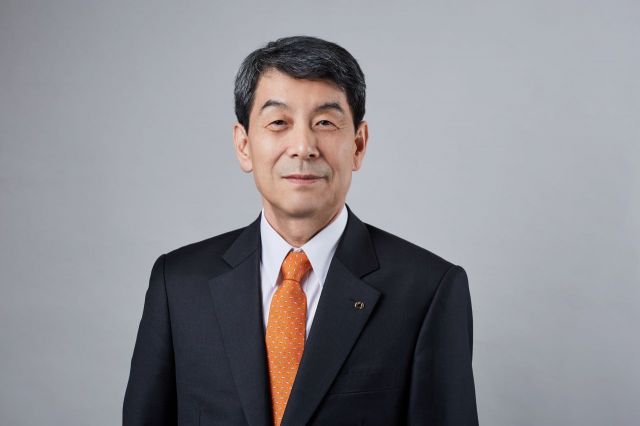
[Asia Economy Reporter Kangwook Cho] Lee Dong-geol, Chairman of the Korea Development Bank, said on the 28th regarding his reappointment, "I feel a heavy sense of responsibility," and added, "The immediate task is to overcome the COVID-19 crisis."
At an online press conference that day, Chairman Lee said, "I will do my best to overcome the COVID-19 crisis and deal with its aftermath."
He stated that he will focus on three main pillars: ▲innovation-driven growth, ▲restructuring, and ▲organizational change and innovation.
Regarding innovation-driven growth, he plans to concentrate on discovering and nurturing new industries as well as transforming outdated parts of traditional industries into advanced industries.
Chairman Lee explained, "Discovering new companies related to cultural contents, bio, and the Green New Deal is an unavoidable task in overcoming the COVID-19 crisis."
He particularly pointed out the logistics sector as an outdated industry among traditional industries.
He said, "Although Korea is called a delivery paradise, the logistics industry is very backward in terms of financial power and technology, and its development is slow compared to its investment value domestically. Especially since logistics is included in the Korean New Deal, the Ministry of Land, Infrastructure and Transport and the Financial Services Commission are paying attention, so we will focus on growing the logistics industry in cooperation with government agencies."
Regarding restructuring of insolvent companies, Chairman Lee said that the task is to properly conclude major pending issues.
He also shared his reflections on the overall problems related to restructuring, emphasizing that outdated customs need to be improved as much as the immediate restructuring tasks.
Chairman Lee stressed, "Unnecessary labor-management conflicts not only become serious obstacles in the process of corporate normalization but also create sources of conflict. We must uphold three principles: responsible roles of major shareholders, shared pain among stakeholders, and sustainable management normalization plans."
He particularly criticized some company labor unions for not implementing agreements made with management when preparing self-help contracts. For example, despite agreeing to discuss wage increases only when the company makes a profit, some unions have insisted on raises and gone on strike even while the company continues to operate at a loss, or have failed to honor promises of unpaid leave for a certain period.
Chairman Lee argued that wage and collective bargaining agreements should be extended beyond one year to multiple years, as one-year agreements are inefficient for establishing mid- to long-term plans. He explained that in the United States, most agreements are for four years.
He also mentioned that a review of the seniority-based pay system is necessary. In some restructured companies, there are individuals receiving large annual salaries based on seniority, which makes restructuring difficult due to intergenerational conflicts.
Chairman Lee emphasized, "The sacrifices arising from restructuring should not be borne by individuals alone; a social safety net must be established so that society as a whole can share the pain. Only then can production and office workers of insolvent companies overcome difficulties more easily."
© The Asia Business Daily(www.asiae.co.kr). All rights reserved.
![Clutching a Stolen Dior Bag, Saying "I Hate Being Poor but Real"... The Grotesque Con of a "Human Knockoff" [Slate]](https://cwcontent.asiae.co.kr/asiaresize/183/2026021902243444107_1771435474.jpg)
















