Ruling Party Includes 'Resolution Urging Permission for North Korea Individual Tourism'
Opposition Claims Discussing Resolution Premature Amid Strong Public Anger
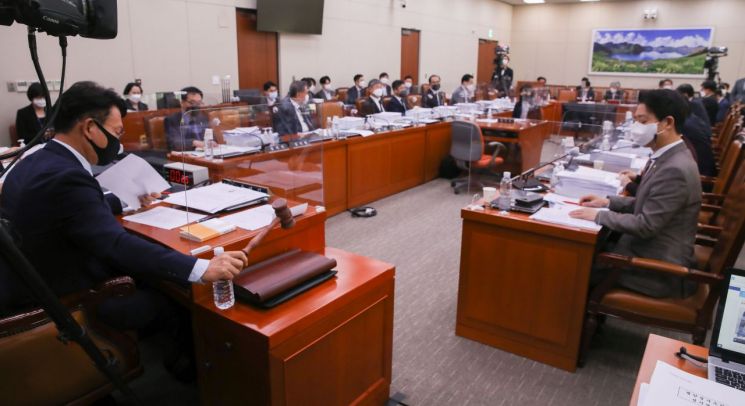
[Asia Economy Reporter Lee Ji-eun] The National Assembly's Foreign Affairs and Unification Committee (FAUC) witnessed a fierce clash between the ruling and opposition parties over the submission of the 'Resolution Urging the Declaration of the End of the War.' While the ruling party proposed discussing the resolution through the FAUC's bill subcommittee following the proper procedures after submission, the opposition insisted that the resolution should be withdrawn and discussed in the Agenda Coordination Committee. After much controversy, the resolution was ultimately referred to the Agenda Coordination Committee as the opposition demanded.
On the 28th, Rep. Cho Tae-yong of the People Power Party stated during the FAUC plenary session, "Resolutions urging the declaration of the end of the war and allowing individual tourism to North Korea require careful discussion in light of North Korea's atrocities," adding, "Is urging the declaration of the end of the war something the National Assembly should be doing right now? It is appropriate to refer these agendas to the Agenda Coordination Committee for in-depth discussion."
Rep. Cho was referring to two resolutions: the resolution urging the declaration of the end of the Korean War, proposed by Rep. Kim Kyung-hyup of the Democratic Party of Korea, and the resolution urging the allowance of individual tourism to North Korea for peace on the Korean Peninsula, proposed by Rep. Kang Byung-won of the same party. Given the heightened public anger following the Yeonpyeong Island shelling incident, discussing related resolutions in the National Assembly is considered premature.
Opposition FAUC secretary Rep. Kim Seok-ki also added, "It makes no sense to push for the adoption of these resolutions under the current circumstances," and said, "Although the resolutions have been submitted, they should be withdrawn." Rep. Lee Tae-gyu of the same party said, "Even though our citizens were brutally killed, if the resolution urging the declaration of the end of the war is submitted and passed to the bill subcommittee, what kind of signal would we be sending to North Korea?" He added, "What our National Assembly should do first is to pass a strong resolution condemning North Korea."
In response, ruling party secretary Rep. Kim Young-ho of the Democratic Party said, "Regarding the resolution urging the declaration of the end of the war, the reflection period has been fulfilled, so it was submitted as soon as the session opened today," adding, "I understand and agree with some of the opposition members' opinions. When the time comes to consider the public's perspective and sentiment, let's discuss it thoroughly by bringing it to the bill subcommittee."
Rep. Lee Jae-jung of the Democratic Party also said, "In principle, the procedure to refer the resolution to the bill subcommittee remains, and proposing referral to the Agenda Coordination Committee now is premature," adding, "Considering the timing, it is sufficient for the National Assembly to refer it to the bill subcommittee for discussion."
Rep. Ahn Min-seok of the Democratic Party asked opposition members, "Do you mean you support the declaration of the end of the war but think now is not the time, or do you oppose the declaration and think now is even less the time?" He added, "The opposition says now is not the time, but I think now is precisely the time to discuss the declaration. If the declaration had been made in 2018, this unfortunate incident would not have happened."
As the ruling and opposition parties failed to narrow their differences over the resolution urging the declaration of the end of the war, the FAUC was briefly adjourned in the morning for consultations between the party secretaries. After repeated disputes, the resolution was referred to the Agenda Coordination Committee. The Agenda Coordination Committee is composed of an equal number of ruling and opposition members when there is a need to reconcile differences over bills or resolutions in standing committees, and it can review agendas for up to 90 days.
© The Asia Business Daily(www.asiae.co.kr). All rights reserved.
![User Who Sold Erroneously Deposited Bitcoins to Repay Debt and Fund Entertainment... What Did the Supreme Court Decide in 2021? [Legal Issue Check]](https://cwcontent.asiae.co.kr/asiaresize/183/2026020910431234020_1770601391.png)
















