Disruptions in Vegetable Supply Due to Abnormal Weather Like This Summer's Monsoon and Typhoons
Grain Yields Could Decrease by Over 7% with a 1℃ Rise in Global Temperature
Experts Say "Food Crisis from Weather Anomalies Is Real"
"Public Stockpiling Systems and Related Policies Must Be Introduced"
 A notice posted on the official website of the hamburger franchise 'Burger King' on the 24th. On this day, Burger King announced that tomatoes would be excluded from some menu items due to a shortage of tomato supply. / Photo by Burger King
[Asia Economy Reporter Lim Juhyung] "Due to abnormal weather conditions, tomato supply is difficult nationwide. If providing tomatoes becomes impossible, we plan to offer additional sauces and vegetables included in the product."
This is a notice posted on the official website of the hamburger franchise 'Burger King' on the 24th. Due to disruptions in tomato supply caused by typhoons and monsoons that struck the Korean Peninsula this summer, hamburger franchises have come up with the emergency measure of offering 'tomato-free hamburgers.' The problem is that supply difficulties for grains and vegetables caused by abnormal weather are worsening. Some express concerns that if climate change continues to worsen, even domestic 'table prices' could be threatened.
Major hamburger franchises such as Burger King and Lotteria posted notices on their official websites stating that "tomatoes may be excluded from existing menus." Burger King announced that it plans to provide additional sauces and vegetables instead of tomatoes, while Lotteria said, "We will lower the prices of menus without tomatoes until the supply stabilizes."
Netizens who saw these notices expressed dissatisfaction, saying, "I have never even imagined a hamburger without tomatoes," and "How can I eat it when it's dry and has a meaty fishy smell?"
The reason these franchises are facing tomato supply disruptions is due to abnormal weather this summer. This summer saw prolonged monsoons and consecutive typhoons, resulting in significantly less sunlight than usual, which led to poor crop conditions and reduced tomato harvests.
According to data from the Korea Meteorological Administration, this summer (June to August) showed temperatures different from the average year. The average temperature in July was 22.7°C, marking the first time the average temperature in June (22.8°C) was higher than that of July.
This phenomenon occurred as some regions experienced record-breaking long monsoon periods. The monsoon period in the central region this summer lasted 54 days, the longest on record, and the rainfall (851.7 mm) was also the highest ever recorded. Nationwide rainfall reached 686.9 mm, the second highest since 1973.
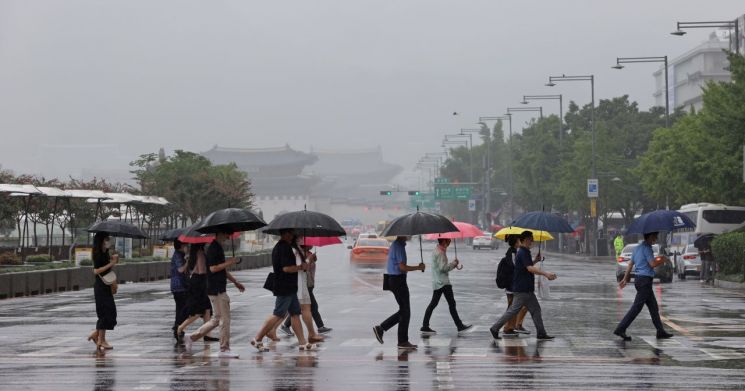 On the morning of the 10th of last month, when the monsoon season continued, citizens were walking near Gwanghwamun Square in Seoul. / Photo by Yonhap News
The impact of typhoons was also significant. From the 26th to 27th of last month, Typhoon 'Bavi' affected the West Sea, while 'Haishen' passed over the Korean Peninsula from the 5th to 8th, and 'Maysak' from the 2nd to 3rd.
As a result, the supply of some crops that need sunlight to ripen drastically decreased, causing prices to soar. According to agricultural product distribution information, as of the 24th, the average wholesale price of tomatoes was 62,660 KRW per 10 kg, more than double last year's 28,320 KRW.
The problem is that these abnormal weather conditions are linked to global warming. If warming intensifies, there are concerns that it could lead not only to reduced production of some fruits and vegetables but also to a food security crisis.
The unusually long monsoon this summer was caused by climate change, which led to abnormal high temperatures in Siberia, Russia, causing changes in atmospheric pressure. Cold air that was supposed to move north to Russia instead flowed into the Korean Peninsula. In fact, the temperature in Verkhoyansk, Sakha Republic, the coldest region in Russia, soared to 38°C on June 20.
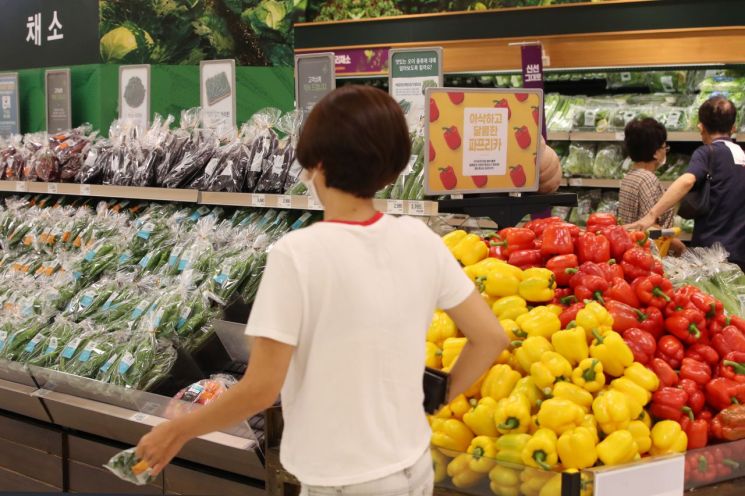 According to the Korea Agro-Fisheries & Food Trade Corporation on the 27th, the prices of major vegetables that fill our summer tables, such as napa cabbage, lettuce, and young radish, have surged to more than twice the average of previous years. / Photo by Yonhap News
As global warming changes the climate, the productivity of existing farmland may significantly decline, increasing the risk of unstable agricultural product prices. Grains such as wheat and rice, which are staple foods for humanity, are particularly vulnerable to climate change. According to the 'Special Report on Global Warming of 1.5°C' published by the United Nations in 2018, the production of corn, rice, and wheat decreases by about 3-7% for every 1°C rise in average global temperature.
Warming can also stimulate pests' appetites, causing significant damage to crops. Pests are cold-blooded animals whose body temperature changes with external temperature; as temperatures rise, their body temperature increases, leading to higher oxygen consumption and energy demands. This means pests need to eat more to survive and reproduce.
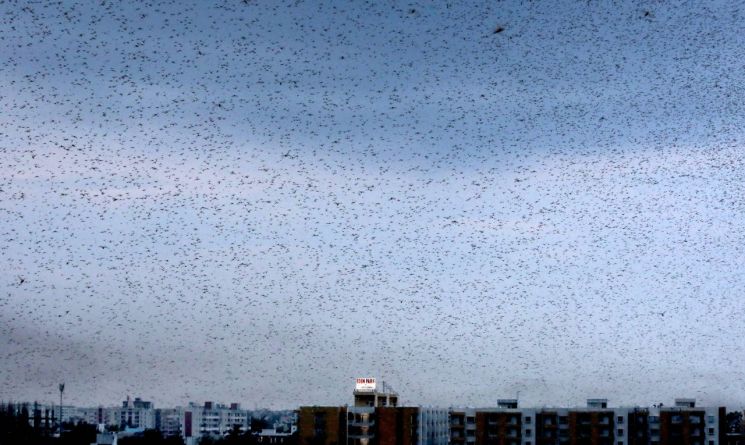 On June 14th (local time), a swarm of locusts covered the skies over Bhopal city in Madhya Pradesh, central India. / Photo by Yonhap News
The locust swarms that ravaged eastern Africa at the end of last year and spread to Asia, including India and China, in February, damaging over 5.55 million hectares of farmland, are also said to be related to climate change.
Experts advise that policies should be developed and implemented to respond to food crises caused by changes in grain supply due to abnormal weather.
Dr. Park Sungjin of the Korea Rural Economic Institute emphasized at the 'Food Security Seminar' hosted by the Korea Food Security Research Foundation on the 14th, "Historically, abnormal weather has caused grain production disruptions and sharp increases in grain prices," and stressed, "Related systems are needed, such as stockpiling the minimum necessary amount of grains to prepare for food crises."
He added, "Japan also operates a public stockpiling system for emergencies, storing edible wheat, rice, and feed grains," and suggested, "Establishing a system to import necessary quantities during emergencies through agreements with major grain-exporting countries could also be a solution."
© The Asia Business Daily(www.asiae.co.kr). All rights reserved.
![User Who Sold Erroneously Deposited Bitcoins to Repay Debt and Fund Entertainment... What Did the Supreme Court Decide in 2021? [Legal Issue Check]](https://cwcontent.asiae.co.kr/asiaresize/183/2026020910431234020_1770601391.png)

















