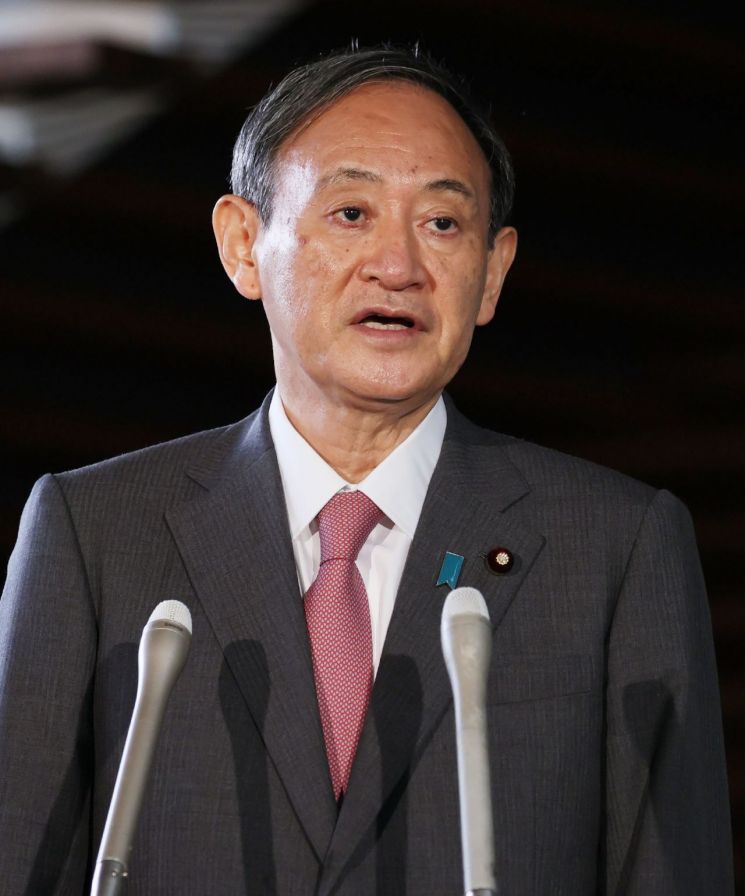
[Asia Economy Reporter Moon Chaeseok] A national policy research institute has analyzed that it will not be easy for Prime Minister Suga Yoshihide to differentiate his economic, diplomatic, and security policies from those of former Prime Minister Abe Shinzo's administration even after taking office.
On the 28th, the Industrial Research Institute stated this in a report titled "Prime Minister Suga's Inauguration and the Whereabouts of Abenomics."
First, it evaluated that Japan enhanced economic vitality through Abenomics by raising stock prices, improving export companies' performance via a weaker yen, and increasing employment rates through deregulation.
However, it viewed that the initial goals?achieving a 2% inflation rate to completely escape deflation, expanding consumption and economic growth through wage increases, and improving productivity?were insufficient.
It predicted that under the Suga administration, it will be difficult to secure independence or distinctiveness in economic, diplomatic, and security policies compared to Abenomics.
Primarily, it anticipated that Prime Minister Suga will strongly promote the reconstruction of supply chains (VC) and the return of Japanese companies to their home country (U-turn) as measures to address U.S.-China friction and the novel coronavirus disease (COVID-19).
However, it expected that the financial easing policies and expansionary fiscal policies of Abenomics will inevitably be continued for the time being, as COVID-19 response is necessary.
Researcher Sagong Mok of the Industrial Research Institute said, "Japan has almost no room for additional financial easing policies due to negative interest rates and must rely on fiscal policy," adding, "Fiscal deficits will sharply increase."
The Suga administration is expected to focus on structural reforms to promote digitalization in the future, including ▲ establishing a Digital Agency and streamlining government organizations ▲ restructuring small and medium-sized enterprises and regional banks ▲ abolishing vested interests ▲ lowering mobile phone charges ▲ raising the minimum wage.
The yen exchange rate is expected to maintain around 105 yen per dollar for the time being.
Researcher Sa explained, "For the Suga administration to maintain long-term governance, it must demonstrate skill in fiscal soundness issues during the COVID-19 response process and in improving productivity through structural reforms."
He urged both governments to actively work on restoring the previously strained relationship, responding to COVID-19, reorganizing the global value chain (GVC), expanding human exchanges such as tourism, and establishing a global trade environment to prevent protectionism.
Researcher Sa said, "To resolve current issues such as conflicts related to the forced labor ruling, Japan's export restrictions on Korea and exclusion from the whitelist, Korea's WTO complaint against the Japanese government, and Korea's boycott of Japanese products, both governments should present a big deal plan and work together to create an atmosphere for negotiation settlement."
© The Asia Business Daily(www.asiae.co.kr). All rights reserved.
![User Who Sold Erroneously Deposited Bitcoins to Repay Debt and Fund Entertainment... What Did the Supreme Court Decide in 2021? [Legal Issue Check]](https://cwcontent.asiae.co.kr/asiaresize/183/2026020910431234020_1770601391.png)















