Understanding Signal Systems in the Occipitoparietal Cortex of the Cerebral Cortex
A Step Closer to Building a Brain Map for Decision-Making in the Cerebrum
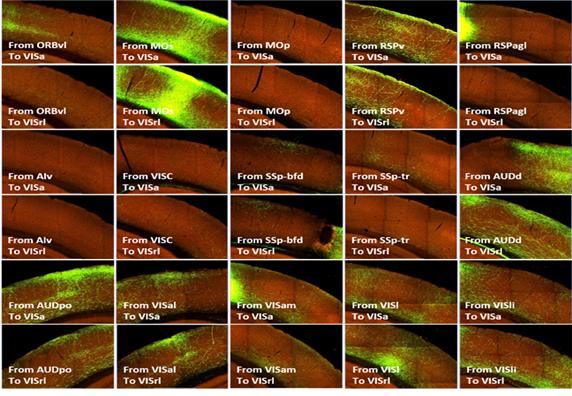 Quantitative analysis of inflow/outflow signals from the occipitoparietal cortex (signal intensity between detailed subregions within the occipitoparietal cortex. The higher the amount of green fluorescent material, the stronger the signal transmission)
[Asia Economy Reporter Junho Hwang] The process of signal exchange between the occipitoparietal cortex, which is responsible for integrating visual and sensory information in our brain, and other brain regions has been revealed. The research team evaluated this as a foundational study to elucidate the main functions and structure of the occipitoparietal cortex, and it is expected to contribute to the treatment of brain disorders such as schizophrenia in the future.
The Korea Brain Research Institute announced on the 22nd that a joint research team consisting of Dr. Jongcheol Ra and researcher Sukjin Son from the Cerebral Cortex Convergence Research Project Group, and Dr. Seungwook Oh from the Grace Medical Research Institute in the United States, discovered an inter-neural circuit system between the occipitoparietal cortex and other brain regions. The research results were published in Cerebral Cortex, a prestigious international neuroscience journal introducing brain cortical development and functions.
Understanding Neural Circuits of the Occipitoparietal Cortex
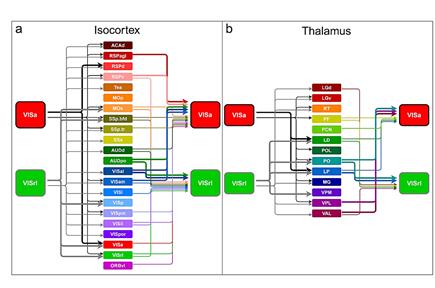 Mutual connection strength between the laryngeal motor cortex and other brain regions (same cortex and thalamus) (arrow thickness indicates connection strength)
The occipitoparietal cortex is a part of the parietal lobe located at the rear vertex of the brain. It is involved in higher cognitive functions such as visual-spatial reasoning and decision-making judgment. The cerebral cortex is responsible for the highest functions of the human brain, including perceptual information, planning, emotion, memory, and language. The occipitoparietal cortex, located within the cerebral cortex, integrates sensory information such as visual and tactile inputs to interpret and judge sensations.
The research team began analyzing the occipitoparietal cortex of mice using publicly available biological data from the Allen Institute for Brain Science in the United States. They reanalyzed the anterograde (outgoing) signals from the occipitoparietal cortex and inversely analyzed anterograde data from over 200 other brain regions to infer incoming signals to the occipitoparietal cortex. Through this, they investigated comprehensive incoming and outgoing signals of the occipitoparietal cortex throughout the entire brain. They also quantified and analyzed the connection strengths between different subregions within the occipitoparietal cortex and other brain areas.
Through this, they discovered that the mutual signal strength among subregions within the occipitoparietal cortex differs during perception-based decision-making. This anatomically proves that the importance of regions within the occipitoparietal cortex varies depending on the type of sensory information, such as visual or tactile, during sensory-based decision-making. The research team evaluated that they have laid the foundation for studying the main functions and structure of the occipitoparietal cortex.
Contributing to Treatment of Brain Dysfunction Disorders such as Schizophrenia
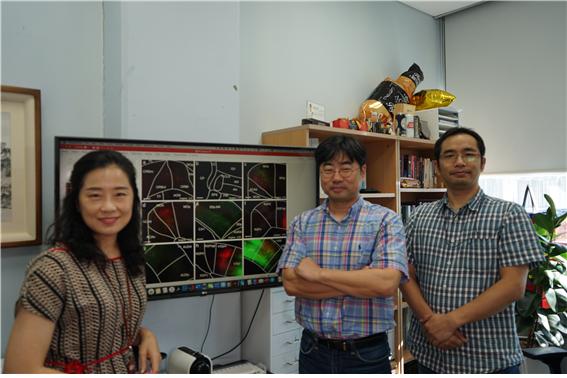
Dr. Jongcheol Ra, the corresponding author of this paper, stated, "Research on the occipitoparietal cortex is essential for understanding higher cognitive functions such as integrated processing of sensory information, judgment, and motor planning, which are major functions of the cerebral cortex. Understanding the circuits of the occipitoparietal cortex is expected to provide fundamental solutions for brain dysfunction disorders such as schizophrenia, which exhibit symptoms like short-term memory impairment, as well as sensory disorders including visual impairments."
The Cerebral Cortex Convergence Research Project Group at the Korea Brain Research Institute was launched in 2016 to unravel the secrets of decision-making and short-term memory through the occipitoparietal cortex. With the goal of establishing a functional precise brain map by 2026, the project aims to classify the occipitoparietal cortex at the circuit level and establish a foundation to analyze the characteristics of connections among these circuits.
© The Asia Business Daily(www.asiae.co.kr). All rights reserved.
![User Who Sold Erroneously Deposited Bitcoins to Repay Debt and Fund Entertainment... What Did the Supreme Court Decide in 2021? [Legal Issue Check]](https://cwcontent.asiae.co.kr/asiaresize/183/2026020910431234020_1770601391.png)

















