Concerns Over Franchise Industry Contraction Due to Franchise Business Act
Class Action System Poses Bankruptcy Risk from Reduced Lawsuits in Food Industry
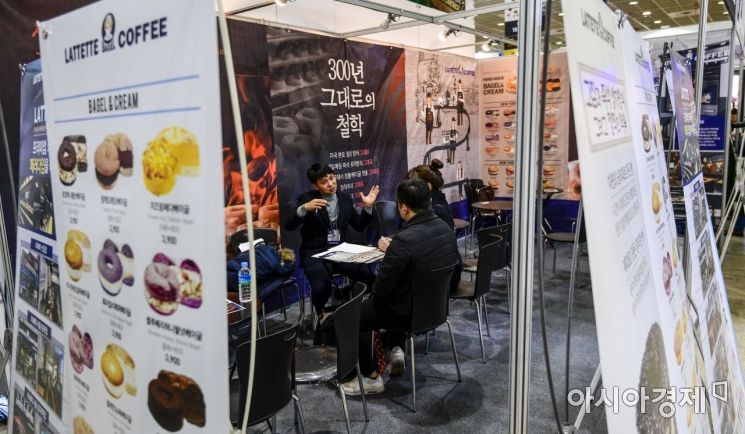 The 'Franchise Startup Expo' held in 2019 at COEX, Gangnam-gu, Seoul. Prospective entrepreneurs participating in the event are consulting with representatives of participating companies. Photo by Jinhyung Kang aymsdream@
[Asia Economy Reporters Seon-ae Lee and Hye-seon Lim] Domestic food service, food, and distribution industries are grimacing at the government's one-sided tightening of regulations, including restrictions on franchise headquarters' marketing activities, class action lawsuits, preferential treatment in internal transactions, and restrictions on complex shopping mall operations. Amid concerns over survival due to the novel coronavirus disease (COVID-19), there are even worries that the growth momentum will be lost due to the proliferation of regulatory tightening policies.
On the 28th, the Fair Trade Commission announced the legislative notice of the amendment to the "Act on the Fairness of Franchise Business Transactions (Franchise Business Act)" until November 9, sparking strong opposition from the convenience store and food service franchise industries. A new provision was introduced requiring franchise headquarters to operate direct stores for at least one year, raising entry barriers, and franchise headquarters must obtain prior consent from a certain percentage of franchisees when conducting advertising and promotional events that impose burdens on franchisees. While unilateral cost-shifting by franchise headquarters will disappear, marketing activities such as advertising and promotions will face significant restrictions. A franchise industry official said, "The government policy denies the 'efforts of franchisees,' which is a key factor in franchise success, and blames all responsibility on the franchise headquarters," adding, "The franchise industry will shrink due to all-around regulations, and growth momentum will disappear."
The legislative notice of the class action law, which focuses on expanding the class action system, has also cast a cold shadow over the food industry. The side effects such as abuse of lawsuits are expected to outweigh the intended effects. There are concerns that cases like Starbucks in the U.S., sued for having too much ice and too little coffee, and McDonald's, sued for hamburgers having higher calories than advertised, could be replicated domestically. A food industry official said, "Due to the small scale of the industry, it is feared that many businesses will go bankrupt because they cannot bear the time and costs required for class action lawsuits."
Concerns have been raised that the strengthened regulations on preferential internal transactions included in the Fair Trade Act amendment could deteriorate industrial competitiveness. A food industry official said, "Many companies have second- and third-generation management succession centered on the founders, with high ownership stakes by the controlling family, and internal transactions are inevitable to improve business efficiency," adding, "Although only unfair internal transactions are sanctioned, the fact that mid-sized and quasi-large companies, which are expanding as regulatory targets, are being investigated by the Fair Trade Commission is a burden." The industry expects that if the amendment passes, most food companies such as Harim, Nongshim, Ottogi, Dongwon, and Samyang Foods will become subjects of investigation.
The distribution industry, including department stores and large supermarkets, is also expressing reluctance toward the amendment to the Distribution Industry Development Act. There are as many as 12 proposed amendments in the 21st National Assembly. The bill mandating two weekly holidays per month for complex shopping malls, department stores, outlets, duty-free shops, and specialty stores is causing the greatest concern. A distribution industry official said, "If the bill passes, many distribution stores will close like mushrooms after rain," and argued, "In a situation where the e-commerce market is rapidly growing, we need to abandon the dichotomous thinking between offline large distribution stores and traditional markets."
© The Asia Business Daily(www.asiae.co.kr). All rights reserved.

















