Union Emphasizes 'Practicality' While Holding Negotiation Site... Consensus on 'Overcoming Crisis'
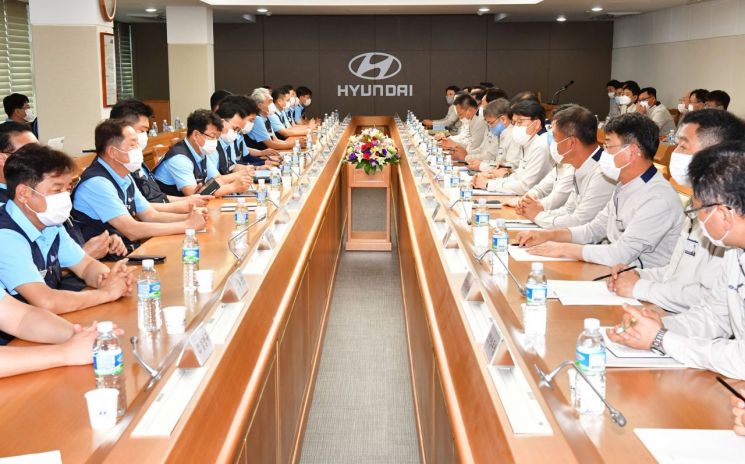 On the 13th of last month, the Hyundai Motor labor-management negotiation representatives held an introductory meeting for this year's wage negotiations. (Photo by Yonhap News)
[Asia Economy Reporter Kim Ji-hee] There were no strikes or physical confrontations. Instead, both sides put their heads together to address industrial structural changes brought by the electric vehicle era and the crisis caused by the novel coronavirus disease (COVID-19). The anxiety over ‘survival’ changed the atmosphere of the negotiations between Hyundai Motor Company’s labor and management. As a result, the two sides agreed to freeze wages for the first time in 11 years.
According to Hyundai Motor on the 28th, the labor and management held a signing ceremony in the afternoon regarding the 2020 wage negotiation agreement. Earlier, on the 25th, Hyundai Motor’s union conducted a provisional agreement approval vote among all union members (49,598 people), which passed with a 52.8% approval rate. The agreement included a wage freeze, a management performance bonus of 150%, a COVID-19 crisis recovery incentive of 1.2 million KRW, 10 shares of employee stock ownership, and 200,000 KRW worth of traditional market gift certificates.
The main reason this year’s negotiations differed from previous ones was the union’s change. Even before entering full negotiations this year, Hyundai Motor’s union, emphasizing ‘pragmatism,’ led the changed collective bargaining process. The union’s initial demands to management included a monthly wage increase of 120,304 KRW, but employment measures for the electric vehicle era were prioritized. After the provisional agreement was announced, some hardliners voiced opposition to the wage freeze, but they did not become the majority.
The result of the survival concerns was reflected in the ‘Social Declaration for Joint Labor-Management Development and Changes in Labor-Management Relations’ adopted together in this negotiation. The declaration included ▲ securing future competitiveness of domestic plants and employment stability for current workers ▲ responding to changes in the future automobile industry such as the expansion of electric vehicles ▲ operating job transition programs in preparation for future industrial changes ▲ realizing labor-management relations together with customers and the public. Specifically, they agreed to maintain an annual domestic production volume of over 1.74 million units and to pursue additional designation of electric vehicle-exclusive plants.
Now, attention is focused on the impact of Hyundai Motor’s union changes on the industry. For now, other automakers are also conducting negotiations with an emphasis on employment. Kia Motors’ union is demanding the same monthly wage increase of 120,304 KRW as Hyundai Motor, along with internalizing factories related to future vehicle parts. However, considering Hyundai Motor’s precedent of reaching an early consensus on the broad framework of job security before adjusting other issues such as wages, a quick settlement does not seem easy.
The atmosphere at Korea GM is even less favorable. The Korea GM union is demanding wage increases and the allocation of new vehicles to the Bupyeong 2 plant. This plant produces models such as the Trax and Malibu, but sales have been continuously declining, causing employment concerns. However, management argues that assigning new vehicles is difficult from the perspectives of competitiveness and efficiency. The union has already received a decision to suspend mediation from the Central Labor Relations Commission and secured the right to strike legally.
An industry insider said, "Hyundai Motor is the ‘eldest brother’ in the complete vehicle industry, and since this year’s collective bargaining themes are similar, other companies were likely watching Hyundai Motor’s negotiation results closely. However, even if the job security issue is the same, the range within which each company can accommodate union demands varies, which could be a variable."
© The Asia Business Daily(www.asiae.co.kr). All rights reserved.
![Clutching a Stolen Dior Bag, Saying "I Hate Being Poor but Real"... The Grotesque Con of a "Human Knockoff" [Slate]](https://cwcontent.asiae.co.kr/asiaresize/183/2026021902243444107_1771435474.jpg)
















