Impact of COVID-19 Spread on Contactless Era Daily Life
Activation of Unmanned Machines like Kiosks
Elderly Express Difficulties Using Kiosks with Complex Menus
Experts Say "Continuous Social Attention Needed for Digitally Disadvantaged Groups"
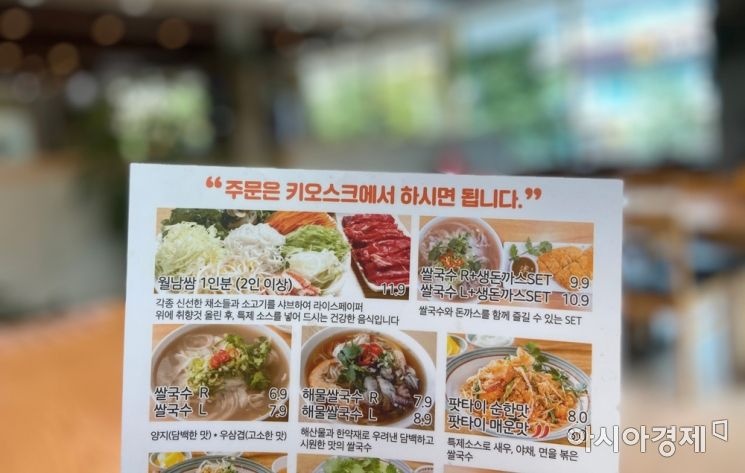 A menu board at a restaurant in Guro-gu, Seoul. It guides customers to order via kiosk. Photo by Young-eun Kim, Intern Reporter youngeun928@asiae.co.kr
[Asia Economy reporters Han Seung-gon and Kim Young-eun] Amid the spread of the novel coronavirus infection (COVID-19), kiosks (unmanned payment machines) have become active in various stores, but there are elderly people who cannot properly use them, calling for social attention.
These individuals hesitate in front of the machines for a while before barely managing to order food, placing them in a kind of digital blind spot. Experts suggest that systems to reduce the digital divide, such as operating volunteers on-site to assist them, are necessary.
As COVID-19 spreads, contactless transactions are becoming more active. Not only fast-food restaurants but also large supermarkets, movie theaters, hospitals, and public health centers are reducing face-to-face orders and direct payments to minimize human contact. In places where people have disappeared, kiosks have been installed.
Kiosks are touchscreen-based information delivery systems installed in public places. They offer convenience and accuracy and have the advantage of reducing anxiety and burden related to face-to-face contact. Additionally, companies and business owners can expect labor cost savings through kiosk use.
According to a survey, kiosk installations have steadily increased since the COVID-19 outbreak. On the 1st, leisure platform company 'Yanolja' announced that sales of its self-developed kiosk 'Y-Flux' increased by an average of 63% per month since March, when COVID-19 began in earnest.
In particular, kiosk sales in April this year increased by 227% compared to the previous month, marking the highest growth rate. Also, fintech technology company 'BT One' reported that its kiosk supply volume in March nearly tripled compared to the same month last year.
 Consumers aged 65 and older have been found to struggle with non-face-to-face transactions due to unfamiliarity with e-commerce and kiosks. The photo is unrelated to specific expressions in the article. Photo by Yonhap News
The problem is that there are users who cannot properly use these kiosks. Especially elderly consumers are reported to have difficulties with contactless transactions through kiosks.
The Korea Consumer Agency recently conducted a survey of 300 elderly consumers aged 65 or older who had experience with contactless transactions via e-commerce or kiosks over the past year, revealing that elderly consumers expressed difficulties.
Among the 300 respondents, 81.6% had experience using kiosks, and 59.7% had experience with e-commerce. Consumers who used both e-commerce and kiosks accounted for 41.4%. Among them, 245 elderly consumers with kiosk experience evaluated the difficulty of kiosk use by industry, finding that 'retail stores' kiosks were the most difficult, followed by 'hospitals,' 'food service,' 'public transportation,' 'cultural facilities,' and 'government offices' in that order.
Regarding inconveniences during kiosk use (multiple responses allowed), 'complex steps' (51.4%, 126 people) was the most frequently cited, followed by 'difficulty finding the next step button' (51.0%, 125 people), 'feeling pressured by people waiting behind' (49.0%, 120 people), and 'poor visibility of pictures and text' (44.1%, 108 people).
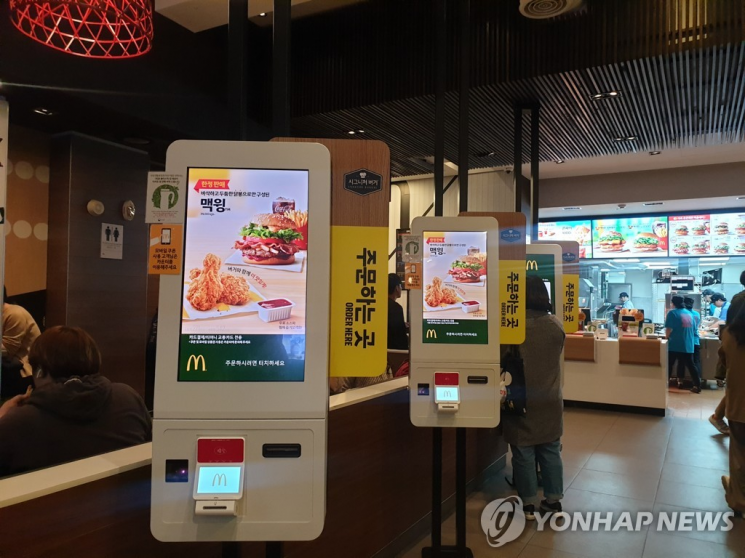 Fast food restaurant kiosk. The photo is unrelated to specific expressions in the article. [Image source=Yonhap News]
Elderly people encountering kiosks at fast-food restaurants expressed difficulties in using the machines. Most complained that they could not find the order button location and were practically unable to use them.
At around 2 p.m. on the 25th, orders using kiosks were ongoing at a fast-food restaurant in Jung-gu, Seoul. Mr. Choi (male, in his 70s), who ordered food through the kiosk there, said, "It's complicated and inconvenient," adding, "I just want to order face-to-face, but it seems to take more time, and it's bothersome every time I come."
Also, Ms. Park (female, in her 60s), who ordered via kiosk at a restaurant in Guro-gu, Seoul, shared her difficulties, saying, "It's difficult, but I feel sorry because of the young people waiting behind me," and added, "Even if the speed is a bit slow, if we take our time, we can do it."
Due to the difficulties elderly people face in using kiosks, the Korea Consumer Agency provides education on how to use unmanned payment machines through its website.
However, there are criticisms that this is ineffective because users must access the internet, find the relevant site, refer to the educational methods, and understand how to operate the kiosks.
The Korea Consumer Agency conducts various consumer education programs targeting the elderly in the untact (contactless) era through its website. The kiosk usage education page provides basic information such as 'touch the start button,' 'scan the barcode on the reader,' 'touch the payment button,' and 'pay with a credit card,' accompanied by helpful images. However, the actual form and usage of kiosks vary by industry and store, and there are doubts about whether elderly consumers can undertake online education.
Meanwhile, in November last year, the National Assembly passed an amendment to the 'Framework Act on National Informatization' that guarantees accessibility for people with disabilities and the elderly to 'unmanned kiosks' used for ticketing and ordering at airports, railways, theaters, and restaurants. Accordingly, accessibility and convenience for information-vulnerable groups regarding kiosks are expected to improve in the future.
Meanwhile, experts emphasize the need for continuous social attention to elderly people who may be digitally marginalized in the untact era.
Professor Lee Eun-hee of the Department of Consumer Studies at Inha University said, "Even if educational materials for unmanned payment machines are posted on the internet, elderly consumers rarely view them due to high entry barriers," emphasizing the need for appropriate education, "As society changes, the information gap between younger and older generations will widen, so education on electronic devices for elderly consumers is necessary."
She also suggested, "The best way is to have volunteers accompany elderly people to help them become familiar with kiosks," adding, "In the COVID-19 era, if we do not help each other, one side will inevitably be left behind. Rather than volunteers solving everything unilaterally, teaching how to use the machines and helping through direct education is the best way to reduce digital exclusion."
© The Asia Business Daily(www.asiae.co.kr). All rights reserved.



















