Seoul City to Announce 'Gwanghwamun Square Area Change Plan' on 27th
Traffic Measures to Be Discussed with Related Agencies and Residents
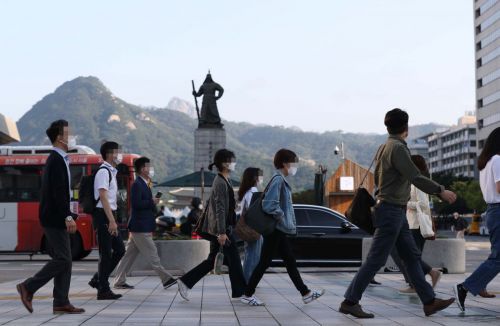 On the 14th, with cool early autumn weather, commuters are walking at the Gwanghwamun intersection in Seoul on their way to work. / Photo by Mun Ho-nam munonam@
[Asia Economy Reporter Cha Min-young] Gwanghwamun, the center of finance, administration, and culture in South Korea, is undergoing a significant transformation. The Gwanghwamun Plaza, which currently has roads on both sides, will be expanded toward the Sejong Center for the Performing Arts, and a park will be created in this space. However, since the number of lanes will be reduced while pedestrian environments improve, traffic congestion in the area may worsen, so related countermeasures have been prepared.
Expanding Gwanghwamun Plaza and Reducing Roads
On the 27th, Seoul City revealed the 'Gwanghwamun Plaza Area Change Plan,' which includes partially expanding the east-side road of Sejong-daero on both sides of Gwanghwamun Plaza, removing the west-side road, and maintaining Sajik-ro. Traffic measures near the plaza were finalized through consultations with local residents, the Ministry of the Interior and Safety, the Cultural Heritage Administration, and other related agencies, as well as various preliminary administrative and review procedures.
Kim Hak-jin, Deputy Mayor for Administration of Seoul City, said, "We have completed the blueprint for the plaza reflecting the wishes of citizens and local residents," adding, "The transformed Gwanghwamun Plaza will be a project marking Seoul’s full transition into an ecological civilization city that coexists with nature and is resilient to disasters."
Since mid-last year, the city has been promoting the restructuring of Gwanghwamun Plaza, aiming to expand the plaza and reduce roads. During this process, the project was delayed for a long time due to opposition from the Ministry of the Interior and Safety, which manages the Government Seoul Office, and residents around Gwanghwamun.
A Park-like Plaza in the Heart of the City
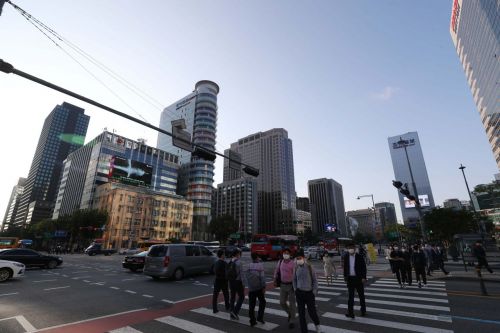 On the 14th, with cool early autumn weather, commuters are walking at the Gwanghwamun intersection in Seoul on their way to work. Photo by Mun Ho-nam munonam@
The Sejong-daero roads flanking Gwanghwamun Plaza, which used to allow northbound traffic on the east side and southbound traffic on the west side, will now be a thing of the past. The city plans to remove the west-side road between the Sejong Center for the Performing Arts and Gwanghwamun Plaza and incorporate this space into the plaza. The city’s plan is to create a 'park-like plaza in the heart of the city' by planting flowers and trees. According to the city, this plan "was comprehensively considered based on citizen preference surveys, expert opinions, and connectivity with surrounding buildings."
The current site of Gwanghwamun Plaza will retain the statues of Admiral Yi Sun-sin and King Sejong, and thematic resting areas will be established. No underground development will take place. Considering concerns about the decline of nearby commercial districts and potential damage to underground cultural heritage, the existing underground Haechi Yard will only be remodeled.
Expanding East-side Lanes First to Divert and Distribute Traffic
The two-way traffic function, previously divided east and west around the plaza, will be concentrated on the east-side road toward the U.S. Embassy. The number of lanes on the east-side road will increase from the current five to between seven and nine through road expansion construction starting this October. There will be seven driving lanes. This plan takes into account concerns that the average traffic speed around Gwanghwamun might decrease. By diverting and distributing traffic volume, the city aims to intensively manage urban traffic demand and improve the traffic operation system around the plaza in detail to maintain current traffic speeds.
After the east-side road maintenance is completed, a detailed archaeological excavation of cultural heritage will be conducted on the west-side road. The city also announced plans to improve pedestrian environments around Gwanghwamun Plaza, including Bukchon and Cheonggyecheon. To this end, a 'Comprehensive Development Plan for the Gwanghwamun Area' will be established and incorporated into Seoul’s highest-level urban plan, the '2040 Seoul Master Plan.'
Restoration of Gyeongbokgung Woldae Continues
Meanwhile, Seoul City decided to continue the restoration of the Gyeongbokgung Woldae, one of the controversial issues in the Gwanghwamun restructuring. Woldae refers to a wide platform placed in front of palace buildings and corresponds to the front area of Gyeongbokgung Palace. Since it is located in front of Gwanghwamun, restoring this space could disrupt vehicle flow on Sajik-ro and Yulgok-ro, major roads north of Gwanghwamun Plaza.
The city once considered blocking Sajik-ro and creating a detour road, but this plan faced significant opposition. In the current plan announcement, the city stated, "The Gwanghwamun Woldae will be restored within a range that does not interfere with vehicle flow on Sajik-ro. Consultations with related agencies will be held in the first half of next year, followed by detailed excavation in the second half, and cultural heritage such as the Woldae will be restored by 2023."
© The Asia Business Daily(www.asiae.co.kr). All rights reserved.
![User Who Sold Erroneously Deposited Bitcoins to Repay Debt and Fund Entertainment... What Did the Supreme Court Decide in 2021? [Legal Issue Check]](https://cwcontent.asiae.co.kr/asiaresize/183/2026020910431234020_1770601391.png)
















