US Presidential Candidates Trump vs. Biden, Trade and Commerce Policies Both Prioritize 'America First'
Both US Republican and Democratic Parties Indicate Protectionist Stance and Tough Approach Toward China
[Asia Economy Reporter Changhwan Lee] An analysis of the 2020 presidential election platforms of the U.S. Republican and Democratic parties revealed that regardless of which party's candidate becomes president, the United States is likely to maintain a policy of putting its own interests first in foreign affairs, with ongoing conflicts with China expected to continue.
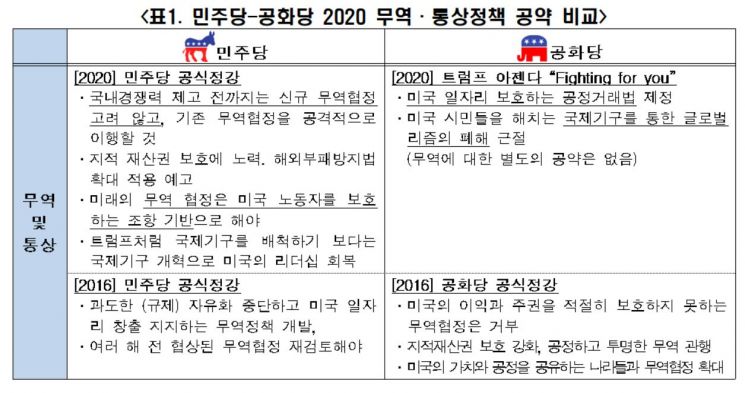
On the 28th, the Federation of Korean Industries (FKI) analyzed the policy directions outlined in the platforms (agenda) of both parties after assuming power and found that while the two parties showed clear differences in domestic policy according to their political leanings, their stances on foreign trade issues and a tough approach toward China were similar.
According to the FKI, ahead of this year's U.S. presidential election, both the Democratic and Republican parties are expected to maintain a stance of 'America First' regarding international trade.
Analysis of trade and commerce-related pledges showed that both parties prioritize enhancing U.S. competitiveness and interests over expanding trade agreements, and share a common direction in strengthening intellectual property protection, enforcing the Foreign Corrupt Practices Act, and promoting fair trade.
Additionally, while the Democrats pledge to base new trade agreements on provisions protecting American workers, the Republicans promise to enact fair trade laws to protect American jobs, demonstrating a shared commitment to prioritizing the protection of American workers and employment.
A notable point is that protectionism, exemplified by the Trump administration's America First policy launched in 2017, is also reflected in the Democratic party's platform.
Due to the protectionist measures of the Trump administration over the past four years, such as tariffs and safeguards on automobiles and steel, the non-tariff barriers that the Korean economy has faced are likely to remain regardless of the election outcome. Pressure from the U.S. side regarding the implementation of the Korea-U.S. FTA is also expected to continue.
◆Continued U.S.-China Global Economic Leadership Dispute, Korea Remains in a Shrimp’s Back Position Between Economic Powers
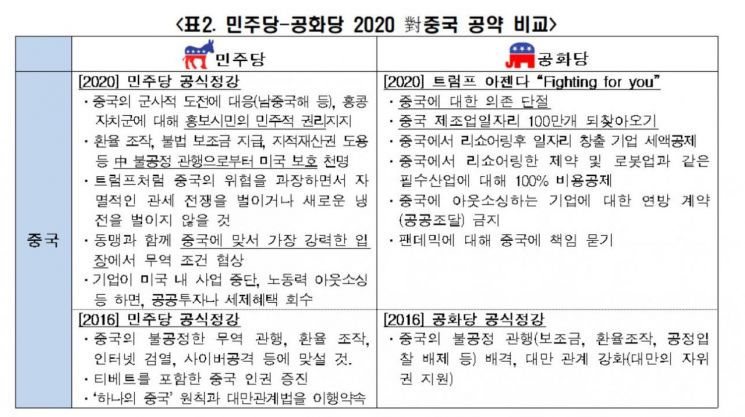
Regarding U.S. policy toward China, the platforms of both parties were not significantly different. Both parties strongly expressed through their platforms that they will not tolerate unfair practices by China such as currency manipulation and illegal subsidies from the U.S. perspective, and are determined to prevent the outflow of American jobs and investments to China and other overseas locations.
A particularly noticeable change is the Democratic Party’s stance: the phrase recognizing the 'One China Policy' included in the 2016 Democratic platform was removed, and issues such as the South China Sea and Hong Kong were mentioned, reflecting a tougher position on China. The commitment to actively respond to China’s military challenges contrasts with the more moderate China policy of the 2016 Democrats.
Hardliner candidate Trump pledged to 'decouple from China' and made reducing U.S. economic dependence on China a core agenda. He also proposed aggressive reshoring policies to bring back American corporate investments and jobs from China to the U.S.
The Democrats, while less intense, also declared policies such as 'protecting the U.S. from China’s unfair practices,' and differentiated themselves by stating they would avoid the exhausting tariff wars like those under the Trump administration’s U.S.-China trade conflict.
With the Democratic Party’s China policy expected to remain on par with the Republicans’, the Korean business community is likely to remain in a state of tension regardless of the election outcome.
Given Korea’s high dependence on China, it inevitably suffered direct and indirect damage from the U.S.-China trade dispute triggered in 2017 and the U.S.’s strengthened import regulations. In fact, the Bank of Korea reported that the 2019 growth rate decline due to the U.S.-China trade dispute reached 0.4 percentage points.
Meanwhile, on North Korea policy, the two parties showed differing positions. The Republican platform in 2016 emphasized 'Complete, Verifiable, and Irreversible Dismantlement (CVID)' and a tough response to the North Korean regime’s threats, but the 2020 agenda made no special mention of North Korea.
The Democrats in their 2020 platform stated support for humanitarian aid to North Korea while strengthening responses to human rights abuses. Regarding alliances, the Republicans pledged to 'encourage allies to pay their fair share,' whereas the Democrats promised to 'rebuild alliances damaged by President Trump,' showing clear differences.
Kim Bongman, Director of International Cooperation at the FKI, said, “Since the two parties hold very similar positions on foreign policies closely related to Korea, such as international trade and China policy, the impact of the U.S. presidential election on the Korean economy is rather predictable.” He added, “Although there may be differences in degree and method, it is clear that America First and the U.S.-China conflict will continue, which is a red light for the Korean economy.”
He continued, “Based on case studies over the past three years, it is necessary for our government and business community to prepare countermeasures for the uncertain trade environment,” and said, “The FKI, which operates the Korea-U.S. Business Council, a key channel for Korea-U.S. relations, will also strengthen cooperation between the private sectors of both countries and respond accordingly.”
© The Asia Business Daily(www.asiae.co.kr). All rights reserved.


















