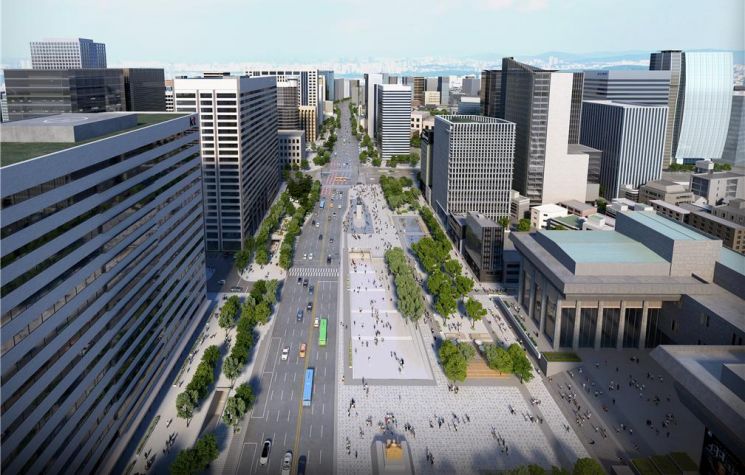
 Bird's-eye view of the changing Gwanghwamun Square (from Gwanghwamun Square to Sungnyemun direction).
[Asia Economy Reporter Donghyun Choi] The area around Gwanghwamun Square in Seoul will be reborn as a space where citizens can walk comfortably. Gwanghwamun Square will be expanded toward the Sejong Center for the Performing Arts, incorporating park-like elements in this space. The east-side lanes of the section from Sejong-daero Intersection to Gwanghwamun will be expanded and adjusted to 7 to 9 lanes. Additionally, through connection with the Sejong-daero Saramsup-gil, a pleasant urban walking path of approximately 2.6 km will be created from Seoul Station to Gwanghwamun.
On the 27th, the Seoul Metropolitan Government announced that it has prepared a detailed plan for the ‘changing Gwanghwamun Square’ through discussions with experts and related organizations based on citizens’ opinions. Reflecting the results of communication with citizens, the original plan was revised, and the direction to transform the square into a ‘place where people can rest and walk comfortably’ has been further specified this time.
The city set the basic directions for the changing Gwanghwamun Square based on citizens’ wishes as ▲gradual promotion of full pedestrianization ▲incorporation of park-like elements ▲formulation of a future-oriented plan encompassing the Gwanghwamun area, and revealed four major specific plans that have significantly changed through citizen communication.
First, Sajik-ro will maintain its current function to minimize citizen inconvenience caused by worsening traffic congestion, while the east-side lanes of the section from Sejong-daero Intersection to Gwanghwamun will be expanded and adjusted to two-way 7 to 9 lanes (7 driving lanes). Traffic measures near the square were finalized through consultations with local residents, the Ministry of the Interior and Safety, the Cultural Heritage Administration, and other related organizations, as well as various preliminary administrative (review) procedures since the announcement of citizen communication results in February.
The west-side road near the Sejong Center for the Performing Arts will be transformed into a square embracing a park. By planting flowers and trees that clearly show seasonal changes, it will be transformed into a ‘park-like square in the city.’ The plan to convert the west-side road into a square was comprehensively considered based on citizen preference surveys, expert opinions, and connectivity with surrounding buildings.
The underground space will be remodeled at the level of the existing Haechi Yard located underground, rather than large-scale development. This decision reflects the voices of citizens and experts concerned about the decline of nearby commercial districts and damage to underground archaeological remains. The public multi-use facilities will be focused on, such as drastically improving the restrooms in Haechi Yard, to enhance the quality of services.
The changes in the square will spread to surrounding areas, improving the overall pedestrian environment around the square, including the west side of Gyeongbokgung Palace, Bukchon, and Cheonggyecheon, transforming the city into a place where people can walk comfortably. Along with this, a ‘Comprehensive Development Plan for the Gwanghwamun Area’ will be established, connecting Gwanghwamun, Uijeongbu, Sejong-ro Park, and Seoul Station.
To carry out this development project, the city plans to start construction at the end of October to expand and maintain the east-side lanes of the square for two-way traffic. This will be completed in connection with the ongoing Sejong-daero Saramsup-gil creation project (Seoul Station to Sejong-daero Intersection).
Meanwhile, the ‘Restoration of Cultural Heritage including Gwanghwamun Woldae at Gyeongbokgung Palace and Surrounding Maintenance’ project, jointly promoted by the Cultural Heritage Administration and Seoul City, will be carried out step-by-step in connection with the changes in the square.
Kim Hak-jin, Deputy Mayor for Administration of Seoul, said, “We have completed the blueprint of the square reflecting the wishes of citizens and local residents,” adding, “The changing Gwanghwamun Square will be a project that marks Seoul’s full-scale transition into an ecological civilization city with vitality that coexists with nature and can prepare for disasters.”
© The Asia Business Daily(www.asiae.co.kr). All rights reserved.

















