Food Services Contribute the Most to the Expansion of Contactless Consumption
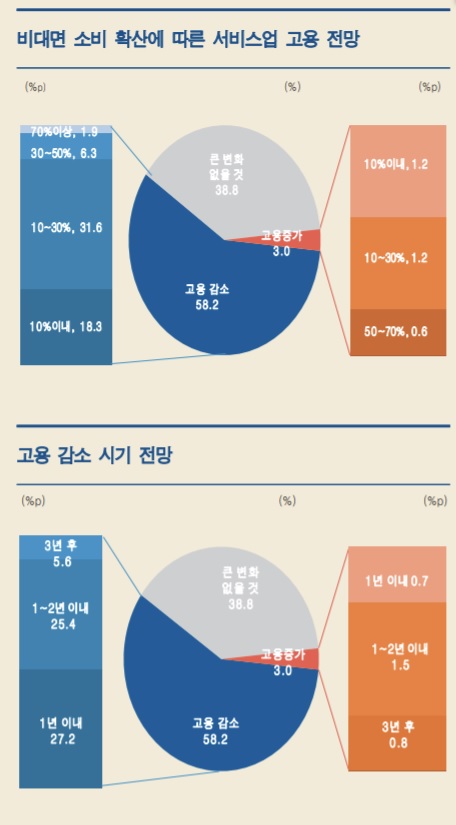
[Asia Economy Reporter Eunbyeol Kim] Amid the increase in non-face-to-face consumption due to the spread of the novel coronavirus infection (COVID-19), food services were found to have contributed the most to non-face-to-face consumption. Service companies predicted that employment would decrease by 10-30% within two years due to the expansion of such non-face-to-face consumption.
According to the "Regional Economic Report" released by the Bank of Korea on the 25th, when looking at the increase rate of non-face-to-face consumption and the contribution by item from February to July, "food services" contributed the most. Non-face-to-face consumption increased by 30.3% year-on-year from February to July, of which food services contributed as much as 5.9 percentage points.
The spread of non-face-to-face consumption patterns was also observed in credit card usage statistics. The proportion of non-face-to-face consumption in credit card usage increased by an average of 0.1 percentage points per month from 2017 to 2019, but since February this year, it has been expanding by an average of 0.4 percentage points per month.
As a result of investigating the impact of the spread of a non-face-to-face and contactless consumption culture, many service companies expected that the expansion of non-face-to-face consumption would have a negative effect on their business conditions. They were concerned about sales decline (46.5%), increased uncertainty in the business environment (25.4%), and market share reduction (14.8%).
Especially, 58.2% of companies anticipated that employment would decrease due to the expansion of non-face-to-face consumption. Regarding the scale of employment reduction (compared to the current employment level), the largest proportion (31.6%) responded that it would be 10-30%. Furthermore, the outlook that employment reduction would materialize within two years was held by almost all (90.4% of companies that answered employment reduction).
Meanwhile, 24% of the responding companies pointed out that government support policies were insufficient in coping with the market environment. Companies that responded that they lacked investment funds accounted for 22.4%.
To resolve difficulties, 37.2% responded that related laws should be amended and regulations eased, 30.6% said investment-related subsidies were necessary, and 21.3% answered that tax benefits were a support measure.
The Bank of Korea conducted a survey targeting 291 companies nationwide from August 12 to September 2. The response rate was 70.4%.
© The Asia Business Daily(www.asiae.co.kr). All rights reserved.

















