"Excluding High-Speed Rail by Ministry of Land, Infrastructure and Transport, a Myopic Policy Decision" ... Request for Cooperation from Cheongwadae, Prime Minister's Office, and National Assembly
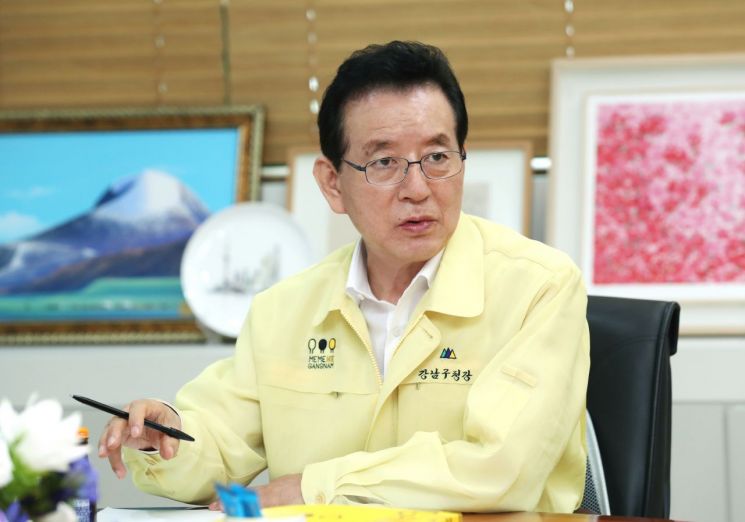
[Asia Economy Reporter Jong-il Park] On the 27th, Jung Soon-gyun, Mayor of Gangnam District, sent a letter urging the prompt implementation of the introduction of the high-speed railway at Samseong Station to the Blue House, the National Assembly, the Prime Minister's Office, and the Ministry of Land, Infrastructure and Transport (MOLIT), explaining the necessity of the project.
In the letter under Mayor Jung's name, he refuted point by point the Ministry of Land, Infrastructure and Transport's stance of not extending the Suseo High-Speed Train (SRT) to Samseong Station, citing unclear new demand as reported recently in the media, calling it a "short-sighted policy decision," and requested that the introduction proceed as originally planned.
Previously, when MOLIT reapplied for the preliminary feasibility study of GTX-C (47.9 km) connecting Deokjeong in Gyeonggi Province to Suwon in 2016, it planned to operate the Suseo-origin high-speed train 25 times a day, but early last year, it reversed its position by excluding the high-speed rail platform included in the original design of the existing Samseong Station Complex Transfer Center.
Following opposition from Seoul City and Gangnam District, MOLIT promised to consider alternatives such as introducing high-speed trains compatible with both low and high platforms, but recently changed its stance again, citing "unclear new demand."
Mayor Jung emphasized that despite MOLIT's reversal, the Samseong Station Complex Transfer Center will serve GTX-A and C lines, Wirye-Sinsa Line, Subway Lines 2 and 9, and will be directly connected underground to the nearby 105-story GBC (Hyundai Global Business Center) under construction and COEX, ensuring sufficient new demand. He also highlighted that the preliminary feasibility study's cost-benefit (B/C) analysis and Analytic Hierarchy Process (AHP) evaluation passed with good scores.
He also conveyed experts' analyses that for the convenience of high-speed rail users, the high-speed train must connect to urban areas like Samseong-dong. Furthermore, he stressed that with the government's North-South railway project preparing for the era of peace on the Korean Peninsula, connecting to the Eurasian continent, Samseong Station will become a key hub connecting to North Korea at the shortest distance, increasing its economic utility value.
Jung Soon-gyun, Mayor of Gangnam District, said, "For national economic development, improved transfer convenience, and preparation for the era of peace on the Korean Peninsula, the nationwide high-speed railway must operate up to Samseong Station." He added, "I ask for persuasion and support so that MOLIT can comprehensively review cost issues and demand forecasts again and make policy decisions that all citizens can agree with."
Meanwhile, this letter was sent to the Blue House Policy Office, the Prime Minister's Office officials, all 299 members of the National Assembly from both ruling and opposition parties, the Democratic Party representative office, and the Ministry of Land, Infrastructure and Transport's minister and vice minister offices.
---------------------------------
Hello, I am Jung Soon-gyun, Mayor of Gangnam District.
Recently, the Ministry of Land, Infrastructure and Transport announced a policy not to operate high-speed trains at Samseong Station due to lack of new demand, low economic feasibility, and social benefits, but I believe this is a typical short-sighted policy decision excluding nationwide high-speed rail for the sake of the private GTX project’s profitability.
First, there is sufficient new demand.
Samseong Station will be connected to existing Subway Lines 2 and 9, GTX-A, GTX-C, and the Wirye-Sinsa Line, and will become an underground city connected to the 105-story Hyundai GBC and COEX. Once the Yeongdong-daero area development is completed, this place will become the heart of Korea’s economy, tourism, and MICE (Meetings, Incentives, Conferences, and Exhibitions).
Second, economic feasibility has already been verified.
In December 2018, the preliminary feasibility study for the GTX-C line including high-speed train operation showed a B/C ratio of 1.36 and an AHP score of 0.616, indicating high economic feasibility. Who would trust the government if such results are unilaterally overturned?
Third, transfer convenience will be dramatically improved.
If passengers coming from Busan and Gwangju transfer at Samseong Station, it will save time and make entering downtown Seoul much more convenient. Furthermore, if the high-speed train extends to the northeastern metropolitan areas such as Nowon, Dobong, Dongdaemun, and Uijeongbu, it will greatly contribute to balanced development of the metropolitan area.
Fourth, we must prepare for the era of peace on the Korean Peninsula.
When the era of peace arrives, the high-speed train will connect to the Eurasia Line (North Korea~China/Russia~Europe), and Samseong Station will function as a hub connecting local areas and North Korea (Wonsan) at the shortest distance. The economic utility value will double.
Fifth, experts also say the high-speed train must be directly connected to Samseong Station.
Rail is the only transportation mode directly connected to urban centers, and even operating about 20 high-speed trains per day departing from Samseong Station would have a positive effect on passenger convenience, according to the majority opinion.
For national economic development, improved transfer convenience, and future generations, I earnestly ask for your persuasion and support so that the nationwide high-speed railway can definitely operate up to Samseong Station.
September 2020
Jung Soon-gyun, Mayor of Gangnam District
© The Asia Business Daily(www.asiae.co.kr). All rights reserved.
![From Bar Hostess to Organ Seller to High Society... The Grotesque Con of a "Human Counterfeit" [Slate]](https://cwcontent.asiae.co.kr/asiaresize/183/2026021902243444107_1771435474.jpg)
















