- Among a total of 2,432,422 applicants by August, 1,180,834 applied for large complexes with over 1,000 units
- Preference influenced by various community facilities within complexes and convenience and investment value leading local market prices
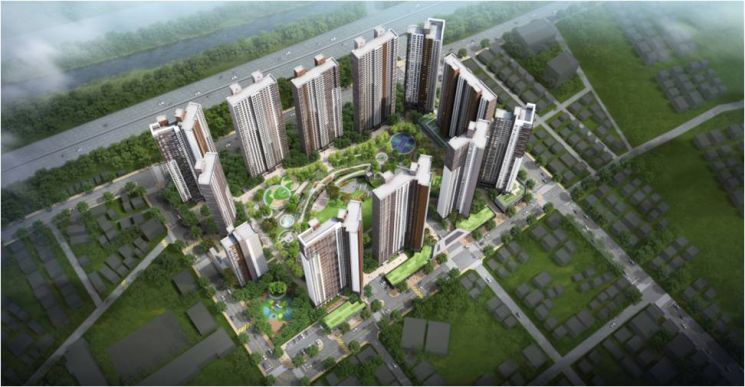
An analysis of subscription applications for newly launched apartments from January to August this year revealed that the largest number of applicants flocked to large complexes with over 1,000 households. This is attributed to the appeal of various community facilities within the complex and the economies of scale that help lead local market prices.
In particular, large complexes with over 1,000 households have maintained steady demand despite the announcements of real estate measures on February 20, June 17, and July 10, establishing themselves as a smart single property even in an uncertain market.
According to Real Today, a real estate research firm, an analysis of subscription applications for newly launched apartments nationwide from January to August this year showed that a total of 2,432,422 people applied for 277 complexes (excluding public supply).
Among these, 1,180,834 applicants (48.5% of the total) applied for 54 large complexes with over 1,000 households, making them the most popular. Complexes with 500 to 1,000 households (93 complexes) attracted 693,643 applicants (28.5%), and those with fewer than 500 households (130 complexes) attracted 557,945 applicants (23%).
The complex with the highest subscription competition rate in Seoul was also a large complex with over 1,000 households, ‘DMC SK View I’Park Foret’ (1,464 households, 340.27 to 1). Similarly, complexes with high subscription competition rates in other regions were also large complexes with over 1,000 households, such as ‘Bupyeong SK View Haemoro’ in Incheon (1,559 households, 105.34 to 1), ‘Cheonan Prugio Lakeside’ in Cheonan (1,023 households, 131.05 to 1), ‘Daeyeon Prugio Clacent’ in Busan (1,057 households, 157.62 to 1), and ‘Dongdaegu Station Hwaseong Park Dream’ in Daegu (1,079 households, 87.82 to 1).
This is likely because larger complexes have higher investment value. In fact, when looking at apartment price increase rates by size over the past five years (2015?2019), apartments with over 1,000 households showed strong price growth.
Among these, apartments with over 1,500 households had the highest price increase rate at 43.13%, followed by those with 1,000 to 1,499 households at 31.22%. Next were apartments with 700 to 999 households at 27.69%, 500 to 699 households at 25.66%, and 300 to 499 households at 25.00%. Apartments with fewer than 300 households showed a slight increase of 29.10%, but still did not match the price growth of large complexes with over 1,000 households.
A real estate expert explained, “There are not many places with large enough sites to develop complexes with over 1,000 households within a region, so there is scarcity from the supply side. Especially, large construction companies with experience in large-scale projects mainly handle construction, enhancing the quality, so the product competitiveness of large complexes is naturally superior to that of medium and small complexes.”
As large complexes with over 1,000 households continue to show strength in the real estate market, notable large complexes are expected to be supplied in the remaining market this year, including ‘Gumi I’Park The Sharp’, ‘Ray County’, ‘Gapcheon 1 Triple City Hillstate’, and ‘Osong Station Paragon Central City’ in various regions.
First, HDC Hyundai Development Company and POSCO Construction plan to launch ‘Gumi I’Park The Sharp’ in October through the Wonpyeong 1 District housing redevelopment project (around 330-2 Wonpyeong-dong) in Gumi City, Gyeongbuk Province. It is the first complex to be launched among Wonpyeong 2 and 3 Districts. The complex will have up to 42 floors above ground, 12 buildings, with units ranging from 39 to 101 square meters, totaling 1,610 households, of which 1,314 will be offered to the public. As Gumi City’s first ‘I’Park The Sharp’ branded apartment, it features the tallest design in the area and landscaping space about twice the size of a soccer field (approximately 16,000 square meters). The complex is located right next to Gumi Elementary School, with easy access to Gumi Girls’ Middle School, Gumi High School, and Gyeongbuk Foreign Language High School. Commuting to Gumi National Industrial Complex, home to Samsung Electronics, LG Electronics, and LS Cable, is convenient, and regional travel is easy via Gumi Station on the Gyeongbu Line, Gumi IC on the Gyeongbu Expressway, Gimcheon JC on the Jungbu Inland Expressway, and National Road 33.
Samsung C&T, Daelim Industrial, and HDC Hyundai Development Company will hold the first subscription for ‘Ray County’ on the 25th, built through the Geoje 2 District housing redevelopment project (around 802 Geoje 2-dong) in Yeonje-gu, Busan. The complex consists of 34 buildings from 3 basement floors to 35 floors above ground, with units ranging from 39 to 114 square meters, totaling 4,470 households (230 rental units), of which 2,759 will be offered to the public. Community facilities include a swimming pool, fitness center, GX room, sauna, golf practice range, and caf?. Nearby schools include Geoje Elementary, Changsin Elementary, Geoje Girls’ Middle School, and Geoseong Middle School, and it is close to the Sajik-dong academy district. The complex is adjacent to Busan Subway Line 3’s Sports Complex Station, Geoje Station (transfer station for Line 3 and Donghae Line), and Geoje Haemaji Station on the Donghae Line.
Daejeon Urban Corporation and Hyundai Construction plan to launch ‘Gapcheon 1 Triple City Hillstate’ in October in Block 1 of the Gapcheon district waterfront area in Yuseong-gu, Daejeon. The complex will have 18 buildings from 2 basement floors to 20 floors above ground, with units ranging from 59 to 84 square meters, totaling 1,116 households. Nearby schools include Wonsinheung Elementary, Bongmyeong Elementary, Bongmyeong Middle, and Daejeon Physical Education High School. Transportation developments such as the Daejeon Metro Line 2 tram and the opening of the Wolpyeong?Doan connecting road are also planned near the complex.
Dongyang Construction Industry plans to launch ‘Osong Station Paragon Central City’ in October in Block B2 of the Osong 2nd Life Science Complex in Heungdeok-gu, Cheongju, Chungcheongbuk-do. The complex will have 19 buildings from 2 basement floors to 25 floors above ground, with units of 59 square meters, totaling 2,415 households. Educational and commercial facilities for elementary, middle, and high schools will be established nearby. The complex is close to KTX and SRT Osong Station and offers easy access to the BRT main road connecting to Sejong.
© The Asia Business Daily(www.asiae.co.kr). All rights reserved.

















