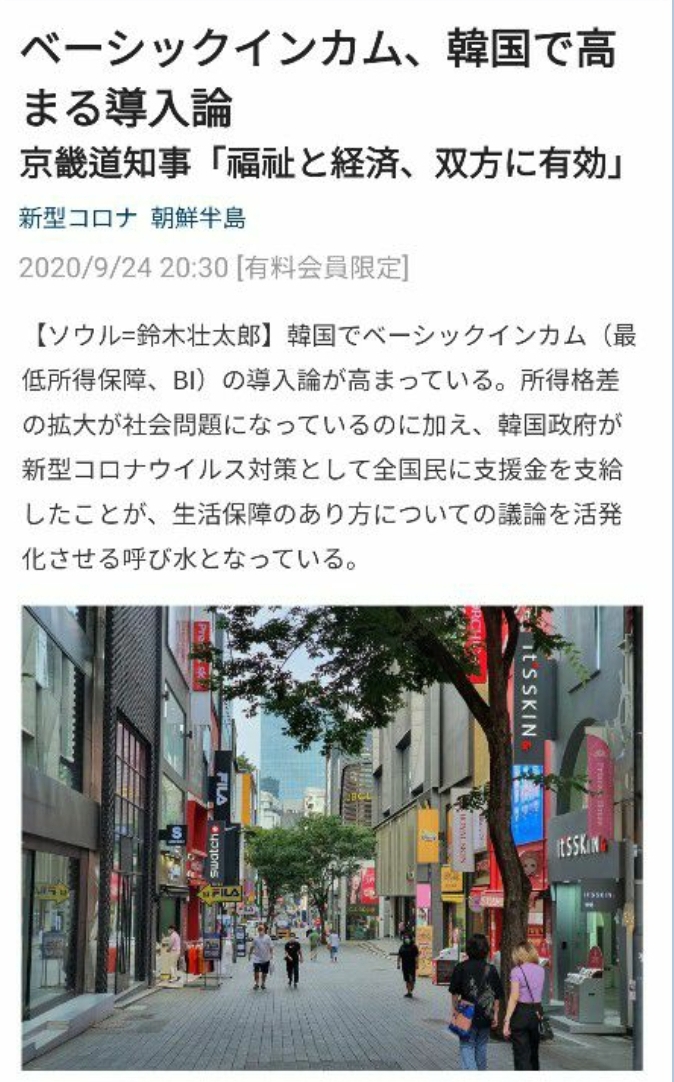
 A quiet scene of Myeongdong, Seoul, featured in the Nihon Keizai Shimbun on the 24th. Through an article by its Seoul correspondent on the same day, the newspaper published an analysis suggesting that the possibility of introducing basic income by Lee Jae-myung, Governor of Gyeonggi Province, is increasing in South Korea.
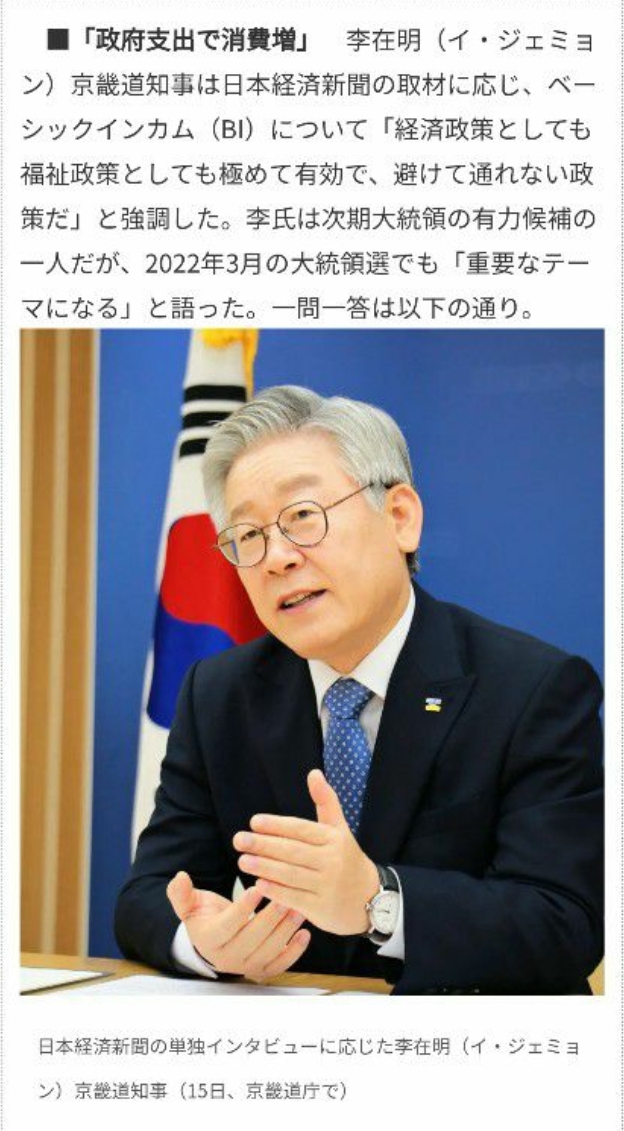
[Asia Economy (Suwon) = Reporter Lee Young-gyu] Japan's leading economic newspaper, Nihon Keizai Shimbun, has drawn attention by highly evaluating Gyeonggi Province Governor Lee Jae-myung's 'basic income' and reporting that the possibility of its introduction in Korea is increasing.
On the 24th, the newspaper, through a Seoul correspondent (Suzuki Sotaro), reported, "Voices advocating the introduction of basic income are growing louder in Korea," and evaluated, "The widening income gap has become a social problem, and the Korean government's payment of support funds to all citizens as a COVID-19 measure has served as a catalyst for active discussions on the desirable direction of livelihood security."
Reporter Suzuki Sotaro introduced, "The person leading the basic income introduction movement is Gyeonggi Province Governor Lee Jae-myung," and explained, "Governor Lee plans to start by paying 500,000 won (approximately 45,000 yen) per person annually and gradually increase the amount, aiming long-term for a basic income of 500,000 won per month, which is almost equivalent to the basic livelihood security recipients (corresponding to Japan's livelihood protection)."
He added, "If it is 500,000 won annually, 25 trillion won is needed, but it is considered possible to secure the cost by reviewing fiscal expenditures."
Furthermore, he reported, "Governor Lee claims that although paying 500,000 won per month is currently impossible, it can be realized in 15 to 20 years through securing new tax revenues such as strengthening taxation on public land, carbon tax on carbon dioxide emissions from fossil fuels, and digital tax on internet companies profiting from data we produce."
In particular, he explained, "Regarding Governor Lee's basic income introduction theory, 14 members including Assemblyman Cho Jung-hoon of the Innovation Party and Democratic Party members jointly proposed the 'Basic Income Enactment Act' on the 17th. This law aims to establish a 'Basic Income Committee' to discuss payment amounts and funding, starting with 300,000 won per month from 2022 and increasing to over 500,000 won per month by 2029."
Suzuki Sotaro said, "The basic income introduction theory is gaining voices not only from the left, who are enthusiastic about reducing disparities and enhancing welfare, but also from the right, who advocate for a 'small government.' Kim Jong-in, emergency committee chairman of the conservative opposition party 'People Power Party,' said on the 6th, 'The time has come to fundamentally review basic income.' Earlier, on September 2, the People Power Party inserted the phrase 'The state actively helps individuals to lead stable and free lives through basic income' into their basic policy titled 'Top 10 Promises.'"
Regarding the background of the surge in basic income introduction discussions in Korea, he said, "It is because income disparity is widening due to the increase in low-wage irregular employment," diagnosing, "In fact, the ratio showing how many times the top 20% income group earns compared to the bottom 20% increased from 4.37 times in October-December 2015 to 5.26 times in the same period in 2019."
Suzuki Sotaro reported, "However, the Korean government still maintains a cautious stance on basic income," citing Deputy Prime Minister and Minister of Economy and Finance Hong Nam-ki's statement in July, "Overcoming the COVID crisis is the priority now, and basic income discussions should come afterward."
© The Asia Business Daily(www.asiae.co.kr). All rights reserved.


















