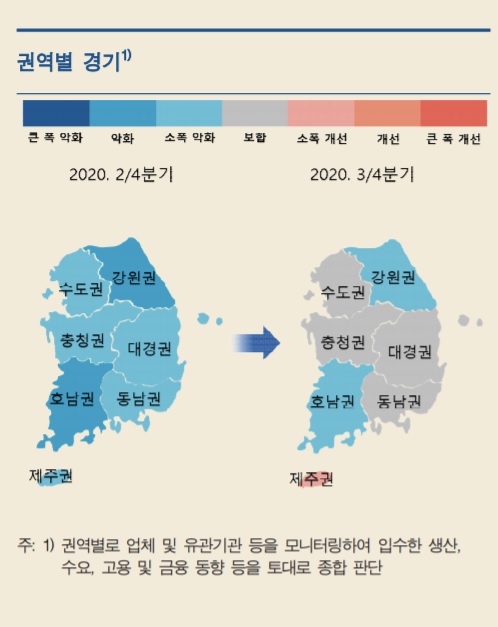
[Asia Economy Reporter Eunbyeol Kim] In the third quarter, the regional economy showed signs of slight improvement in most areas despite the continued impact of the novel coronavirus disease (COVID-19). In the Jeju region, a slight recovery was observed as the number of domestic tourists increased.
According to the 'Regional Economy Report' released by the Bank of Korea on the 25th, manufacturing production in the third quarter slightly increased in the Daegyeong and Gangwon regions, while other regions such as the Seoul metropolitan area remained at the second quarter level.
In the Daegyeong region, there was a slight increase centered on domestic demand sectors such as automobile parts, export-oriented textiles, and displays. The Gangwon region showed strong performance in ramen products, dairy products, and export-oriented automobile parts. In the Seoul metropolitan area, semiconductor production remained flat as the decline in server demand was offset by a recovery in mobile demand, and pharmaceutical products and machinery equipment also maintained second quarter levels.
In the Dongnam region, overall weak domestic and foreign demand led to stagnation in automobiles, machinery equipment, steel, petrochemicals and refining, and metal processing. The Chungcheong region remained at second quarter levels, focusing on displays, semiconductors, petrochemicals, and steel. The Honam region showed flat levels as steel production was adjusted due to sluggish upstream industries, and shipbuilding remained steady despite new orders for liquefied natural gas (LNG) ships and favorable export growth, affected by adverse weather conditions.
In the Jeju region, alcohol beverage production slightly increased due to the recovery in tourist numbers, but non-alcoholic beverages decreased and food products remained flat, resulting in an overall level similar to the second quarter.
Monitoring results indicate that manufacturing production is expected to slightly increase in the Chungcheong and Jeju regions, while other regions are projected to remain at third quarter levels.
In the third quarter, service industry production slightly increased in the Jeju region compared to the second quarter, but slightly decreased in the Seoul metropolitan, Dongnam, Honam, and Gangwon regions, while Chungcheong and Daegyeong regions remained flat. The Jeju region saw a slight increase centered on accommodation, food services, and car rental businesses as domestic tourist numbers recovered.
Conversely, in the Seoul metropolitan area, social distancing measures limited the operation of various facilities, leading to sluggish accommodation, food services, and educational services. In the Dongnam region, real estate increased, but accommodation, food services, and transportation were sluggish due to prolonged monsoon rains and early closure of beaches. The Honam region experienced sluggish retail and transportation industries due to weak domestic and international travel demand and reduced import-export cargo volume.
In the Gangwon region, transportation increased due to low-cost carriers expanding routes in the Yeongdong area, but accommodation and food services were sluggish as weather volatility reduced the number of vacationers.
From the demand side, consumption remained flat in the Daegyeong and Jeju regions, while slightly decreasing in the Seoul metropolitan and other regions. Facility investment slightly increased in the Chungcheong region but remained at second quarter levels in other regions. Construction investment slightly decreased in the Seoul metropolitan area and remained flat in the Dongnam and other regions. Exports were sluggish across all regions in the third quarter, although the decline narrowed compared to the second quarter.
A Bank of Korea official stated, "Future regional economic outlooks show a mixture of upward and downward risks due to expectations of domestic and foreign demand recovery and ongoing uncertainties related to COVID-19."
© The Asia Business Daily(www.asiae.co.kr). All rights reserved.

















