[Asia Economy Reporter Park Cheol-eung] While the class action system that the government plans to legislate is commonly adopted overseas, punitive damages are limited to countries such as the United States and the United Kingdom. It can help victim relief and prevent illegal acts by companies, but there are concerns that it may conflict with the existing legal system and increase the burden on companies.
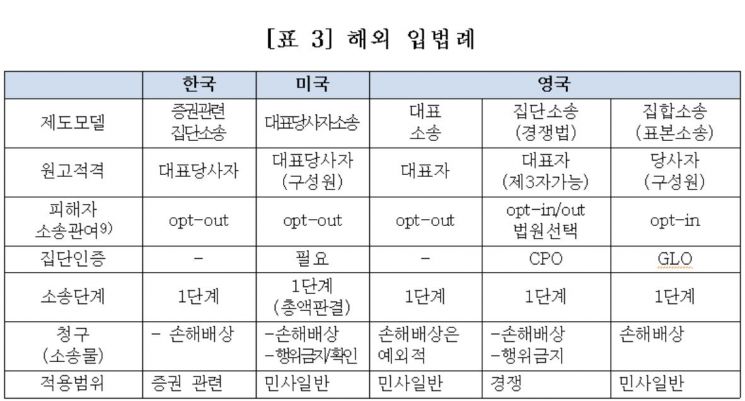
According to a report prepared by Heo Byeong-jo, a specialist at the National Assembly's Legislation and Judiciary Committee, the United States allows class actions regardless of the field, and if the plaintiff wins, the compensation is distributed from a relief fund created by the defendant.
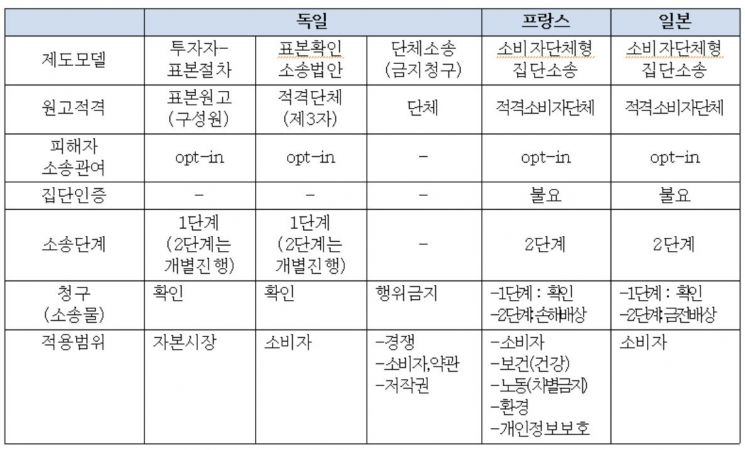
The United Kingdom also operates a class action system, but generally requires participants to register under the Civil Procedure Rules for the judgment to take effect. Japan has a two-step process where consumer groups first file damage compensation lawsuits against businesses, and then creditors are confirmed in the second step. Germany also has a system where organizations meeting certain requirements receive claims from victims and conduct collective damage relief lawsuits.
Specialist Heo said, "Expanding the introduction of class actions is positive in that it can reduce the burden of frivolous lawsuits while promoting efficient relief for many victims," but added, "Since there are views that the burden on individual businesses increases, it is necessary to consider both pros and cons."
Opposing opinions also cite concerns about frivolous lawsuits as a main reason. Litigation costs are low, so the risk of losing is minimal, and lawyers can expect relatively high fees. From a corporate perspective, the mere fact of a class action being filed can damage external credibility. He also pointed out that, in terms of the legal system, it may conflict with the civil procedure principles of 'disposition principle' and 'res judicata.'
The disposition principle is the rule that courts cannot rule on matters not requested by the parties, and res judicata is the legal effect that prevents claims or judgments that contradict the content of a finalized judgment.
Regarding the punitive damages system, he explained, "It is regulated through case law and statutes in common law countries such as the United States, Canada, and Norway, but most civil law countries like Germany and Japan have not introduced it."
In the United States, most states recognize punitive damages. Specialist Heo said, "Since the 1980s, the number of cases recognizing punitive damages has sharply increased, and as the amount of damages has become high, issues such as an increase in bankrupt companies and soaring insurance premiums have arisen, leading to debates. Discussions are ongoing on various measures such as stricter recognition requirements, burden of proof, and balancing the malice of the defendant's conduct with the amount of damages."
He added, "If the punitive damages system is applied to all illegal acts, it could promote overall fairness among victims and cover various types of illegal acts, but there are criticisms that full introduction would be difficult to harmonize with the principles of damage compensation under civil law and the civil and criminal litigation systems."
It is because while illegal acts can result in obtaining more benefits (windfall profits) than if no illegal act had occurred, civil law realistically compensates only for actual damages and does not allow retention of windfall profits.
© The Asia Business Daily(www.asiae.co.kr). All rights reserved.
![Clutching a Stolen Dior Bag, Saying "I Hate Being Poor but Real"... The Grotesque Con of a "Human Knockoff" [Slate]](https://cwcontent.asiae.co.kr/asiaresize/183/2026021902243444107_1771435474.jpg)











