EU to Collect Opinions by End of Next Month and Implement from 2023... US Possible Adoption
Ministry of Industry Monitoring Trends... Companies Busy Preparing Measures for Various Scenarios
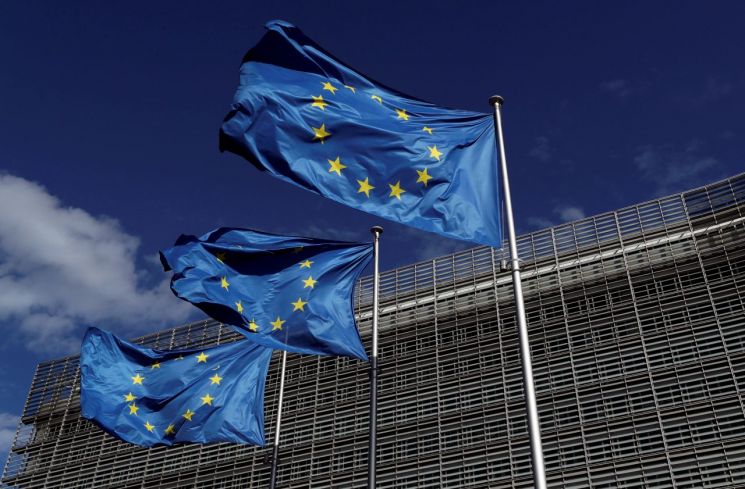
[Asia Economy Reporter Moon Chaeseok] As Europe and the United States announce the implementation of carbon border taxes, greenhouse gases are increasingly likely to act as new trade barriers. Along with the carbon emissions trading system already in place domestically, concerns have been raised that companies may face a double burden. Our government, along with steel, petrochemical, and IT companies, is closely monitoring the situation and preparing countermeasures.
According to the government on the 25th, the Office for Government Policy Coordination, Ministry of Trade, Industry and Energy, Ministry of Foreign Affairs, and Ministry of Environment held a meeting earlier this month to discuss countermeasures related to the European Union (EU)'s introduction of the carbon border tax. They plan to continue discussions with a second meeting scheduled for this month. Considering the COVID-19 pandemic, opinions will be gathered through future non-face-to-face (untact) meetings with industry groups.
The government has begun preparing countermeasures because the carbon border tax is becoming a reality. According to the Korea Energy Economics Institute, the EU will collect opinions until the end of next month, adopt detailed operational plans in the second quarter of next year, and implement carbon border adjustments starting January 2023.
The United States is also expected to introduce similar policies. Joe Biden, the Democratic presidential candidate, recently announced plans to invest $2 trillion (approximately 2,338 trillion KRW) by 2035 to eliminate carbon gas emissions from all power generation. If Biden wins the presidential election in November and the Democratic Party gains a majority in the Senate, the pace of decarbonization policies, including the carbon border tax, is expected to accelerate.
If major markets like the EU and the US strengthen carbon reduction policies, it is anticipated that our export companies will inevitably be affected. An official from the Ministry of Trade, Industry and Energy said, "It has not yet been specified which industries the EU will apply the carbon border tax to, nor which of the three methods?imposing tariffs only on imports subject to carbon tax within the region, expanding the emissions trading system, or others?will be used to implement the system." However, "there is much expectation that energy-intensive industries such as steel, cement, and petrochemicals, which currently receive free allocation of carbon emission permits within the EU, will be prioritized. We plan to monitor trends, share information among related ministries, and communicate with industry groups."
Besides the industries subject to carbon emissions permits and the method of imposition, the government and companies are preparing scenario-based countermeasures considering ▲ whether the Most-Favored-Nation treatment, concessions, and other World Trade Organization (WTO) international law issues (trade) ▲ the introduction of RE100 (a campaign to convert 100% of electricity to renewable energy by 2050) and whether carbon emissions permit performance will be reflected (energy) ▲ measures to reduce waste and other factors during product manufacturing (manufacturing). It is understood that among domestic companies, a significant number, excluding major conglomerates such as Samsung, SK, LG, and Hyundai, are not yet prepared.
The National Assembly Budget Office recently advised in its report "Trends and Countermeasures of EU Carbon Border Adjustment" that "If carbon border adjustment is implemented, Korean companies, which already bear emission costs through the domestic emissions trading system, may face a double burden related to carbon emissions and are expected to be negatively affected in exports to the EU." It added, "As various discussions such as standardization of greenhouse gas emissions, verification, and reporting are expected during the EU's carbon border adjustment process, proactive efforts by companies to develop greenhouse gas reduction technologies and products, along with government support, are necessary."
© The Asia Business Daily(www.asiae.co.kr). All rights reserved.
![Clutching a Stolen Dior Bag, Saying "I Hate Being Poor but Real"... The Grotesque Con of a "Human Knockoff" [Slate]](https://cwcontent.asiae.co.kr/asiaresize/183/2026021902243444107_1771435474.jpg)
















