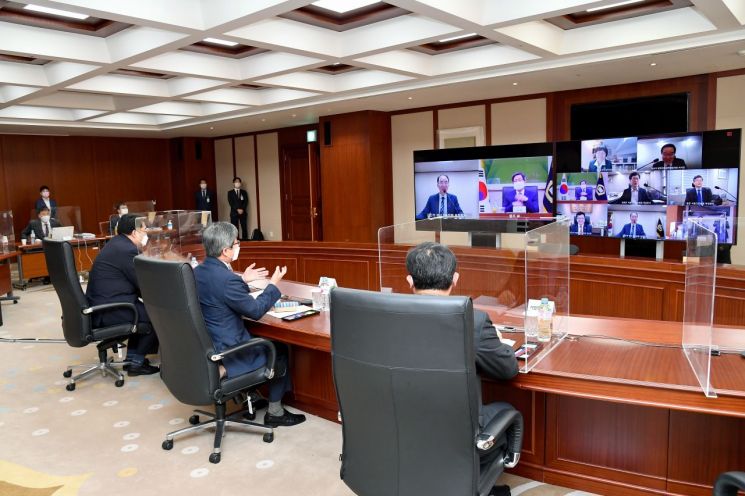
 On the 24th, Chief Justice Kim Myeong-su is seen speaking at the 8th Judicial Administration Advisory Meeting held via video conference in Conference Room 409 of the Supreme Court building in Seocho-dong, Seoul. Photo by the Supreme Court
[Asia Economy Reporter Seokjin Choi] The Supreme Court has decided to prioritize the disclosure of provisional civil, administrative, and patent rulings, excluding criminal rulings.
Additionally, it plans to establish specialized courts such as labor and maritime courts and implement a long-term judge tenure system starting from the personnel appointments in February next year.
On the 24th, the Supreme Court held the 8th Judicial Administration Advisory Meeting in Conference Room 409, presided over by Chief Justice Kim Myung-soo, where they discussed improvements to the ruling disclosure system and the establishment of additional specialized courts.
Considering the spread of the novel coronavirus (COVID-19), the meeting was conducted via video conference, with nine members participating remotely except for Chief Justice Kim.
The Supreme Court decided to promote the disclosure of provisional rulings even before related legal amendments, as part of realizing the principle of trial transparency.
Initially, the Supreme Court will disclose provisional civil, administrative, and patent rulings in PDF format and monitor the progress before deciding on the disclosure of provisional criminal rulings. To protect the rights of parties involved in cases to request disclosure restrictions, related regulations will also be revised.
Furthermore, the Court Administration Office has been tasked with securing budgets and developing systems necessary for the disclosure of provisional rulings and converting them into TEXT PDFs.
The members also agreed on the need to establish additional specialized courts, such as a labor court and a maritime court handling civil and administrative cases arising at sea, to enhance the expertise of trials.
The Supreme Court plans to minimize the regular personnel appointments of judges, which occur every two years, to reduce the Chief Justice’s personnel authority and prevent frequent changes in trial panels. Accordingly, the long-term judge tenure system will be implemented at 43 courts nationwide starting from the regular personnel appointments in February next year.
© The Asia Business Daily(www.asiae.co.kr). All rights reserved.

















