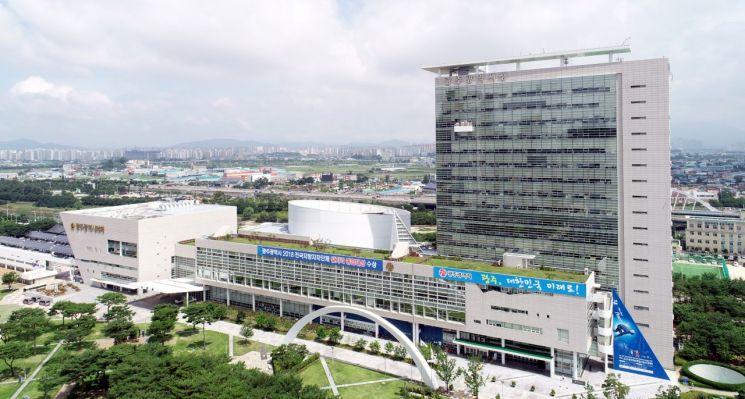
[Asia Economy Honam Reporting Headquarters Reporter Park Seon-gang] Gwangju Metropolitan City announced on the 24th that it is focusing on strengthening its infectious disease response capabilities and has prepared an organizational restructuring plan to strengthen the foundation for Gwangju's future growth in preparation for the post-COVID-19 era. Related ordinances and regulations are scheduled to be announced for legislative notice on the 28th.
The main points of this organizational restructuring plan include the establishment of the ‘Infectious Disease Management Division’ to build a stronger response system to protect citizens' health and safety from COVID-19, and the establishment of the ‘Gwangju Free Economic Zone Authority’ to lead regional job creation through fostering new industries and attracting investment companies.
First, the ‘Infectious Disease Management Division’ will be newly established within the Welfare and Health Bureau as a dedicated organization for comprehensive prevention, management, and continuous response to infectious diseases.
The ‘Infectious Disease Management Division’ expands and reorganizes the functions of infectious disease management previously handled within the Health Policy Division, enhancing expertise in establishing mid- to long-term infectious disease response measures, training epidemiologists, and expanding medical resources.
In addition, to strengthen the surveillance system for new infectious diseases and enhance diagnostic testing capabilities, the ‘New Infectious Disease Division’ will be established within the Infectious Disease Research Department of the Health and Environment Research Institute, taking charge of diagnostic testing for respiratory-related infectious diseases.
To respond quickly and efficiently in the event of a disaster, disaster management departments will be separated according to disaster types and reorganized into the ‘Natural Disaster Division’ and the ‘Social Disaster Division’.
This reflects field opinions that the existing Disaster Response Division, which handled both social and natural disaster tasks, faced limitations in responding promptly due to manpower shortages during simultaneous multiple disasters.
With the reorganization of disaster management departments, the ‘Natural Disaster Division’ will integrate functions such as safety inspections of vulnerable facilities and maintenance of disaster risk improvement districts, establishing a unified preparedness system from natural disaster prevention to response and recovery.
The ‘Social Disaster Division’ will strengthen its control tower function to respond swiftly to over 40 social disasters, including infectious diseases and fine dust.
The Gwangju Free Economic Zone Authority will be established to lead regional job creation by focusing on fostering future strategic industries and attracting investment companies.
Following the final designation of the Gwangju Free Economic Zone in June, which was a key initiative of Gwangju City during the 7th local government administration, the Gwangju Free Economic Zone Authority will be established to carry out related economic free zone affairs and will officially launch in January next year.
The Gwangju Free Economic Zone Authority is expected to serve as a turning point for Gwangju to leap forward as a city that is business-friendly and attractive for investment by focusing on fostering future strategic industries such as artificial intelligence and future mobility, and improving the business environment.
Accordingly, the organizational structure of Gwangju City will expand from the existing 4 offices, 8 bureaus, 2 headquarters, and 67 divisions to 4 offices, 8 bureaus, 2 headquarters, and 68 divisions, with one division added, and the Gwangju Free Economic Zone Authority will newly launch as a branch office.
Meanwhile, the ordinance on the number of public officials mainly includes an increase of 58 personnel, raising the total number from 3,940 to 3,998.
The organizational restructuring plan announced for legislative notice this time is scheduled to be submitted as an agenda item at the 293rd extraordinary session of the City Council, which will be held until the 27th of next month.
Kim Gwang-hwi, Director of the Planning and Coordination Office of Gwangju City, said, “This organizational restructuring was carried out swiftly to strengthen the infectious disease response organization and personnel in response to the nationwide resurgence of the COVID-19 crisis, to protect citizens' health and safety, and to lay the foundation for regional job creation through full-scale promotion of future strategic industry development and investment attraction. We will continue to focus our administrative capabilities to open an era of a safe and comfortable Gwangju, and a just and prosperous Gwangju.”
© The Asia Business Daily(www.asiae.co.kr). All rights reserved.

















