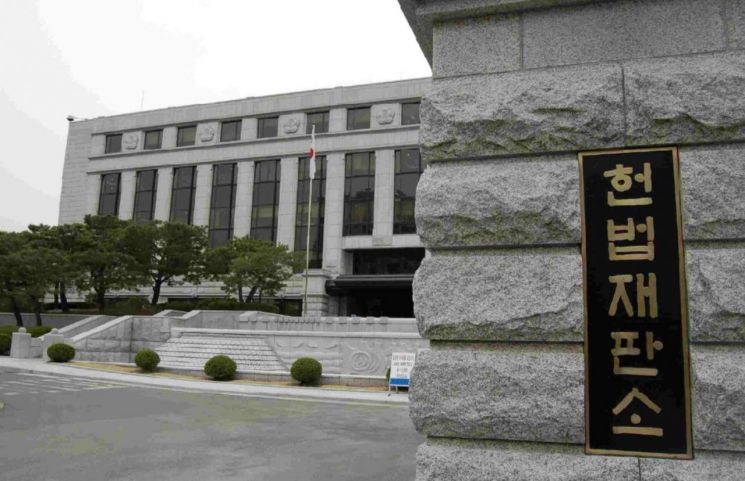
[Asia Economy Reporter Baek Kyunghwan] The Constitutional Court has ruled that the military personnel law provision serving as the basis for the 'Yeongchang' disciplinary action violates the Constitution.
On the 24th, the Constitutional Court delivered a 7 to 2 decision declaring unconstitutional the part concerning 'Yeongchang' in Article 57, Paragraph 2 of the former Military Personnel Act, which allowed for Yeongchang disciplinary action, in a constitutional review and constitutional complaint case filed by two soldiers who had received Yeongchang punishments.
Mr. A, who served as a cook on a Navy ship, was disciplined with 15 days of Yeongchang in December 2016 for violating the duty to not leave his post. While continuing a lawsuit to cancel the disciplinary action, Mr. A requested a constitutional review, arguing that the 'Yeongchang' part of the provision was unconstitutional, and the Gwangju High Court accepted this request.
Mr. B, who served in the Army, also filed a constitutional complaint against the same provision. Mr. B received a 7-day Yeongchang disciplinary action in July 2016 for violating the duty of diligence and filed the constitutional complaint during the course of his lawsuit.
The Constitutional Court accepted their claims and found the provision unconstitutional. It pointed out, "The disciplinary reasons for Yeongchang include cases of disobedience to orders, damage to dignity, violation or negligence of official duties," and stated, "These reasons are excessively broad compared to cases where criminal detention is permitted, allowing Yeongchang even for minor acts that are not highly blameworthy."
Although Yeongchang is similar to criminal detention, the Constitutional Court explained that the procedures deciding such disciplinary action are insufficient compared to criminal procedures. The Court stated, "The disciplinary committee can be composed solely of non-commissioned officers if the subject is a soldier. The human rights military legal officer is also appointed from among those under the command of each military unit commander," and added, "There are no procedures comparable to criminal procedures."
However, Justices Eun Ae Lee and Jongseok Lee dissented, stating, "Yeongchang disciplinary action aims to maintain internal military order and establish the command system," and "If the decision is made through an independent institution's review, it may be insufficient to achieve these objectives."
Meanwhile, the Yeongchang system was abolished after 124 years with the enforcement of the revised Military Personnel Act on August 5.
© The Asia Business Daily(www.asiae.co.kr). All rights reserved.
![User Who Sold Erroneously Deposited Bitcoins to Repay Debt and Fund Entertainment... What Did the Supreme Court Decide in 2021? [Legal Issue Check]](https://cwcontent.asiae.co.kr/asiaresize/183/2026020910431234020_1770601391.png)















