Tesla Falls Short of 'Battery Day' Expectations
Nasdaq Drops 3%...US Tech Stocks Plunge
Hydrogen Electric Vehicle Nikola and Medical Equipment Nanox
Plunge 26% and 3% in One Day Amid Technology Fraud Allegations
Financial Authorities Urge Caution on Overseas Investment Risks
[Asia Economy Reporter Minji Lee] "Should I sell now?" On the morning of the 24th, office worker Lee (29) sighed deeply. Having joined the ranks of 'Seohak Ants' by purchasing Tesla stocks earlier this month, Lee confessed that opening a stock account now feels frightening. He said, "I was confident that Tesla's stock price could rise again due to the 'Battery Day' issue," adding, "It had been called 'God-sla' because of its significant previous gains, so I thought it was worth betting on this time as well."
After the impact of the novel coronavirus (COVID-19), U.S. tech stocks, which had shown an unstoppable upward trend, have plunged, leaving individual investors who bought overseas stocks restless. Electric vehicle maker Tesla, hydrogen electric vehicle maker Nikola, and medical equipment company Nanox have all faced doubts about their technology within the U.S., causing some stocks to plummet more than 25% in a single day. The losses inflicted by these three stocks on domestic investors alone amount to 540 billion KRW.
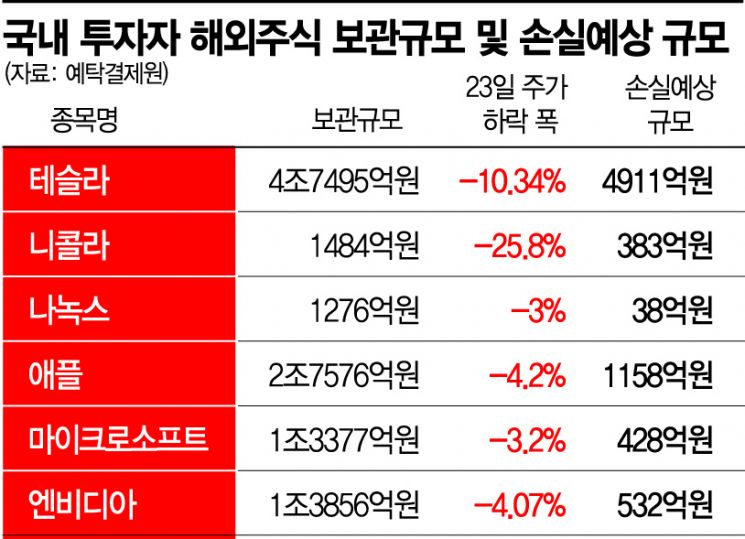
According to the Korea Securities Depository's securities information system, SEIBRO, on the 24th, Tesla, listed on the U.S. Nasdaq, fell 10.34% on the 23rd (local time), which is expected to result in losses for domestic investors. As of the previous day, the scale of Tesla stock holdings by domestic investors was $4.06226 billion (4.7495 trillion KRW), and reflecting the decline, the value of Tesla stocks held by domestic investors is estimated to have evaporated by about 491.1 billion KRW in one day.
Tesla's stock plunged 10% in a single day because the new battery technology failed to meet investors' expectations. Tesla, which earned the reputation of "all show and no substance," is criticized for having only challenges and visions but no tangible reality. After Battery Day, U.S. securities firms reportedly lowered Tesla's target price by $105 to $305. Gu (34), an office worker who sold Tesla stocks last month, said, "Even after failing to be included in the S&P 500, the stock continued to rise, so I regretted not selling," adding, "After Battery Day, when the company's profit structure issues were raised, I thought it was a gamble."
Nikola and Nanox attracted high interest from domestic investors after their listings but have seen their stock prices fall sharply amid fraud allegations. Nikola, once hailed as the 'second Tesla,' saw its stock price surge about 136% after listing but has now fallen 37% below its closing price on the listing day ($33.75). After short-seller Hindenburg labeled hydrogen cars a scam in a research report and founder Trevor Milton resigned as chairman of the board, widespread market anxiety ensued. Nikola plunged about 26% in one day, causing estimated losses of 38.3 billion KRW for domestic investors.
Nanox, an Israeli medical equipment company listed on the Nasdaq in August, has also been unable to escape a downward trend after being targeted by short-selling firm Muddy Waters. Allegations arose that Nanox does not have technology to produce X-rays using semiconductors and misled investors with fake images. Domestically, SK Telecom is known to have invested 27 billion KRW, and domestic investors have purchased about 127.6 billion KRW worth of Nanox stocks to date. On the 23rd, Nanox fell about 3% on the Nasdaq, resulting in estimated losses of about 3.8 billion KRW for domestic investors.
Experts believe that after running non-stop since March, a correction regarding overheating and concentration phenomena will occur for the time being. Kiwoom Securities researcher Seo Sang-young explained, "Stocks like Nikola and Tesla, which rose based on liquidity-driven rosy expectations, are undergoing corrections, leading to a contraction in investor sentiment," adding, "The market is sensitive to bad news, so this trend is expected to continue."
As concerns grow over losses incurred by domestic investors from overseas investments, financial authorities have also expressed apprehension. Son Byung-doo, Vice Chairman of the Financial Services Commission, said the day before, "Individual investors should once again be mindful of the risks associated with overseas investments made without sufficient information," urging, "The financial sector should also strive to protect customers so that they can invest based on a clear understanding of their investment targets."
© The Asia Business Daily(www.asiae.co.kr). All rights reserved.












