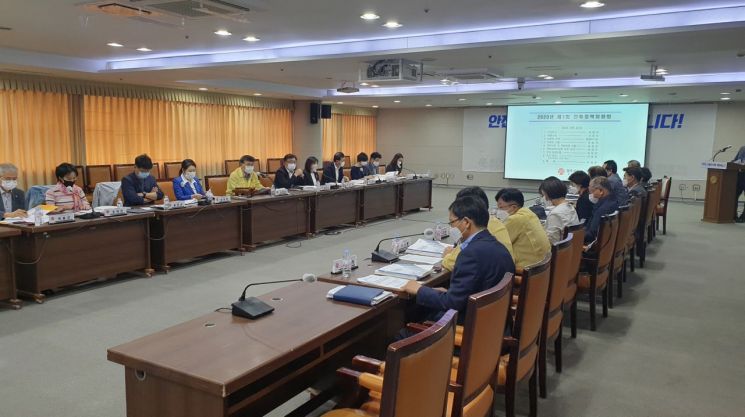
[Asia Economy Honam Reporting Headquarters Reporter Park Seon-gang] The 'Gwangju Metropolitan City Architectural Policy Committee,' which will deliberate and coordinate important policies in the architectural field of Gwangju Metropolitan City, has been launched.
On the 24th, Gwangju City announced that at the '1st Architectural Policy Committee' meeting held at City Hall on the 23rd, Kim Jong-hyo, Deputy Mayor of Gwangju, was elected as the inaugural Chairperson of the Gwangju Architectural Policy Committee, and Ham In-seon, Gwangju's Chief Architect, was elected as Vice Chairperson.
The Architectural Policy Committee is a deliberative and advisory body under the Framework Act on Architecture, consisting of a total of 27 members: 22 private members, 4 ex officio members, and 1 city council member.
The term of office is two years, and the committee plays a role in deliberating and coordinating major architectural policies, including presenting regional architectural policy visions, revising the basic architectural ordinance, establishing and implementing basic architectural plans, improving architectural administration, and planning public architectural projects.
At the meeting, the committee reviewed the architectural planning for two public architectural projects currently being promoted by Gwangju City.
Going forward, through the deliberation and coordination of the Architectural Policy Committee, a systematic foundation for the creation of public architectural projects will be established, aiming to comprehensively improve the quality of public buildings, promote efficient use and management of spatial environments, and present project programs, thereby significantly enhancing the level of public buildings and spatial environments in Gwangju City through thorough review of all projects.
Through this, the plan is to design high-quality spatial environments linked between local projects and utilize them as regional assets.
Gwangju City expects that by enhancing the quality of public buildings, citizens' perception will shift to recognize buildings and spatial environments not as private spaces but as public goods of the city, and that the quality of private buildings will also improve accordingly.
Kim Jae-sik, Director of the Urban Planning Division, said, "With the active activities of the Architectural Policy Committee, we hope to strengthen the public nature of architecture in the Gwangju area and improve the quality of public architecture, creating high-quality buildings and spatial environments," and added, "We will actively support the vigorous operation of the Architectural Policy Committee in the future."
© The Asia Business Daily(www.asiae.co.kr). All rights reserved.

















