Banpo Jugong 1-Danji 3-Jugu Union
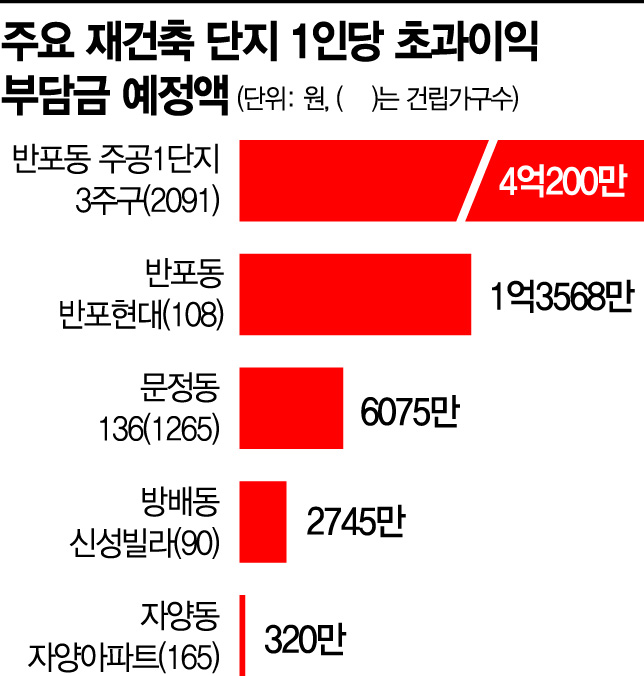
Excess Profit Burden 400 Million Won Per Household
Highest Amount Ever Imposed 'Panic'
[Asia Economy Reporter Choi Dong-hyun] "The inevitable has come."
The news that the Banpo Jugong 1 Complex 3rd District reconstruction in Banpo-dong, Seocho-gu, Seoul, will be subject to the highest ever excess profit charge of 400 million KRW per household has put reconstruction complexes in the Gangnam area on edge. Although some reactions say the amount is lower than initially expected, major reconstruction projects are responding by either switching to one-to-one reconstruction methods or postponing the project until the next administration to avoid the multi-hundred-million KRW burden. Experts are concerned that with the government's strong regulatory signals reaffirmed, the supply shortage in the Seoul area will worsen for the time being.
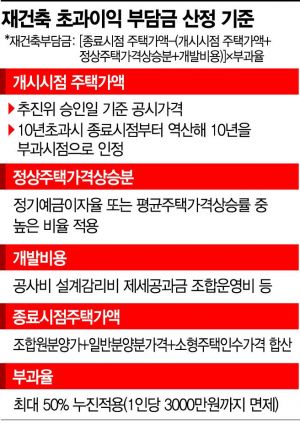
According to the industry on the 24th, the Seocho District Office in Seoul notified the Banpo 3rd District union the day before that the estimated burden amount under the Reconstruction Excess Profit Recovery System (재초환) is 596.56844 billion KRW. The burden per union member is 402 million KRW, the highest amount since the system was reinstated in 2018. The estimated burden amount is notified within one month after the reconstruction union, which has received project implementation approval, submits related documents such as construction costs to the local government within three months. Although there may be differences from the actual burden amount notified within four months from the completion date, the notification of the estimated amount itself has a significant impact on the market.
Upon hearing the news of the multi-hundred-million KRW burden, reconstruction unions in the Gangnam area shared the information among residents, creating a tense atmosphere. Especially in projects subject to both the price ceiling system and the excess profit recovery system, there were many agitated reactions. A union member of Hyundai Apartments in Apgujeong-dong, Gangnam-gu, said, "How can a retired elderly person who only owns one house, without selling it, come up with hundreds of millions of KRW to pay?" and added, "If it's to pay as tax, it's better to go with one-to-one reconstruction." One-to-one reconstruction is a method of reconstruction with almost no increase in the number of households, which reduces excess profits and thus lowers the burden amount as costs increase. A representative of the reconstruction promotion committee of Eunma Apartments in Daechi-dong, Gangnam-gu, said, "Since the two-year mandatory residence period must also be fulfilled, many residents have decided to wait until the administration changes," adding, "Many residents are already prepared for a long-term battle."
For the time being, the fear of burden charges is expected to grow in major reconstruction sites in Seoul. This is because the government declared in the 6.17 measures after the constitutional ruling on the excess profit recovery system at the end of last year that it would intensify the collection of burden charges from the second half of this year. Accordingly, additional collection work is expected to take place within the year at places such as Hannam Yeonrip in Hannam-dong, Yongsan-gu, and Doosan Yeonrip in Cheongdam-dong, Gangnam-gu.
The industry is concerned that the government's policy stance will further shrink the already insufficient housing supply in Seoul, ultimately leading to a rise in housing prices. Since the implementation of the price ceiling system on July 29 in Seoul, a "supply cliff" has become a reality. In Seoul, which is usually considered a peak season for sales, only two complexes?'Sinmokdong Paragon' in Yangcheon-gu and 'Jangan SI Palace' in Dongdaemun-gu?were supplied this month, totaling just 398 households. October is expected to be similar. Although about 4,000 households were initially scheduled to be supplied across four complexes, the schedule has been delayed due to the price ceiling system, making it highly likely that the supply volume will be zero. In fact, complexes such as Raemian One Bailey in Banpo-dong, Seocho-gu, are delaying sales while weighing the Housing and Urban Guarantee Corporation (HUG) assessed prices against the price ceiling system prices. Dunchon Jugong in Dunchon-dong, Gangdong-gu, considered the largest-scale reconstruction project since the founding of Korea with a total of 12,032 households, is also indefinitely delayed for the same reason.
Seo Jin-hyung, president of the Korea Real Estate Society (professor at Gyeongin Women's University), said, "With the realization of the highest burden amount ever, the market price of reconstruction complexes in the three Gangnam districts may shrink for the time being," adding, "However, as reconstruction and redevelopment are blocked, prolonging the supply cliff, housing prices will inevitably rise as demand in the three Gangnam districts and Seoul cannot be met."
© The Asia Business Daily(www.asiae.co.kr). All rights reserved.
![Clutching a Stolen Dior Bag, Saying "I Hate Being Poor but Real"... The Grotesque Con of a "Human Knockoff" [Slate]](https://cwcontent.asiae.co.kr/asiaresize/183/2026021902243444107_1771435474.jpg)

















