Korea Appraisal Board Weekly Apartment Price Trends for 3rd Week of September
Apartment Sale and Jeonse Prices Continue to Rise Despite Government Measures
Hong Nam-gi "Key Is Whether Government Follow-up Measures Are Reflected"
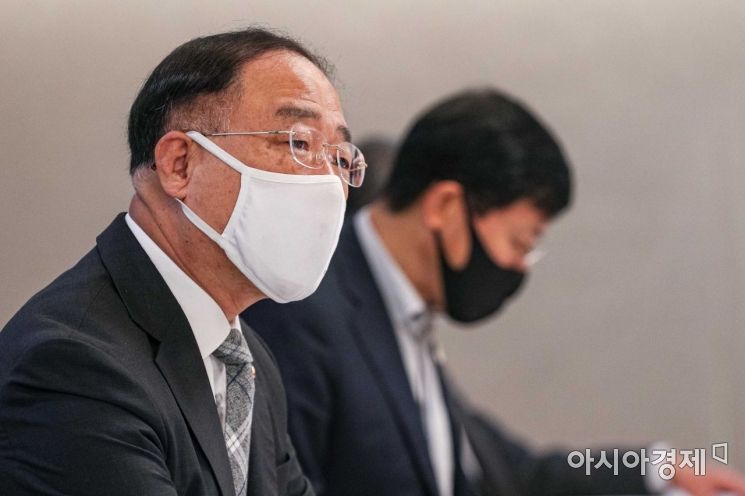 Hong Nam-ki, Deputy Prime Minister and Minister of Economy and Finance, is delivering opening remarks at the 'Real Estate Market Inspection Meeting of Related Ministers' held on the 23rd at the Government Seoul Office in Jongno-gu, Seoul. Photo by Kang Jin-hyung aymsdream@
[Asia Economy Reporter Moon Jiwon] This week, the apartment sale price increase rate in the Seoul metropolitan area has expanded compared to the previous week. Apartment sale prices in Seoul have also maintained a 0.01% increase rate for five consecutive weeks. Although the government believes that the effects of successive real estate measures will soon appear, the upward trend in sale and jeonse prices remains unchanged.
According to the weekly apartment price trend for the third week of September announced by the Korea Real Estate Board on the 24th, as of the 21st, apartment sale prices in the metropolitan area rose by 0.07%, an increase from 0.06% the previous week. The sustained rise in Seoul and Gyeonggi Province, along with the expanded increase rate in Incheon, is analyzed as the cause.
In Seoul, prices rose by 0.01% this week, maintaining the same increase rate for five consecutive weeks. The Korea Real Estate Board explained, "Due to the 7·10 measures and 8·4 supply measures, as well as concerns about economic contraction caused by COVID-19, a wait-and-see stance is observed, but the upward trend continued mainly for apartments priced below 900 million KRW and small to medium-sized units."
Due to increased property tax burdens, Seocho and Songpa Districts (0.00%) remained flat, but Gangnam and Gangdong Districts (0.01%) continued to rise mainly in new complexes. The increase rates expanded in Jungnang District (0.01%→0.02%), Seongbuk District (0.00%→0.01%), Nowon, Gangseo, and Guro Districts (0.01%→0.02%), and Gwanak District (0.02%→0.03%).
The apartment sale price increase rate in Incheon expanded from 0.04% last week to 0.05% this week. Michuhol District (0.16%) rose mainly in Dohwa-dong and Juan-dong, which have good transportation environments, and Bupyeong District (0.11%) increased mainly in Samsan and Bugae-dong, benefiting from the Line 7 extension.
Gyeonggi Province maintained a 0.10% increase rate. Yongin Giheung (0.27%) and Suji District (0.23%) rose in station areas with good transportation access, and Goyang City Deogyang District (0.23%) increased mainly in new complexes in Sinwon-dong and older complexes in Hwajeong-dong. However, Dongducheon City (-0.04%) continued to decline due to decreased demand in aging complexes such as Saengyeon-dong, and Yeoju City (-0.04%) also continued to decline mainly in older complexes.
Deputy Prime Minister and Minister of Economy and Finance Hong Nam-ki held the 7th real estate market inspection meeting at the Government Seoul Office the day before and said, "A calming trend in sales sentiment, which precedes housing market prices, is appearing," but the housing prices do not seem to be shifting to a downward trend easily.
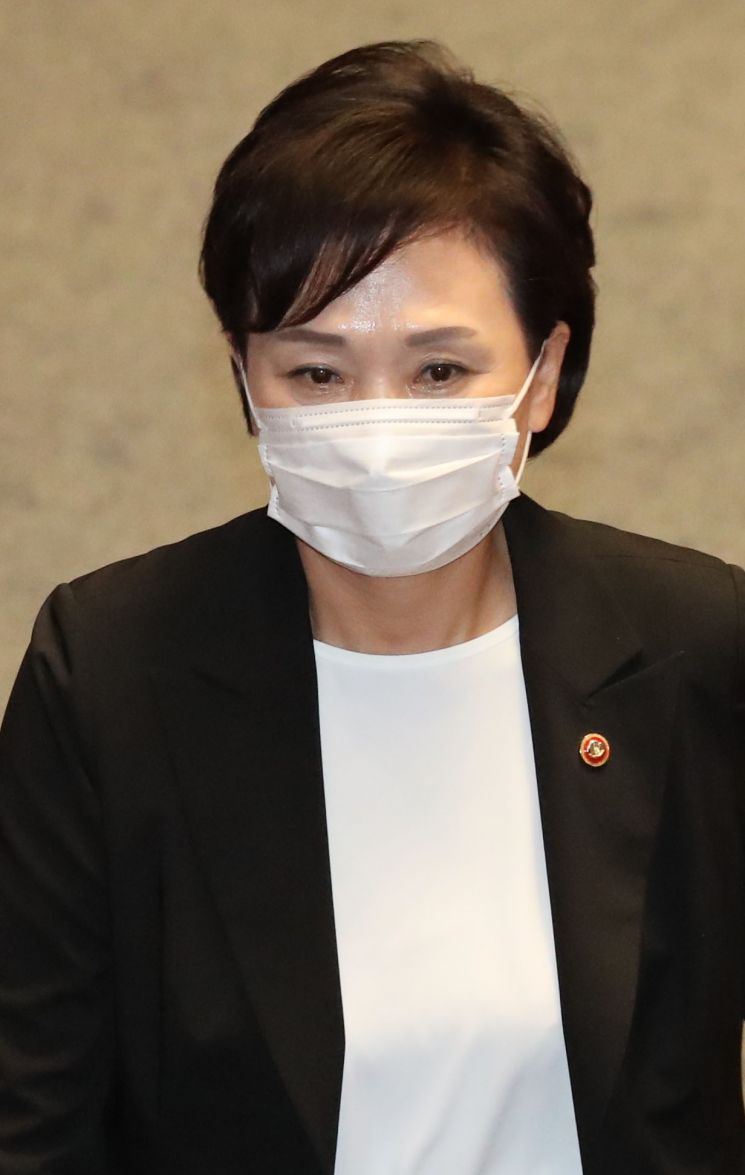 Minister of Land, Infrastructure and Transport Kim Hyun-mi is returning to her seat after answering questions during the economic sector government inquiry at the National Assembly plenary session on the 16th. (Photo by Yonhap News)
Apartment jeonse prices, which have been soaring since the implementation of the two lease laws, continue to rise. Seoul apartment jeonse prices rose 0.08% this week, down from 0.09% last week, but have increased for 65 consecutive weeks.
The Korea Real Estate Board analyzed, "Due to the low interest rate trend, the implementation of the rent ceiling system and the right to request contract renewal, and the autumn moving season, the upward trend continued mainly in station areas with good location conditions. However, due to the rapid rise, a pause was observed, and the increase rate narrowed."
Deputy Prime Minister Hong said about jeonse prices the day before, "The rate of increase has somewhat slowed down," and predicted, "Whether market expectations for follow-up real estate policy measures are additionally reflected will be the key to the speed of stabilization."
In Seoul, the upward trend was clear in Gangdong District (0.13%), Songpa District (0.12%), and Gangnam District (0.09%). Dongjak District (0.08%) saw jeonse price increases mainly in Noryangjin and Sindaebang-dong station areas, Yangcheon District (0.07%) in Mokdong New Town with good educational environments, and Gangseo District (0.07%) mainly in Magok District.
Sejong, which showed a sharp rise of 2.15% in jeonse prices last week, rose 1.48% this week. Due to the continued shortage of jeonse listings, prices rose mainly in Jochiwon-eup and Goun and Dajeong-dong, but overall the increase rate narrowed compared to last week.
© The Asia Business Daily(www.asiae.co.kr). All rights reserved.


















