Professor Hyeon Taek-hwan of Seoul National University, Mentioned as a Nobel Chemistry Prize Candidate
Challenged Nanoscience 20 Years Ago, Now a Leading Nobel Prize Contender
Currently Developing Nanoparticles for Intractable Disease Treatment
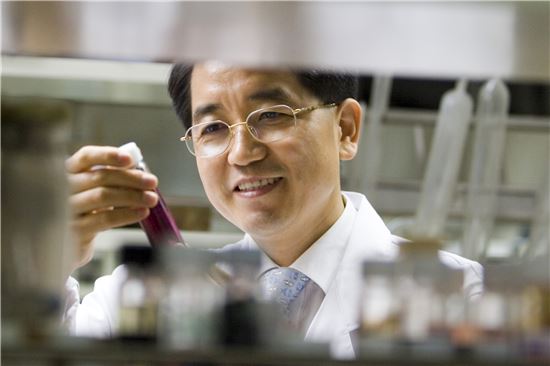 Hyuntaek Hwan, Distinguished Professor at Seoul National University (Director of the Nanoparticle Research Division, Institute for Basic Science)
[Asia Economy Reporter Junho Hwang] "If you want to become somebody special, take on challenges."
Hyun Taek-hwan, Distinguished Professor at Seoul National University and Director of the Nanoparticle Research Group at the Institute for Basic Science, who has been selected as one of the leading candidates for this year's Nobel Prize in Chemistry, stated in an interview with Asia Economy on the 24th, "If you want to achieve accomplishments, you must take on challenges."
Korean Selected as a Leading Candidate for the Nobel Prize
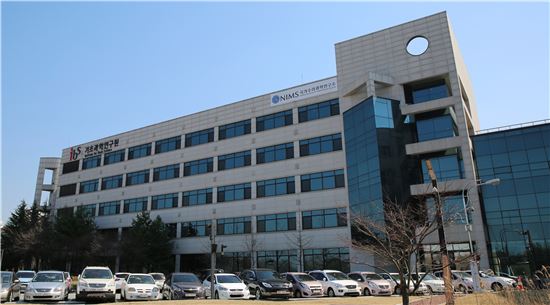 ▲Institute for Basic Science
Professor Hyun is a candidate for this year's Nobel Prize in Chemistry, selected by Clarivate Analytics (CA), which identifies highly cited researchers as potential Nobel laureates. Among 24 candidates from six countries, he is the only Korean on the list. Since 2002, only four Koreans, including Professor Hyun, have been named candidates among 336 individuals. Of those identified by CA, 52 have actually won the Nobel Prize.
Although Professor Hyun earned his Ph.D. in sonochemistry, he ventured into nanoscience and emerged as a world-renowned scholar. His 2001 paper published in the Journal of the American Chemical Society, the most prestigious journal in chemistry, on "a method for synthesizing uniform nanoparticles by gradually increasing temperature at room temperature," has been cited 1,660 times. In 2004, another paper published in the esteemed journal Nature Materials on the mass synthesis of uniform nanoparticles attracted about 3,000 citations from scientists, earning him the title of a leading candidate for the Nobel Prize in Chemistry. The nanoparticle manufacturing method he proposed is used to mass-produce quantum dots, semiconductors that produce color in QLED displays, in desired sizes.
He said, "When I was appointed as a professor at Seoul National University, I made a decision to challenge a new field and jumped into nanoscience research. It was quite challenging, but it was worth it." He added, "Even when I conduct assistant professor evaluations at MIT, the most important factor I consider is whether the candidate has taken on new challenges. I always emphasize new challenges to my juniors and students."
Next Challenge: Solving Intractable Diseases
However, he showed humility regarding the actual Nobel Prize award. He explained, "Professor Moungi Bawendi of MIT, who was also named a leading candidate this time, and Christopher Murray, a professor at the University of Pennsylvania and Bawendi's first student, are those who demonstrated the ability to produce uniform nanoparticles. Before them, there were senior scholars who proposed the principles that made this possible. If any of my seniors receive the Nobel Prize, then I might consider it next."
His focus is on the next challenge. Professor Hyun said, "I am currently taking on a new challenge to treat intractable diseases for which there are no FDA-approved drugs." He emphasized, "We have developed nanoparticles that can be used as MRI contrast agents and have successfully conducted experiments on primates." This year's Nobel Prizes will be announced from the 5th to the 12th of next month, starting with the Physiology or Medicine Prize.
© The Asia Business Daily(www.asiae.co.kr). All rights reserved.
![User Who Sold Erroneously Deposited Bitcoins to Repay Debt and Fund Entertainment... What Did the Supreme Court Decide in 2021? [Legal Issue Check]](https://cwcontent.asiae.co.kr/asiaresize/183/2026020910431234020_1770601391.png)















