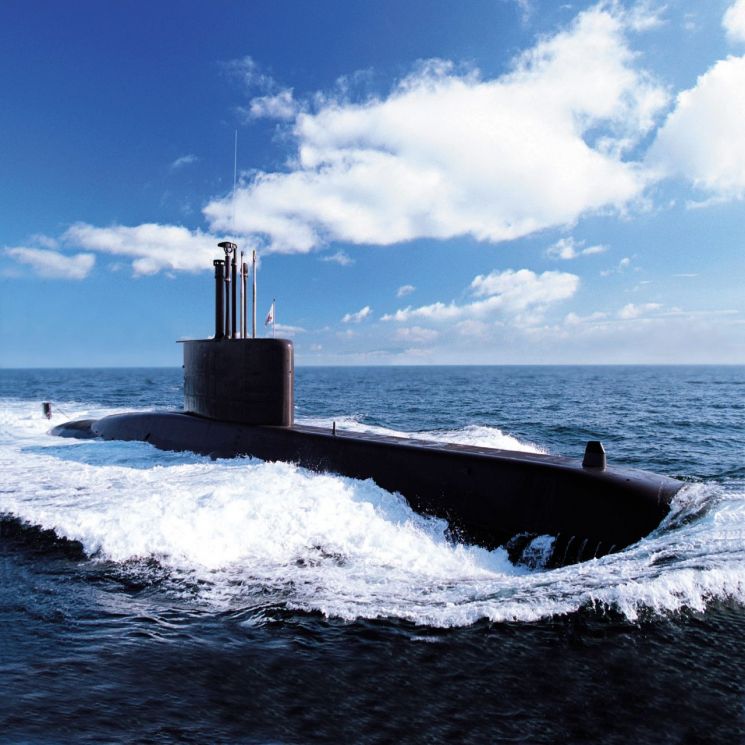
[Asia Economy Yang Nak-gyu, Military Specialist Reporter] Starting next month, a prototype of the lithium-ion battery to be installed in the Jangbogo-III Batch-II submarines will be produced. The prototype of the next-generation submarine power lithium-ion battery will be made for performance verification tests by the first half of next year, and once production is completed, full-scale performance testing will begin.
According to the Defense Acquisition Program Administration on the 24th, the lithium battery for the 3,600-ton Jangbogo-III Batch-II submarine is being developed by Samsung SDI, with Hanwha Defense integrating the entire system, and Daewoo Shipbuilding & Marine Engineering installing this system on the submarine. Three Jangbogo-III Batch-II submarines equipped with lithium-ion batteries are scheduled to be built from 2025 to 2027.
The lithium-ion battery uses lithium for the battery's anode plate, and compared to lead, manganese, and mercury batteries, it has a significantly longer lifespan. Installing lithium-ion batteries on submarines greatly improves energy density, battery life, submerged endurance, and maintenance convenience compared to the existing lead-acid battery system.
Currently, major countries around the world regard lithium batteries as the next-generation growth engine and are competitively investing in technology. South Korea is leading in the field of large-capacity energy storage system (ESS) lithium battery technology, including electric vehicle batteries. Unlike primary batteries, which are disposable, secondary lithium batteries can be recharged and reused. Russia's decision to jointly design next-generation submarines with China is also because China possesses lithium battery technology for diesel submarine power systems.
The development of lithium-ion batteries is also expected to aid exports. India is currently undertaking a next-generation submarine project to replace all 12 aging submarines with 18 new Air-Independent Propulsion (AIP) submarines. This project alone is worth $7.5 billion (approximately 8.92 trillion KRW), and Daewoo Shipbuilding & Marine Engineering is a strong candidate. There is a high possibility that lithium-ion batteries will be exported along with the submarines.
A military official stated, "Once the prototype is made, it will undergo rigorous tests such as flame tests (800°C) and seawater immersion tests (1 hour) to ensure that the lithium-ion battery does not explode inside the submarine," adding, "After additional verification of performance and safety at the land test site, it will be installed."
© The Asia Business Daily(www.asiae.co.kr). All rights reserved.

















