[Asia Economy Reporter Hwang Yoon-joo] Samsung Heavy Industries is preparing for the 'post-LNG' era by consecutively unveiling various eco-friendly ship fuel propulsion technologies that can actively respond to decarbonization demands.
On the 24th, Samsung Heavy Industries announced that it had obtained the Approval in Principle (AIP) from Lloyd's Register (LR) in the UK for the 'Ammonia Propulsion A-Max Tanker.' The A-Max (Aframax) tanker refers to crude oil carriers with a deadweight tonnage (DWT) of 85,000 to 125,000, which are the most in demand and economically efficient.
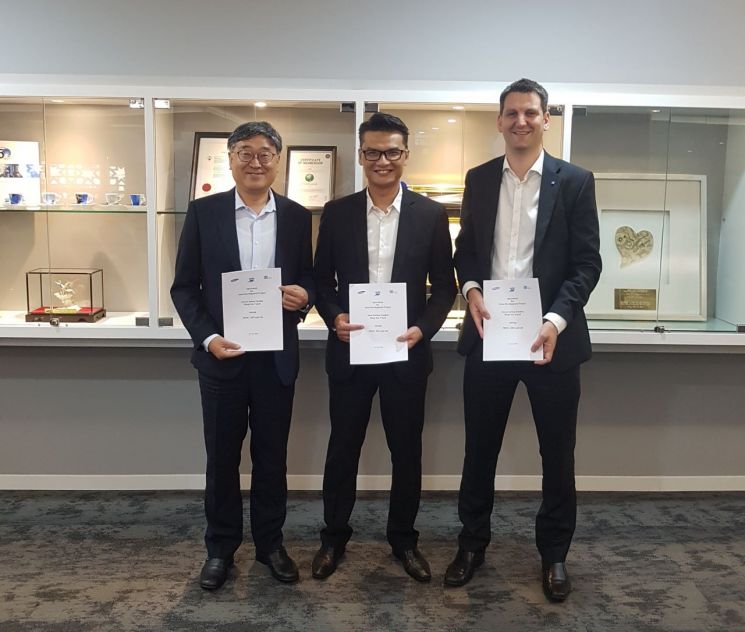
The ammonia propulsion A-Max tanker is a future eco-friendly ship jointly developed since July last year by Samsung Heavy Industries together with Malaysia's shipping company MISC, the global ship engine manufacturer MAN, and Lloyd's Register in the UK, all of whom possess technological leadership in their respective fields.
Based on this basic certification, Samsung Heavy Industries plans to commercialize the ship in 2024 after developing an independent ammonia fuel supply system and detailed ship design.
Ammonia (NH3) is a synthetic compound of nitrogen (N2) and hydrogen (H2) that emits no carbon dioxide during combustion, making it a clean alternative fuel. It is attracting attention as one of the suitable ship fuels for the decarbonization era due to its stable supply and relatively easy storage, transportation, and handling. The International Energy Agency (IEA) projected in its 2020 Energy Outlook report that the use of ammonia, hydrogen, and other fuels in shipping will gradually increase, with over 60% of new ships using these fuels by 2060, and ammonia expected to account for nearly half of that share.
Yoon Jong-hyun, Executive Vice President and Head of Ship Design and Drilling at Samsung Heavy Industries, said, "The ammonia propulsion ship development project led by Samsung Heavy Industries involves all stakeholders from fuel suppliers to operating shipping companies, so we expect not only technological progress but also commercial results within a short time."
Meanwhile, the International Maritime Organization (IMO) is moving closer to enforcing regulations in 2025 that require at least a 30% reduction in ship greenhouse gas emissions compared to 2008 levels, and is discussing further strengthening regulations to achieve a 70% reduction by 2050.
Accordingly, Samsung Heavy Industries has been securing leadership in next-generation eco-friendly ship technologies by consecutively pioneering technologies such as the localization of lithium-ion battery systems for ships in collaboration with Samsung SDI and the world's first fuel cell crude oil carrier development with US-based Bloom Energy, thereby securing dominance in eco-friendly fuel technologies beyond LNG.
© The Asia Business Daily(www.asiae.co.kr). All rights reserved.

















