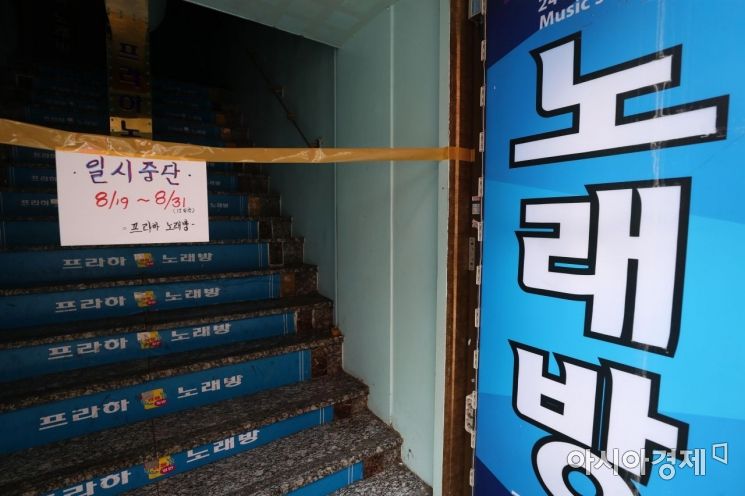
 On the 19th of last month, the government strengthened social distancing measures in the Seoul metropolitan area to curb the explosive spread of the novel coronavirus infection (COVID-19). The photo shows the scene of the Youth Street in Jonggak, Seoul on that day. Photo by Moon Honam munonam@
[Asia Economy Reporter Moon Hyewon] The Ministry of SMEs and Startups announced on the 24th that it will promptly supply 300 billion KRW in emergency management stabilization funds included in the 4th supplementary budget to support small and medium-sized enterprises (SMEs) struggling due to the impact of the novel coronavirus infection (COVID-19).
Since February 13, the Ministry has allocated and supplied a total of 1 trillion KRW in emergency management stabilization funds through August. Of the additional 300 billion KRW from this supplementary budget, 200 billion KRW will be supplied additionally to companies experiencing decreased sales.
The loan targets are SMEs affected by COVID-19 whose sales have decreased by 10% or more or are expected to decrease. The loan interest rate is 2.15%, and a rate of 1.9% is applied to companies located in special disaster areas. The loan period is a 5-year installment repayment including a 2-year grace period during which only interest is paid. The loan limit per company is up to 1 billion KRW, and it cannot exceed 1.5 billion KRW over three years.
Additionally, due to the resurgence of COVID-19, 100 billion KRW out of the 300 billion KRW supplementary budget will be provided to SMEs operating high-risk facilities (service industry companies with five or more regular employees) that face restrictions on business activities due to assembly bans or limitations.
The loan targets are SMEs with five or more regular employees operating in 12 high-risk facility types, excluding entertainment establishments such as nightclubs and colatecs, including emotional bars, hunting pochas, buffets, karaoke rooms, PC rooms, indoor group exercise facilities, indoor standing concert halls, direct sales promotion centers such as door-to-door sales, large academies with over 300 students, and danranjumeok (private bars).
For these high-risk facility industries, the loan interest rate will be set at 1.5% to further ease financial burdens. The loan period (2-year grace, 5-year installment repayment) and loan limit per company (up to 1 billion KRW, within 1.5 billion KRW over three years) remain the same.
SMEs with short-term delinquency history at financial institutions but not in long-term financial distress (such as two consecutive years of deficits) will be allowed support if the delinquency is resolved at the time of loan support.
The Korea SMEs and Startups Agency (KOSME) will assign dedicated personnel called Ambulance Men at 32 regional headquarters nationwide to immediately decide on necessary funds during on-site inspections by exercising delegated authority. Additionally, through simplified fast-track loan screening indicators, companies will be relieved from evaluation burdens.
Park Young-sun, Minister of SMEs and Startups, said, “We reflected additional funds in this 4th supplementary budget to respond to the financial difficulties voiced by SMEs in the field. We hope these funds will help overcome temporary liquidity crises caused by COVID-19 and normalize business operations, and that SMEs will play a significant role in the economic rebound.”
© The Asia Business Daily(www.asiae.co.kr). All rights reserved.

















