70% of Total Heating and Cooling Supplied Environmentally Friendly... First Attempt in Domestic Public Infrastructure
Annual Reduction of 1000 CO₂t Greenhouse Gases and 300 Million KRW Savings in Electricity and Operating Costs
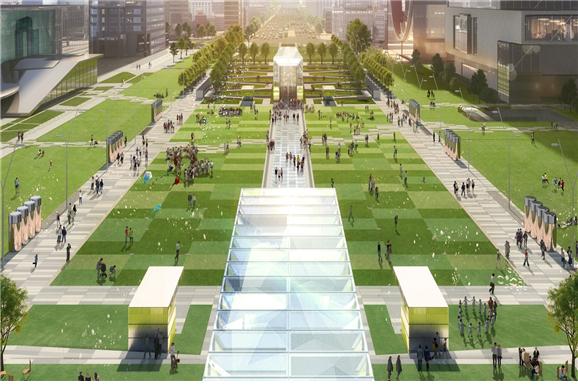
[Asia Economy Reporter Jo In-kyung] The Seoul Metropolitan Government will introduce renewable 'hydrothermal energy' using Han River water to establish an eco-friendly heating and cooling system at the 'Yeongdong-daero Complex Transfer Center (artist's rendering),' scheduled for completion in 2027.
To this end, Seoul announced that on the 24th it will sign a business agreement with Korea Water Resources Corporation focusing on the use of raw water from the metropolitan pipeline.
The hydrothermal energy system is a new eco-friendly heating and cooling technology that utilizes the characteristic of water temperature being lower than the air in summer and warmer in winter. It operates on the principle of using metropolitan raw water from the Han River water pipeline passing near the Yeongdong-daero Complex Transfer Center, exchanging the heat (energy) of river water with indoor heat or cold through a heat exchange device called a 'heat pump' to provide heating and cooling.
While hydrothermal energy has been introduced in the private sector, such as at Seoul Lotte World Tower, Seoul is the first in the country to adopt it in public infrastructure.
The city plans to supply about 70% of the heating and cooling for the Yeongdong-daero Complex Transfer Center using hydrothermal energy. In this case, it is expected to reduce greenhouse gas emissions by about 1,000 tons of carbon dioxide (CO₂t) annually compared to using district heating, and save about 300 million KRW annually in operating costs such as electricity fees required for heating and cooling operations in large underground spaces.
Unlike other renewable energies such as fuel cells, there is no need to secure large-scale land, resulting in cost savings of about 20.5 billion KRW in land compensation and installation construction costs. Additionally, since cooling towers installed outside buildings for heating and cooling large facilities are unnecessary, it is expected to provide citizens with a noise- and vibration-free green plaza and alleviate the urban heat island effect.
Under this agreement, Seoul and Korea Water Resources Corporation will cooperate on ▲priority application of hydrothermal energy within the Yeongdong-daero Complex Transfer Center ▲stable supply of metropolitan raw water and technical support ▲formation of a working-level consultative body for project promotion ▲creation of eco-friendly urban spaces. Also, they plan to gradually conclude basic and implementation agreements to specify project details and install and operate the hydrothermal energy heating and cooling system.
The Yeongdong-daero Complex Transfer Center will integrate five railway lines and surface buses planned to pass through Yeongdong-daero, supporting the public transportation system of the Southeast International Exchange Complex District, and will be filled with various contents such as culture, performances, and exhibitions.
© The Asia Business Daily(www.asiae.co.kr). All rights reserved.

















