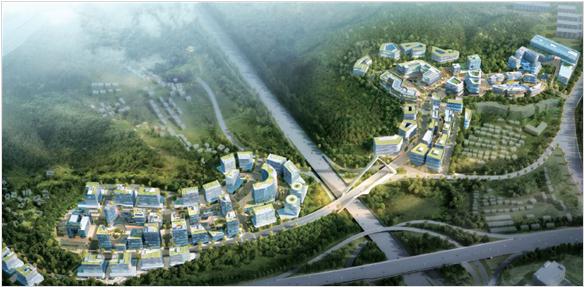
[Asia Economy Reporter Moon Jiwon] The government is creating a 'Second Pangyo 2 Techno Valley' in major provincial cities. The plan is to revitalize the regional economy by establishing urban convergence special zones equipped with excellent integrated infrastructure for industry, housing, and culture.
On the 23rd, the Ministry of Land, Infrastructure and Transport announced at the 27th National Balanced Development Committee plenary meeting that it reported the urban convergence special zone creation plan as a joint agenda with the Ministry of SMEs and Startups.
The urban convergence special zone project aims to create high-density innovation spaces similar to Pangyo 2 Valley in the downtown areas of provincial metropolitan cities to attract companies and talent.
Pangyo 2 Valley is a space created through cooperation among five ministries including the Ministry of Land, Infrastructure and Transport, the Ministry of Science and ICT, and the Ministry of Culture, Sports and Tourism, currently housing about 450 startup and venture companies.
The government plans to implement pilot projects for urban convergence special zones in provincial metropolitan cities and then consider expanding to provincial cities with populations over 500,000.
The urban convergence special zones are modeled after innovation districts established through public or public-private collaboration, such as Poblenou in Barcelona, Cortex Innovation District in St. Louis, USA, and One-North district in Singapore.
The Ministry of Land, Infrastructure and Transport expects the urban convergence special zones to be a starting point for restoring regional competitiveness. To this end, they plan to organize spaces by integrating industry, housing, and cultural projects tailored to regional characteristics and prepare integrated programs including various supports for attracting companies.
The Ministry of SMEs and Startups will prioritize pilot projects utilizing existing policies in cooperation with relevant local governments when there is demand for relocating innovative companies to provinces, and plans to establish new projects based on future outcomes.
The government will form an inter-ministerial consultative body centered on the National Balanced Development Committee to prepare detailed support measures. At the same time, it will begin identifying pilot project sites in consultation with five metropolitan cities.
Park Mu-ik, Director General of the Land and Urban Office at the Ministry of Land, Infrastructure and Transport, said, "We expect the urban convergence special zones to be a turning point that opens new paths for the regional economy," adding, "Efforts to concentrate capabilities without departmental barriers and cooperation with local governments are important."
© The Asia Business Daily(www.asiae.co.kr). All rights reserved.

















