272 in Favor, 1 Against, 9 Abstentions
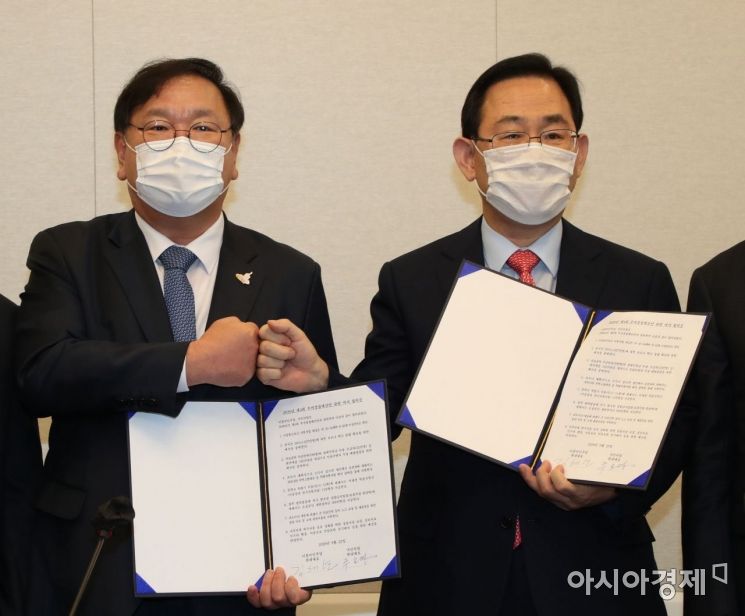 On the 22nd, at the National Assembly, Kim Tae-nyeon, floor leader of the Democratic Party of Korea, and Joo Ho-young, floor leader of the People Power Party, exchanged greetings after reaching an agreement on the 4th supplementary budget bill. The ruling and opposition parties agreed to selectively support communication expenses based on age and to provide special childcare allowances to middle school students. Photo by Yoon Dong-joo doso7@
[Asia Economy Reporter Park Cheol-eung] On the 22nd, the National Assembly held a plenary session and passed the 4th supplementary budget bill amounting to 7.8 trillion won. Among the 282 members present, 272 voted in favor, 1 against, and 9 abstained.
The original government proposal of 7.8444 trillion won was reduced by 617.7 billion won and increased by 588.1 billion won, resulting in a net decrease of 29.6 billion won to 7.8148 trillion won. The explanation was that necessary increases were made to ensure fairness so that no one suffering from the damage caused by the novel coronavirus infection (COVID-19) would be excluded from support, and that the additional fiscal burden was avoided by reallocating funds within the government's proposed budget.
The budget includes 183.9 billion won to secure COVID-19 vaccine supplies for 10.37 million people, about 20% of the entire population, and 31.5 billion won for free influenza vaccines for 1.05 million vulnerable groups including persons with disabilities to prevent the "twindemic."
Also included is 207.4 billion won to provide non-face-to-face learning support funds (150,000 won) to middle school students (approximately 1.38 million), who were initially excluded from care cost support, and 81 billion won to support corporate taxi drivers whose income has decreased with 1 million won per person to ensure fairness between corporate and individual taxi drivers.
Additionally, 64 billion won was allocated to provide 2 million won each to certain restricted businesses (entertainment bars and colatecs) that actively cooperated with government quarantine policies but were excluded from disaster relief payments, and 4.7 billion won was expanded for strengthening protection budgets for at-risk children to prevent tragic incidents like recent "COVID isolation" cases.
On the other hand, the support for mobile communication fees, originally planned to provide 20,000 won per person to all citizens aged 13 and older nationwide, was reduced by 520.6 billion won by limiting the eligible age group to those aged 16 to 34 and those 65 and older. Furthermore, unnecessary expenditures such as 39.6 billion won for national bond interest repayments and 7.5 billion won for administrative support costs were minimized.
The National Assembly also adopted eight supplementary opinions, including urging the government to actively review measures to improve financial support for small business owners and self-employed individuals, as well as tax support and rent burden relief.
© The Asia Business Daily(www.asiae.co.kr). All rights reserved.

















