[Asia Economy Reporter Park Byung-hee] It has been confirmed that sales of Korean novels significantly increased in 2020, the year when the novel coronavirus disease (COVID-19) completely changed our daily lives.
Kyobo Bookstore announced on the 22nd that sales of Korean novels from January 1 to September 20 this year rose by 30.1% compared to the previous year, marking the highest growth rate ever recorded. The sales volume of Korean novels also surpassed the previous record set in 2012 by 4.3%, setting a new all-time high.
Among Korean novels, sales of drama/movie novels increased significantly. Thanks to the popularity of fairy tale books introduced in the drama "Psycho But It’s Okay," sales of drama/movie novels increased about ninefold compared to last year. Sales of SF/science fiction novels increased about 5.5 times, and sales of youth novels doubled.
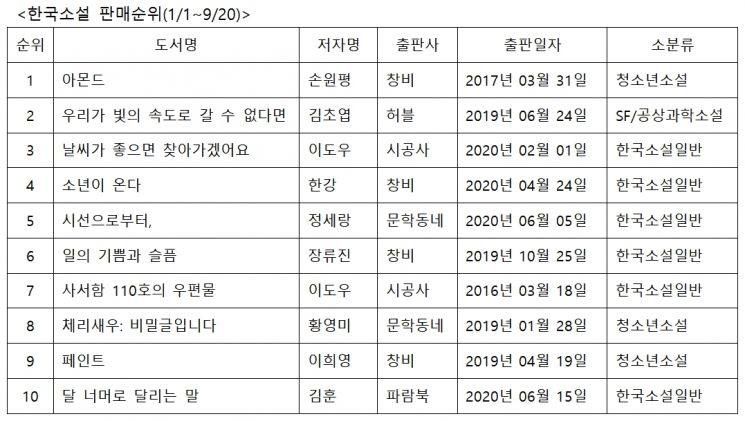
The best-selling Korean novel was confirmed to be "Almond" by author Sohn Won-pyung. Following "Almond" were "If We Cannot Travel at the Speed of Light" and "I’ll Go to You When the Weather Is Nice."
The strong sales of Korean novels were led by women. This year, the purchase ratio of women reached 69.9%, up 5.2 percentage points from 64.7% last year. By age group, the proportion of women in their 20s to 40s expanded evenly.
Kim Hyun-jung, head of bestsellers at Kyobo Bookstore, said, "In 2012, sales were mainly focused on drama/movie original novels to the extent that the term ‘screen seller’ emerged, but this year, various types of books are being sold. Even if there is no mega bestseller, new authors are making new attempts in fields such as youth novels and SF novels, and readers are responding positively to these attempts, which bodes well for the Korean novel market."
The share of Korean novels within the novel category fell to 26.7% in 2015 but rose to 37.4% this year, a figure similar to that of 2012. English and American novels accounted for 24.0%, Japanese novels 16.4%, and novels from other countries 22.2%, which are also similar levels to those in 2012.
© The Asia Business Daily(www.asiae.co.kr). All rights reserved.

















