RDA Plans to Ship Containerized Cargo on Araon Ship Next Month
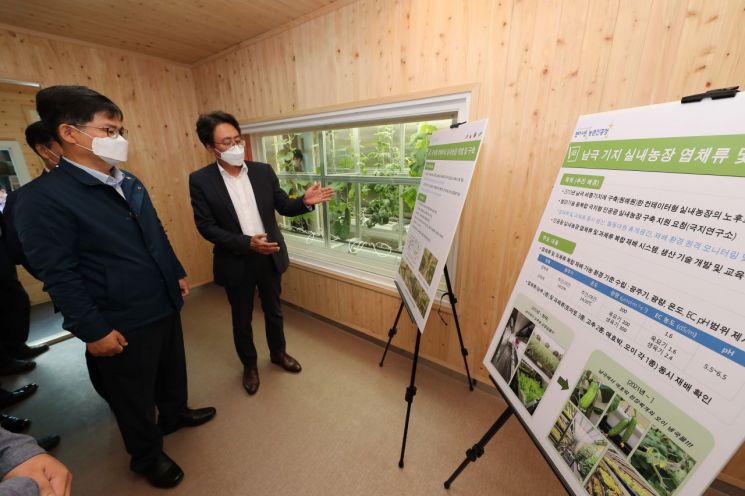 On the 22nd, Heo Tae-woong, Administrator of the Rural Development Administration, visited a smart farm company located in Pyeongtaek, Gyeonggi-do, which is producing a plant factory to be sent to the King Sejong Station in Antarctica, and inspected the interior of the plant factory.
[Sejong=Asia Economy Reporter Kim Hyunjung] The Rural Development Administration announced on the 22nd that, following 2010, it will send a plant factory to the Antarctic King Sejong Station at the end of next month, and once installation is complete, it will begin full-scale operation. The Rural Development Administration has completed preparations to load the plant factory onto the icebreaker research vessel Araon in cooperation with the Korea Polar Research Institute and is awaiting the departure date for Antarctica.
The project to send a plant factory to Antarctica was on the verge of cancellation due to difficulties in securing air or sea transport caused by the COVID-19 pandemic. However, thanks to the bold decision by the Korea Polar Research Institute, related procedures have accelerated.
The plant factory, which will supply fresh vegetables to the personnel at the King Sejong Station in Antarctica, is in the form of an international standard 40-foot container (12×2.4m) and is larger than the plant factory sent in 2010. In addition to leafy vegetables, new functions have been added to simultaneously cultivate fruit vegetables such as chili peppers, tomatoes, cucumbers, and zucchini, which were difficult to grow in the previous plant factory.
Before sending the plant factory, the Rural Development Administration provided training on fresh vegetable cultivation methods to the overwintering researchers at King Sejong Station, led by a specialized plant factory industry group. Once the plant factory capable of cultivating both leafy and fruit vegetables is fully operational, it will be able to produce about 1.5 to 2 kg of leafy vegetables per day.
The fresh vegetables harvested from the plant factory will be provided to the overwintering researchers who, while able to consume vegetables imported from Chile during the summer, have been unable to eat vegetables for nearly six months during the winter due to lack of transportation. The plant factory uses light-emitting diodes (LEDs) as artificial light to minimize energy consumption and is designed to adjust light intensity according to the type of plant and growth stage.
Additionally, smart farm technology has been applied to remotely monitor the cultivation environment and growth status via video, facilitating smooth consultation with experts from the Rural Development Administration. Along with the plant factory, a container-type rest area with transparent windows will be sent so that the overwintering researchers can observe the vegetable cultivation process.
Heo Tae-woong, Administrator of the Rural Development Administration, said, "Despite the difficult conditions caused by COVID-19, we are honored to be able to send a plant factory containing our technology and experience to the special place of Antarctica," adding, "Once the situation improves, we plan to dispatch experts to provide technical support for any shortcomings."
© The Asia Business Daily(www.asiae.co.kr). All rights reserved.

















