[Asia Economy Reporter Jeong Dong-hoon] It has been found that hate speech based on political orientation or place of origin is perceived sensitively online.
On the 22nd, the National Human Rights Commission, Kakao, and the Korean Association for Media and Law announced the interim results of a joint citizen perception study on online hate speech containing such content. The Human Rights Commission began a joint study with Kakao and the Media Law Association last June to respond to the spread of hate speech online.
The Human Rights Commission explained the significance of this survey, stating, "Although various entities are working to find solutions to eradicate online hate speech, there is still a lack of social and academic discussion on what constitutes online hate speech, how the general public perceives hate speech, and how these perceptions differ from those of experts."
Professor Lee Seung-seon of Chungnam National University and Dr. Choi Jin-ho of Hanyang University conducted a survey of about 1,000 citizens regarding their judgments on hate speech, exposure experiences, and production experiences. The survey results showed that awareness levels of online hate speech disparaging political orientation, place of origin, gender, and disability were relatively high, whereas recognition of hate speech targeting race, ethnicity, nationality, religion, sexual orientation, and specific age groups was relatively low.
Sensitivity to hate speech also varied according to gender, age group, and education level.
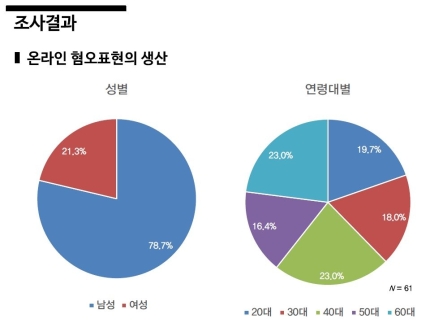
Comparing by gender, men were found to produce hate speech about 3.7 times more than women, showing a significant difference. The most common reason for producing hate speech was "actually thinking that way," accounting for 27.5% of responses, followed by "the other party first posted content criticizing the group I belong to" (21.1%). Survey participants recognized people with disabilities, women, sexual minorities, and the elderly as vulnerable victims of hate speech.
© The Asia Business Daily(www.asiae.co.kr). All rights reserved.
![Clutching a Stolen Dior Bag, Saying "I Hate Being Poor but Real"... The Grotesque Con of a "Human Knockoff" [Slate]](https://cwcontent.asiae.co.kr/asiaresize/183/2026021902243444107_1771435474.jpg)
















