Iran Officials Involved in Missile Cooperation with North Korea Included in Sanctions
"Most Iranian Missiles Based on North Korean Missile Designs"
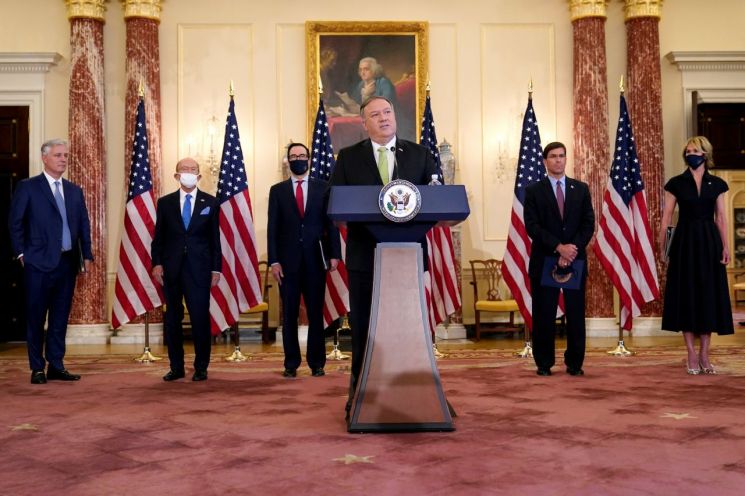
[Asia Economy Reporter Hyunwoo Lee] The Donald Trump administration in the United States has restored United Nations (UN) sanctions on Iran's nuclear, ballistic missile, and conventional weapons programs, including individuals involved in missile cooperation with North Korea among the sanction targets. This is interpreted as a measure to warn about the missile connection suspicions between North Korea and Iran and to prevent possible provocations by North Korea before and after the U.S. presidential election.
On the 21st (local time), Secretary of State Mike Pompeo held a press conference at the State Department headquarters in Washington DC along with Treasury Secretary Steven Mnuchin, Defense Secretary Mark Esper, Commerce Secretary Wilbur Ross, White House National Security Council (NSC) Advisor Robert O'Brien, and U.S. Ambassador to the UN Kelly Craft. He announced, "We are implementing measures to restore UN sanctions on Iran's nuclear, ballistic missile, and conventional weapons programs," adding, "We have placed key individuals, including the Iranian Ministry of Defense, and defense-related companies and organizations on the sanctions list."
Accordingly, 27 organizations and individuals related to Iran's nuclear weapons program, including Iranian scientists known to have been involved in uranium enrichment operations, were added to the sanctions list. Among them, some are known to have led missile development cooperation with North Korea. The U.S. State Department emphasized in explanatory materials on the sanctions list that two senior officials, Asghar Esmailpour of the Iran Aerospace Industries Organization (AIO) and Mohammad Gholami of the Iran Shahid Hemmat Industrial Group (SHIG), participated in the space launch vehicle project promoted with the support of North Korean missile experts. They publicly criticized the missile cooperation between North Korea and Iran and announced sanctions on those leading the cooperation.
Although the U.S. State Department did not present specific evidence or proof in the materials, it is interpreted as a warning that U.S. authorities are closely monitoring the connection suspicions between North Korea and Iran. Inside and outside U.S. authorities, suspicions of a connection that North Korea and Iran share ballistic missile and nuclear technology and are strengthening cooperation have been continuously raised. According to Voice of America (VOA), Bruce Bechtol, a professor at Angelo State University and former analyst at the Defense Intelligence Agency (DIA), pointed out, "The missile cooperation relationship between North Korea and Iran has continued since the 1980s, and most of Iran's liquid-fueled ballistic missiles were developed with North Korean support," adding, "Iran's Khorramshahr medium-range ballistic missile was based on North Korea's Musudan missile, and the space launch vehicle Safir used the Nodong missile as its first-stage propulsion."
The U.S. government also previously warned about the missile connection between the two sides when the U.S. Treasury Department sanctioned Iranian companies and individuals violating North Korea sanctions in 2016, stating, "In recent years, missile technicians from Iran's SHIG have been dispatched to North Korea to participate in work on 80-ton rocket propulsion systems."
© The Asia Business Daily(www.asiae.co.kr). All rights reserved.

















