Consensus on Auto Industry Restructuring and COVID-19 Crisis... This Year's Labor Negotiations Pass the 90% Mark
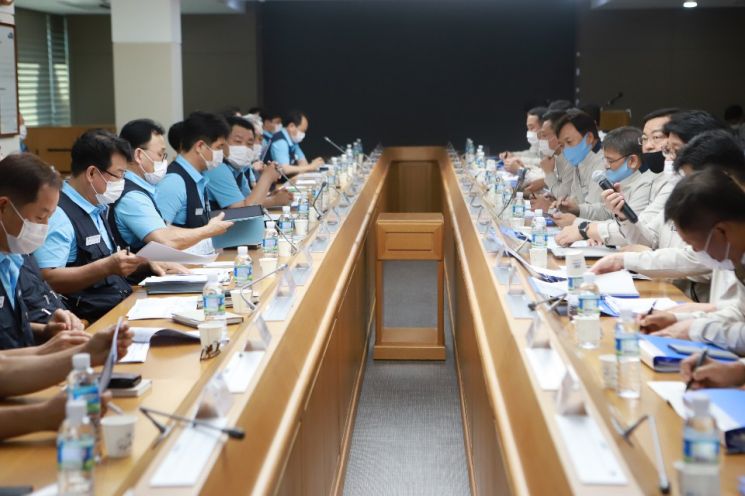
[Asia Economy Reporter Kim Ji-hee] Hyundai Motor Company's labor and management have reached a tentative agreement on this year's wage negotiations, centered on freezing the base salary. This is the first time in 11 years since the 2009 financial crisis that Hyundai has frozen base wages. This reflects a consensus between labor and management amid the restructuring of the automotive industry and the ongoing COVID-19 crisis this year. Attention is focused on whether this tentative agreement at Hyundai will accelerate wage and collective bargaining negotiations at other automakers such as Kia, Korea GM, and Renault Samsung.
According to industry sources on the 22nd, the Hyundai Motor Union plans to hold a vote on the tentative agreement, which centers on these terms, on the 25th. The tentative agreement prepared by Hyundai labor and management the previous day includes, besides the base salary freeze, a management performance bonus of 150%, a COVID-19 crisis relief bonus of 1.2 million KRW, 10 shares of employee stock ownership, and 200,000 KRW in traditional market gift certificates, amounting to an average payment of about 8.3 million KRW per union member. A Hyundai Motor official stated, "We focused on preparing an agreement to secure competitiveness and survival in the future car era amid the COVID-19 crisis and the major transformation of the automotive industry."
Hyundai's wage freeze marks the third time following the 1998 foreign exchange crisis and the 2009 financial crisis. Additionally, by reaching a tentative agreement without disputes for two consecutive years, including last year, Hyundai has set the second-ever record for consecutive dispute-free tentative agreements. Considering the COVID-19 crisis, Hyundai labor and management minimized the negotiation period. Only 40 days passed from the initial meeting on the 13th of last month to the tentative agreement.
In particular, this negotiation is meaningful in that labor and management focused on employment rather than wages in line with the restructuring of the industry centered on electric vehicles. Both sides had already reached an early consensus on job-related issues, such as the dedicated electric vehicle factory and total employment guarantees, which were the biggest topics this year. The jointly adopted "Social Declaration for Joint Labor-Management Development and Changes in Labor-Management Relations" is interpreted in the same context. The declaration mainly commits to joint efforts in ▲ securing future competitiveness of domestic factories and employment stability for current employees ▲ responding to changes in the future automotive industry, such as the expansion of electric vehicles ▲ operating job transition programs in preparation for future industrial changes.
It is also noteworthy that the union, which had previously taken a strike-oriented stance before the start of this year's wage negotiations, stepped back this year. The management proposed its first wage offer at the 11th main negotiation session held on the 17th, which included freezing the base salary and paying a performance bonus of 130% of the monthly ordinary wage plus 500,000 KRW. Subsequently, through practical negotiations, the parties reached a consensus by slightly increasing the performance bonus and relief bonus from the initial proposal while maintaining the base salary freeze.
This tentative agreement has lit a green light for concluding wage negotiations before Chuseok. However, the upcoming union member vote scheduled for the 25th remains a variable. Some hardliners within the union have expressed dissatisfaction with the base salary freeze, so the possibility of rejection in the vote cannot be completely ruled out. On that day, the union plans to hold explanatory meetings for delegates and union members regarding the tentative agreement.
An industry insider said, "Given the global contraction in automobile demand, the union likely judged that protecting employment was the best course," adding, "Especially amid the COVID-19 crisis, negative public opinion about ongoing conflicts between labor and management probably also acted as a burden."
Meanwhile, unlike Hyundai, other domestic automakers such as Kia and Korea GM have yet to find a breakthrough in their negotiations. Kia, which only held its initial wage and collective bargaining meeting at the end of last month, appears to be at a standstill. Disagreements remain unresolved on several key issues, including a monthly base wage increase of 120,304 KRW, performance bonuses, and securing employment related to future vehicles. Kia plans to hold its 5th main negotiation session on the 24th. Korea GM labor and management have been at odds since the union declared a breakdown in negotiations on the 11th in response to management's first proposal. With the union already initiating procedures to secure the right to strike, a strike possibility after Chuseok is even being anticipated.
© The Asia Business Daily(www.asiae.co.kr). All rights reserved.

















