IPO Stocks Struggle to Avoid Weakness After Listing
Many Stocks Fall Below Offering Price
Caution Urged Against Blind Investments
[Asia Economy Reporter Ko Hyung-kwang] Following the successful IPOs of SK Biopharm and Kakao Games, investors are flocking to IPO stocks. Despite subscription rates reaching 'thousands to one' and trillions of won in subscription deposits pouring in, many newly listed companies are struggling with weak stock prices contrary to expectations. Experts unanimously warn that since stock prices do not always rise immediately after listing, 'blind investments' are risky.
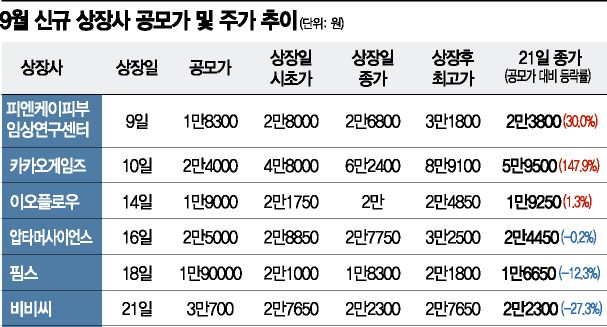
According to the Korea Exchange on the 22nd, BBC, which was listed on the KOSDAQ market the previous day, opened at 27,650 won, below its offering price of 30,700 won. The opening price is usually set between 90% and 200% of the offering price on the first day of listing, but BBC’s opening price was at the lowest end of that range, 90.0%. The stock price steadily declined during trading and closed at 22,300 won, down 19.3% from the opening price. The closing price on the first day was 27.3% lower than the offering price.
BBC, a dental care specialist company based on fine fiber materials, attracted high investor interest, recording a demand forecast competition rate of 977.5 to 1 among institutional investors before listing. A representative from Mirae Asset Daewoo, which underwrote the listing, said, "More than 99% of the demand forecast participation volume offered prices above the top of the price band," leading to the offering price being set at the highest end of the expected price band. Although the general subscription rate was also high at 464.1 to 1, the stock price failed to avoid weakness after listing.
PIMS, which was listed on the 18th, saw its stock price rise to 21,800 won during the first day but closed at 18,300 won, below its offering price of 19,000 won. On the following day, the stock fell another 9.0% to 16,650 won, a 12.3% drop from the offering price. PIMS, an organic light-emitting diode (OLED) mask manufacturer, recorded a demand forecast competition rate of 1,210.2 to 1, with the offering price set at the highest end of the expected band at 19,000 won. The subscription rate was also high at 1,162.02 to 1, but the stock price has struggled since listing.
The closing price of Aptamer Science, listed on the 16th, was 24,450 won the previous day, below its offering price of 25,000 won. Although individual investors drove the price up to 32,500 won on the first day, foreign and institutional investors sold off, causing the price to fall. Aptamer Science, a new drug development platform company based on nucleic acid aptamers, finalized its offering price at the top of the expected band (20,000 to 25,000 won) at 25,000 won during the demand forecast conducted for institutional investors on the 2nd and 3rd. The general subscription held on the 7th and 8th recorded a competition rate of 1,251.2 to 1, with about 4 trillion won in deposits collected, showing high interest, but the stock price performance has not met expectations.
Kakao Games recorded a 'ttasang-sang' (opening price double the offering price followed by two consecutive limit-up days) after listing and at one point rose to 89,100 won, more than 270% above the offering price of 24,000 won. However, the stock price has declined for seven consecutive trading days and is currently down more than 35% from its peak.
Following the IPO fever sparked by SK Biopharm and Kakao Games, individual investors have been pouring into IPO stocks, but many recently listed stocks, such as BBC and PIMS, are causing losses rather than profits. This is why caution is needed for individual investors who engage in blind investments hoping for a 'second SK Biopharm or Kakao Games.'
Investing in IPO stocks is attractive because it offers the potential for significant short-term capital gains with a small amount of money. Unlike real estate, which has strict subscription conditions, anyone can participate by simply opening a securities account, and the initial investment cost is relatively low compared to real estate, making it highly accessible. Additionally, subscription deposits not allocated after the IPO are returned within a few days, so the financial burden is not heavy.
However, experts point out that not all IPO stocks show strong performance, so caution is necessary. A financial investment industry official said, "As the IPO subscription boom continues, blind subscription and purchases are occurring even without solid performance," adding, "Investors should refrain from blindly following newly listed companies, investing without checking financials, or relying solely on unknown experts' advice."
© The Asia Business Daily(www.asiae.co.kr). All rights reserved.

















