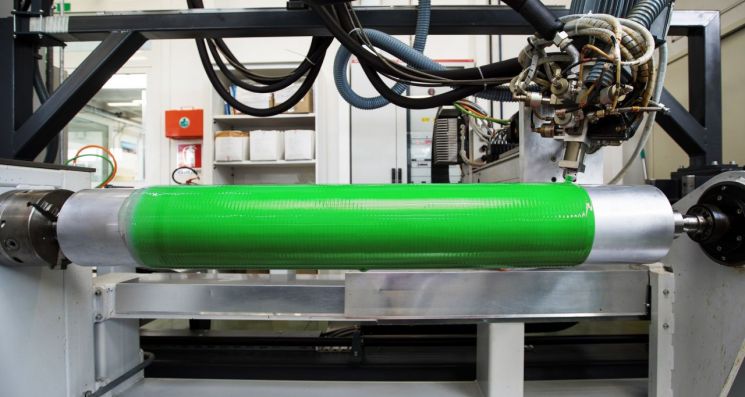
[Asia Economy Reporter Yoonju Hwang] LANXESS introduces 'Adiprene Green,' an MDI-based polyether prepolymer made from renewable bio-based raw materials.
Adiprene Green serves as an alternative to conventional fossil-based prepolymers and can be applied in the production of durable polyurethane (PU) elastomers.
Using starch-based polyether polyol, Adiprene Green reduces carbon dioxide emissions by 20-30% compared to fossil-based prepolymers, contributing to carbon footprint reduction efforts by PU manufacturers.
The bio-based content of Adiprene Green can be adjusted between 30% and 90% depending on the target hardness. Even when using Adiprene Green, the PU process remains the same as before, and the physical properties of the final PU elastomer are equal to or superior to those produced with fossil-based prepolymers.
Adiprene Green is easy to handle and can be processed in the same way as conventional prepolymers. There is no need to change raw material handling methods, processing temperatures, or mixing ratios, and the reaction speed and demolding time are similar to those of fossil-based prepolymers. When cured with 1,4-butanediol, PU elastomers with hardness ranging from 40 Shore A to 60 Shore D can be produced. It is compatible with various PU systems, allowing both manual and mechanical mixing, and can be processed using LANXESS's Vibracat catalyst. The Adiprene Green product line is suitable for demanding applications such as roll covers, wheels, press sleeves, and non-pneumatic tires.
Kim Gunhee, Deputy General Manager of the Urethane Systems Division at LANXESS Korea, stated, "Under a clear sustainability strategy, LANXESS is committed to climate protection with the goal of achieving climate neutrality by 2040. The new Adiprene Green material will help us take a step closer to climate neutrality together with our global customers."
© The Asia Business Daily(www.asiae.co.kr). All rights reserved.

















