Ruling and Opposition Parties Hold Budget Subcommittee Meeting for Supplementary Budget Negotiations
Communication Fees... "Costs Did Not Increase" vs "Perceived Communication Fees Increased Due to Netflix, etc."
Flu Vaccine... "All Secured Supplies Are Free" vs "Securing Budget for COVID-19 Vaccine Is More Important"
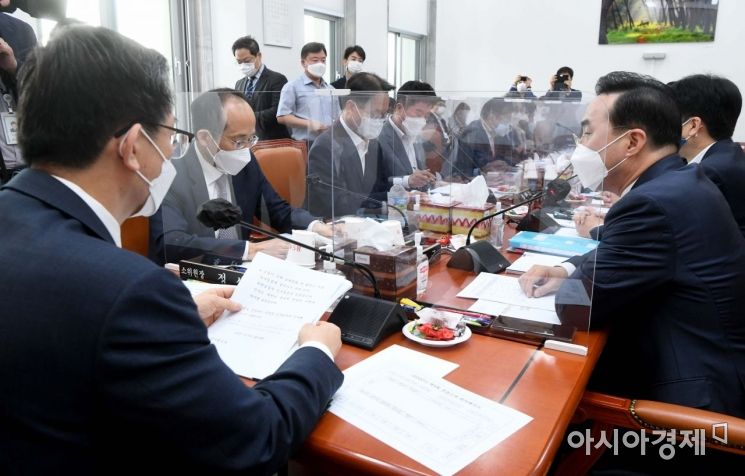 Jeong Seong-ho, Chairman of the National Assembly Budget and Accounts Committee, is attending and presiding over the 4th supplementary budget adjustment subcommittee meeting held at the National Assembly on the 21st. Photo by Yoon Dong-joo doso7@
[Asia Economy Reporter Kim Hyemin] On the 21st, as the ruling and opposition parties began detailed deliberations on the 4th supplementary budget (supplementary budget) bill, they showed differences over the payment of 20,000 won for communication expenses and free flu vaccinations. However, they appeared to find common ground regarding support for corporate taxi drivers excluded from the government’s supplementary budget plan and support for businesses subject to gathering bans, including entertainment bars.
The National Assembly’s Special Committee on Budget and Accounts opened a subcommittee on the supplementary budget from 8 a.m. that day and is reviewing the 7.8 trillion won scale 4th supplementary budget bill.
In the morning session, the ruling and opposition parties clashed over the government and ruling party’s plan to provide 20,000 won in communication expenses to all citizens aged 13 and older nationwide.
The Ministry of Science and ICT, the relevant ministry, emphasized that there is a burdened group for communication expenses, stating, “Data usage has increased by more than 50% compared to last year, with unlimited data users increasing by 30% and non-unlimited users by 10%. This means that even if there is actual demand, those without unlimited plans cannot sufficiently increase their data.” The ministry explained that due to the impact of COVID-19, subscribers to online video services (OTT) such as Netflix and Wavve have increased, leading to a rise in communication expenses.
The Democratic Party of Korea also agreed with this logic and advocated for maintaining the original plan. Representative Han Junho said, “Watching OTT at home is not captured in the communication expense statistics by the Statistics Korea, but the perceived communication expenses have increased,” adding, “The combined gas and electricity bills for a family of four are about 70,000 won, so this has an effect of offsetting that.” Park Hong-geun, the Democratic Party’s budget committee secretary, also urged, “60% of the people use low-cost plans. Since the government has hard-won this budget, please cooperate.”
On the other hand, some argued for cuts, saying it does not align with the supplementary budget’s purpose of supporting those affected by COVID-19. Representative Cho Hae-jin of the People Power Party said, “Providing communication expenses to all citizens is contrary to the original purpose of the project,” and added, “Although non-face-to-face activities have increased due to COVID-19, empirical verification is needed to confirm whether this has led to increased communication charges.” Representative Jung Chan-min also countered, “Many people do not even have a few thousand or tens of thousands of won for ramen or transportation costs. The supplementary budget should be used for more urgent, desperate, and unavoidable needs.”
Representative Chu Kyung-ho, the People Power Party’s budget committee secretary, criticized the claim that the OTT market expanded due to COVID-19, saying, “Even if people live outside, the Netflix and Watcha markets grow. Saying it increased because of COVID-19 is too simplistic,” and added, “Although the amount per individual is not large, the national debt increases by 1 trillion won. It is ineffective for the state to support 20,000 won.”
The ruling and opposition parties also failed to narrow their positions on the People Power Party’s proposal for free flu vaccinations. Representative Chu emphasized, “We can make the 11 million paid doses free, and for realistically unavailable quantities, we can approach them with a time lag,” adding, “It is a matter of the state protecting health from a preventive perspective without burdening the people.”
However, Representative Park said, “The 11 million paid doses are already distributed in the market, and even if they are given for free, there could be public disputes during the selection process,” expressing concerns, “If there are groups raising objections, expanding some groups through public consensus can be considered, but there will be many controversies in determining the groups.” He also argued, “When a COVID-19 vaccine is developed in the future, there could be intense competition. The budget for securing the COVID-19 vaccine is more important than free flu vaccines.”
Regarding the proposal to provide support funds not only to individual taxi drivers but also to corporate taxi drivers, the ruling and opposition parties reached a consensus.
Representative Jung Chan-min of the People Power Party said, “The supplementary budget has ironically caused conflict between individual and corporate taxi drivers,” and insisted, “They should be viewed on an equal footing.” Representative Chu Kyung-ho also urged, “Who distinguishes between individual and corporate taxis? They are all the same people working hard,” and added, “Please find a way to support them in any form.”
Democratic Party Representative Park Hong-geun said, “Although the government has a system to support corporate taxi drivers, the reality is much more difficult compared to individual taxi drivers,” and requested, “While understanding the government’s explanation of the system’s inevitability, it is difficult to accept from the policy consumer’s perspective. The government should actively discuss and find possible measures.”
The ruling and opposition parties also pointed out that fairness should be considered regarding the exclusion of entertainment bars and others from the support targets for businesses subject to gathering bans.
Democratic Party Representative Lee Jung-moon said, “These people also pay taxes and operate their businesses, so imposing only obligations without support is problematic in terms of fairness,” and Representative Park also emphasized, “Although it is naturally opposed by public sentiment, since entertainment establishments have actively cooperated with quarantine measures, it is appropriate to consider support.”
© The Asia Business Daily(www.asiae.co.kr). All rights reserved.
![Clutching a Stolen Dior Bag, Saying "I Hate Being Poor but Real"... The Grotesque Con of a "Human Knockoff" [Slate]](https://cwcontent.asiae.co.kr/asiaresize/183/2026021902243444107_1771435474.jpg)
















