Under Civil Law and Commercial Building Lease Protection Act, Rent Increase/Decrease Claims Can Be Requested via Mediation
Both Contract Parties Suffered Unavoidable Damage Due to COVID-19 Crisis
Legal Interpretation Allows for Possible Reduction, but No Relief Provided During IMF Crisis
Government: "Private Contracts Cannot Be Subsidized by Government Funds"
[Sejong=Asia Economy reporters Kim Hyun-jung and Jang Se-hee] Lee Jae-myung, Governor of Gyeonggi Province, who has been raising his voice on livelihood-related policy issues since the outbreak of the novel coronavirus disease (COVID-19), has now pulled out the 'government-led rent reduction' card based on tenants' right to request rent adjustment. However, it seems difficult to realize. Although there is room for rent reduction based on legal interpretation since business operations were forcibly suspended by government policy, the legal community judges that there is insufficient grounds for government intervention in private transactions between individuals, and the government is also reluctant to provide additional tax credits or direct support to landlords due to financial constraints.
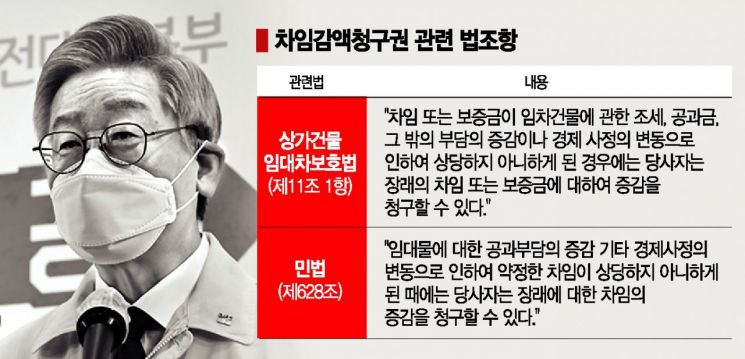
According to Governor Lee Jae-myung and the legal community on the 21st, small business owners hit hard by the COVID-19 crisis can request a reduction in commercial rent based on the Civil Act (Article 628) and the Commercial Building Lease Protection Act (Article 11, Paragraph 1). This is the so-called 'right to request rent adjustment.' Furthermore, Article 537 of the Civil Act states that when the contract cannot be performed due to reasons for which neither party is responsible, the obligor cannot demand performance from the other party.
Governor Lee's proposal through his social network service (SNS) the day before, asking the central government to step in for rent reductions for small business owners, is also based on these related laws. He stated, "In cases where business is effectively prohibited due to the state's order of closure under infectious disease control, tenants may be considered exempt from rent payment obligations," and requested the central government’s authoritative interpretation and administrative guidance for active dispute mediation by local governments.
There have been past cases where tenants, facing difficulties in business due to sudden external variables, requested rent reductions because they could not afford the rent. A representative example is the rent dispute between the government and public institutions (Korea Airports Corporation) during the 1997 IMF foreign exchange crisis. The Supreme Court (2001Da12638 ruling) ruled in favor of landlords, judging that the deterioration in business performance was "due to management miscalculations and investment failures that tenants themselves must bear."
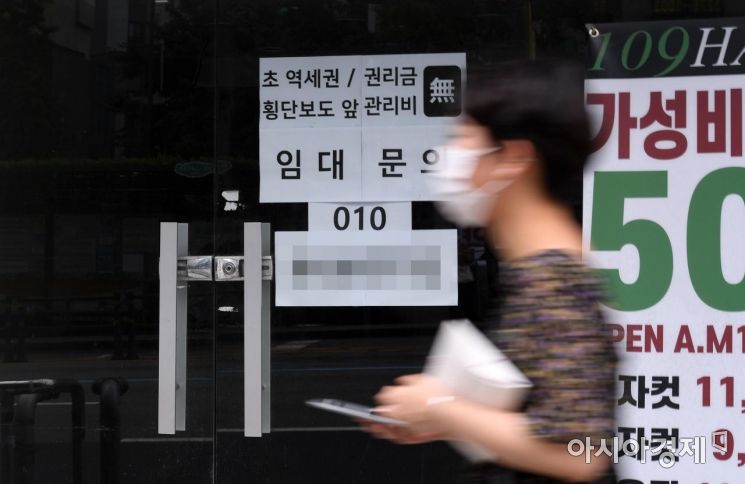 Due to the aftermath of the novel coronavirus infection (COVID-19) and the ongoing economic downturn, a rental notice is posted at a shopping street in front of Ewha Womans University in Seodaemun-gu, Seoul, on the 18th. Photo by Kim Hyun-min kimhyun81@
However, in the COVID-19 situation, since the government unprecedentedly designated specific industries and forcibly closed business premises, legal experts explain that there is room for rent reduction if the matter is legally contested. Attorney Kim Ye-rim of Jeonghyang Law Firm said, "Neither landlords nor tenants are responsible for contract non-performance, and complex issues remain regarding who bears the risk," adding, "The key is how the contract is interpreted; depending on whether COVID-19 is considered a force majeure and whether rent during non-performance constitutes unjust enrichment, there is room for rent reduction."
The rent reduction issue ignited by Governor Lee is also gaining momentum as the political sphere responds one after another. Ahn Cheol-soo, leader of the People’s Party, said at the morning supreme council meeting, "We should encourage public officials or public institution employees who or whose families operate rental businesses to reduce rent even slightly," adding, "Since the ruling party controls most metropolitan and local governments as well as metropolitan and basic councils nationwide, it should not take long if they are willing." He also added, "Furthermore, the government should expand incentives or tax benefits for private landlords who reduce rent and actively promote them."
Within the ruling party (Democratic Party members Jeon Yong-gi and Min Hyung-bae), a bill was proposed to amend the Commercial Building Lease Protection Act to prohibit refusal to renew or termination of contracts due to monthly rent arrears during a special period. Meanwhile, Choo Kyung-ho of the People Power Party proposed a bill to add 'COVID-19' to the list of first-class infectious diseases under current law. The related bills are expected to be reviewed jointly.
However, the government is reluctant regarding rent adjustment measures through additional support to landlords. A senior government official said, "The current tax credit rate is already substantial, so it is difficult to increase benefits," and another government official explained, "There are no policy considerations regarding rent reductions, and the government cannot subsidize what is determined by private contracts with public funds."
© The Asia Business Daily(www.asiae.co.kr). All rights reserved.


















