A 'Secret Trip' Taken Quietly
Vacation Reason: 'Personal Matters'... No Photos Posted on SNS
Worried About Criticism for Traveling During the COVID Era
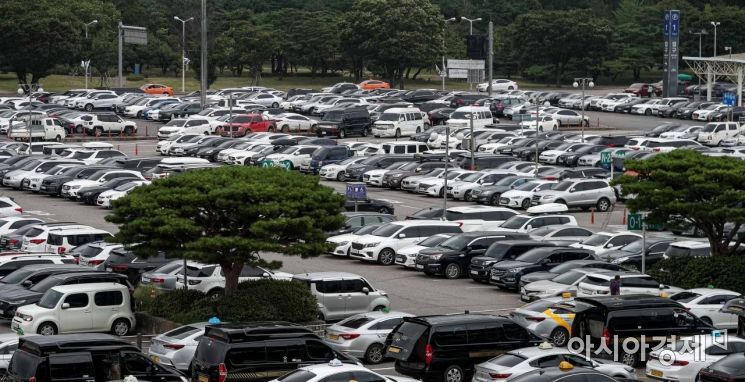 On the 14th, the domestic parking lot at Gimpo Airport in Seoul is filled with vehicles of travelers taking advantage of the golden holiday./Photo by Jin-Hyung Kang aymsdream@
[Asia Economy Reporter Song Seung-yoon] Office worker Jeong Minsu (34, pseudonym) recently took a vacation with three friends and traveled to Jeju Island. Jeong uploaded travel photos on social networking services (SNS) and tagged the places visited to leave 'proof shots' diligently, but this time he did not do so. He did not disclose the fact that he was traveling to anyone outside. The same goes for Jeong's group. Although they submitted vacation plans, they only explained the reason to the company as 'personal matters.' Jeong said, "I felt too suffocated staying at home, so I went on a trip, but I was concerned about others' views, so I did not talk about the trip at all."
The number of 'secret travelers' who quietly travel without informing those around them is increasing. This is because, amid the ongoing COVID-19 pandemic, people fear being frowned upon if it becomes known that they traveled. This is similar in context to the so-called 'Shy Japan' phenomenon that emerged during the boycott of Japanese brands, where people consume Japanese products or travel to Japan but do not disclose it.
Despite social distancing, popular hotels and resorts in tourist areas such as Jeju Island, Gyeonggi, and Gangwon provinces are so crowded that reservations are fully booked on weekends. Even during the Chuseok holiday period, when the government recommended refraining from travel, many places are fully booked. Especially, kid-friendly pensions or pool villas equipped with private pools and various entertainment facilities are difficult to find vacancies throughout this month.
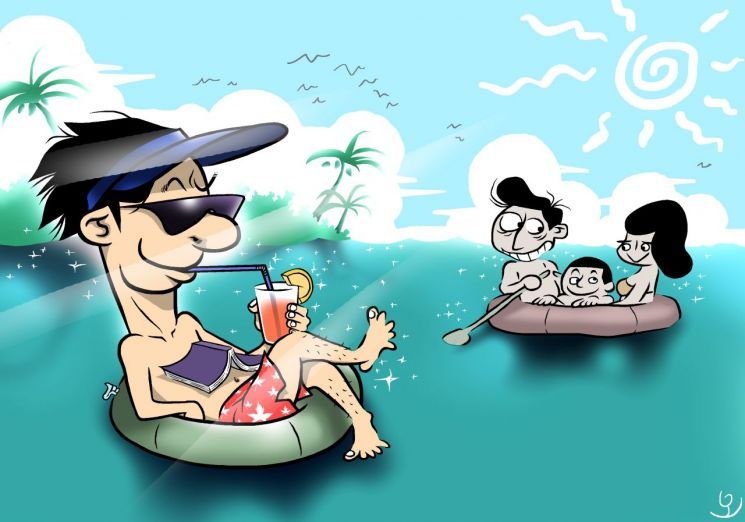
However, on Instagram and other SNS, the number of travel-related hashtags and 'proof shots' has noticeably decreased compared to usual. Many who post travel photos also add hashtags like 'compliance with quarantine rules' and 'wearing masks.' This is a kind of self-defense, saying that although they had to travel, they followed the quarantine rules well. A self-deprecating new term, 'travel in this situation,' has also appeared. Conversely, some use hashtags like 'travel canceled' and 'staying home proof' to certify that they canceled trips or did not go outside over the weekend, appealing for participation in social distancing.
Some voice complaints, saying, "Is it possible to stay at home for months on end?" They argue that people need some breathing room. College student Kang Young-chae (26) said, "I think it's not something to criticize even if you take a short walk near your home or go on a light picnic, even if not traveling," adding, "Not only COVID-19 quarantine but also psychological quarantine is important, and if you follow the rules well, there should be no problem."
On the 21st, a survey conducted by the employment portals Incruit and Albacoal targeting 5,256 adults nationwide in April, June, and September this year showed that 54.7%, 69.2%, and 71.6% respectively reported experiencing depression due to COVID-19. The main causes and symptoms of depression were identified as 'frustration and boredom due to refraining from going out' (22.9%), 'anxiety due to job loss and hiring suspension' (16.5%), and 'lethargy' (16.2%).
© The Asia Business Daily(www.asiae.co.kr). All rights reserved.


















