Survey of Top 10 Groups... 'Separate Election of Audit Committee Members' Ranked No.1 Toxic Clause in Fair Economy 3 Laws
Expansion of Private Interest Appropriation Regulation under Fair Trade Act and Abolition of Exclusive Prosecution Rights Also Obstacles... "They Aim to Increase Regulation Targets and Create a Litigation-Prone Korea"
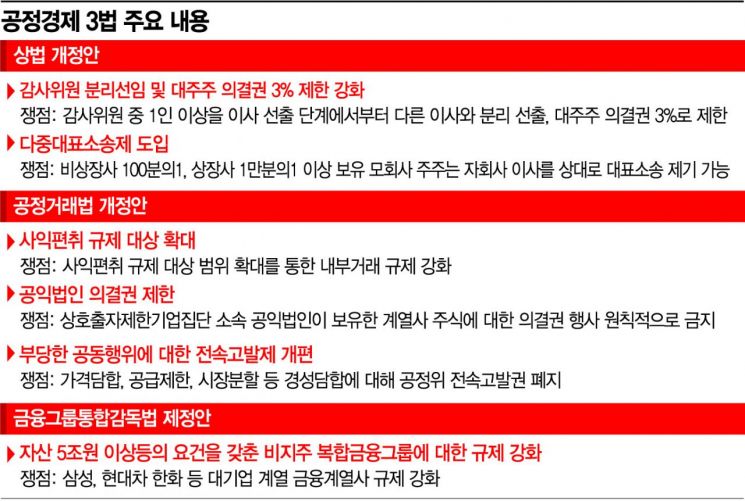
[Asia Economy Reporter Kim Hyewon] Among the so-called 'Fair Economy 3 Acts' (Commercial Act, Fair Trade Act, Financial Group Supervision Act) promoted by the government and ruling party, the business community has expressed the greatest concern over the introduction of the separated election system for audit committee members. Critics argue that starting next year, the government and National Assembly are effectively opening the door for hostile forces to frequently access all kinds of company information by entering the board of directors. ▶Related article on page 5
On the 21st, Asia Economy conducted a full survey of the top 10 groups including Samsung, Hyundai Motor, SK, LG, and Lotte, and identified the 'separated election system for audit committee members' included in the amendment to the Commercial Act as the top toxic clause related to the Fair Economy 3 Acts. Along with the separated election system for audit committee members, the 3% cap on major shareholders' voting rights not only infringes on property rights guaranteed by the constitution but also violates the principle of shareholder equality, which is one share, one vote. The business community's common voice is that if the legislation is forced through, at least minimal defensive measures for companies, such as granting differential voting rights under special circumstances, must be established during the bill review process.
Kwon Tae-shin, Executive Vice Chairman of the Federation of Korean Industries (President of the Korea Economic Research Institute), recently pointed out, "While the multiple derivative suit system can be tolerated by companies in terms of legal and cost burdens due to frequent lawsuits, the separated election system for audit committee members is the biggest problem because there is no way to respond."
While the separated election system for audit committee members is an obstacle applicable to all top 10 groups, LG and Lotte Groups, which have already completed their transition to holding company systems, also cite the expansion of regulations on internal transactions and the abolition of exclusive prosecution rights in the comprehensive amendment to the Fair Trade Act as toxic clauses. An executive from one of the top 10 groups said, "The number of companies trapped within the regulatory framework will increase exponentially, creating a 'litigation Korea' where lawsuits are rampant. The social costs to be paid are considerable, and it will lead to a contraction in business activities, ultimately negatively impacting national power."
There is no sharp measure for major conglomerates and economic organizations to block the legislation of the Fair Economy 3 Acts, which the government and ruling party are strongly pushing. Accordingly, each group has set up control towers such as planning and coordination offices to meticulously analyze the impact of the Fair Economy 3 Acts and regularly prepare reports. Lobbying personnel frequently visit lawmakers' offices to quietly convey the companies' positions. A lobbying officer from a major company lamented, "'Fairness' has suddenly become a key national agenda, but the term 'Fair Economy 3 Acts' itself is wrong. It denies the foundation of joint-stock companies and is full of unfair clauses that are unfair only to specific shareholders. It should rightly be called the Unfair Economy 3 Acts."
© The Asia Business Daily(www.asiae.co.kr). All rights reserved.

















