[Asia Economy Reporter Yoo In-ho] As the selection process for candidate sites for Seoul's public redevelopment projects intensifies, attention is focusing on the specific methods of project implementation.
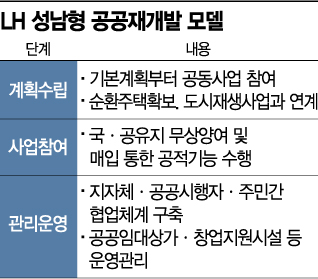
In particular, the so-called 'Seongnam-type public redevelopment' model, which improved the residential environment of the old downtown area of Seongnam City, Gyeonggi Province, is drawing attention as the Ministry of Land, Infrastructure and Transport, Seoul City, and Korea Land and Housing Corporation (LH), the main authorities, are reportedly considering this model for the success of public redevelopment projects.
According to industry sources on the 21st, the Ministry of Land and Seoul City began accepting applications from the 21st to select pilot project candidate sites for the public redevelopment projects being promoted under the '5·6 Metropolitan Area Housing Supply Foundation Enhancement Plan.'
It is understood that there is considerable interest in various areas. However, it remains uncertain how the previously difficult private redevelopment projects, due to various issues, will be resolved through the public redevelopment approach.
The Ministry of Land is considering increasing the floor area ratio up to 120% of the legal limit for public redevelopment, while lowering the proportion of the increased area to be donated through rental housing, etc., from the existing 50-75% to 20-50%.
The issue lies in resolving conflicts such as tenant relocation measures for the original residents of the public redevelopment target areas. Many redevelopment projects in the metropolitan area have stalled due to lack of profitability and internal and external conflicts within the associations.
In this context, the Seongnam-type public redevelopment method promoted by LH and Seongnam City is emerging as an alternative. This is a 'cyclical maintenance' method where LH prepares relocation measures for tenants and others to help original residents resettle before starting the maintenance project. LH explains that the original resident resettlement rate exceeds 50%. The average resettlement rate for redevelopment projects in Seoul is only 15%.
In fact, LH supported residents of the project area to live in rental housing owned by LH while promoting redevelopment projects in Jungdong 3 District and Dandae District, enabling them to resettle in their original neighborhoods. The resettlement rate of original residents in Jungdong 3 District, where the project is underway using this method, is understood to be 53.4%, and 49.9% in Dandae District.
LH states that additional institutional improvements are necessary for the success of public redevelopment based on this Seongnam-type model. To this end, LH suggests that happy housing, which is supplied preferentially as cyclical housing within 50% by class, should be allowed to be used temporarily up to 30% regardless of class distinction. LH also added that the proportion of cyclical housing currently limited to 50% within national rental housing needs to be increased.
However, experts advise that detailed and clear standards for public redevelopment should be promptly established to enhance trust in real estate policies.
© The Asia Business Daily(www.asiae.co.kr). All rights reserved.

















