[Asia Economy Reporter Choi Saeng-hye] The government has decided to further subdivide the stages of 'social distancing' by comprehensively considering not only the number of new confirmed cases of the novel coronavirus infection (COVID-19) but also the scale of critically ill patients and changes in the fatality rate, as well as the healthcare system's response status.
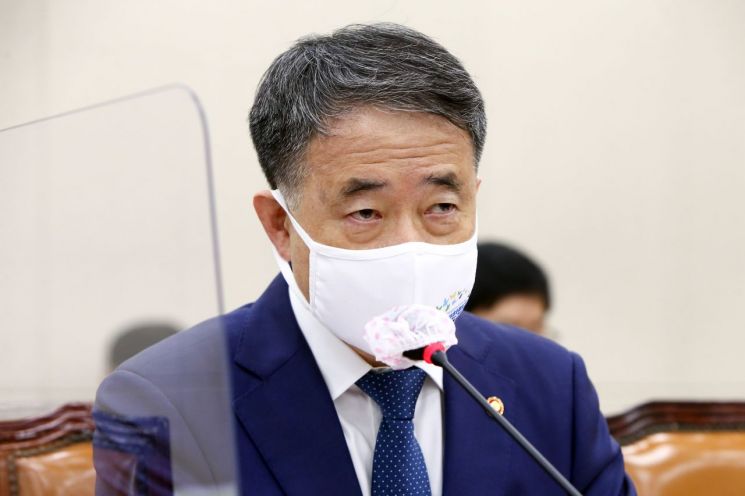
Park Neung-hoo, the first deputy head of the Central Disaster and Safety Countermeasures Headquarters (Minister of Health and Welfare), stated at a regular briefing on the 20th, "Until now, the focus has been on the number of new confirmed cases, but going forward, we will reform social distancing by simultaneously considering the proportion of critically ill patients, the readiness of intensive care units, the fatality rate, and how well our healthcare system can cope."
He added, "Since the criteria and implementation measures for each stage of social distancing were announced last June, various experiences have been accumulated as they were applied in reality. We are preparing to reform the system in a way that fully utilizes these experiences."
He explained, "For example, currently there are stages 1, 2, and 3, and when a situation falls between these, it has been indicated as 2.5 or 1.5. However, we are reviewing the idea that it would be better to subdivide the stages more specifically with concrete numerical values."
He also said, "Discussions on reform are underway to strengthen rules that need to be reinforced at each stage and relax those that can be eased, aiming for sustainability while reducing public fatigue."
The government had previously announced the criteria and measures for each stage of social distancing on June 28. Based on indicators such as the daily number of confirmed cases in the community, the proportion of cases with unknown infection routes, and the status of currently managed cluster outbreaks, social distancing was divided into stages 1 to 3, with the intensity of quarantine measures increasing as the stage rose.
However, since August, with the rapid spread of COVID-19, the social distancing stage was raised from stage 1 to stage 2, and in the Seoul metropolitan area, it was elevated to stage 2.5. As sudden high-intensity measures continued, the pain of business owners and ordinary citizens intensified, leading to calls for a reorganization of social distancing.
Moreover, during the application of the 2.5 stage measures in the metropolitan area, which is neither stage 2 nor stage 3, criticism arose that it was a 'patchwork policy.' There were also opinions that the highest stage, stage 3, should be reserved as a 'last resort' due to the prolonged COVID-19 situation.
The government is reportedly reflecting these criticisms and opinions comprehensively and plans to increase and subdivide the social distancing stages into stages 1 through 5.
© The Asia Business Daily(www.asiae.co.kr). All rights reserved.

















