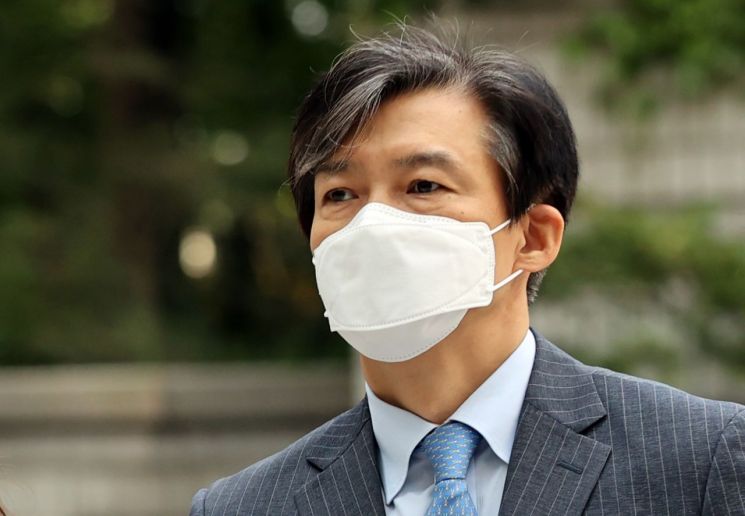
[Asia Economy Reporter Seongpil Jo] "I will follow Article 148 of the Criminal Procedure Act." (Former Minister of Justice Cho Kuk)
"I will not testify." (Professor Jeong Gyeong-sim of Dongyang University, former Minister Cho's son Jo)
Recently, former Minister Cho Kuk and his wife, along with their son Jo, who appeared as witnesses amid suspicions of admission fraud, exercised their right to refuse testimony. The legal basis is the same as former Minister Cho's response: Article 148 of the Criminal Procedure Act. It is the right to refuse to testify if there is a concern that oneself or a relative may be punished. Nevertheless, the prosecution proceeded with the questioning. They paid no heed to the defense team's objections calling it a "futile procedure." Why did the prosecution pour out questions for hours on end to those who gave no answers?
Prosecution Anticipated Prepared Testimony Refusal
It was on the 15th. Professor Jeong appeared as a witness at the continuation trial of Choi Kang-wook, leader of the Open Democratic Party, presided over by Judge Jeong Jong-geon of the Seoul Central District Court Criminal Division 9. The prosecution seemed to have anticipated this. When Professor Jeong exercised the right to refuse testimony, the prosecution immediately requested the court for an opportunity to present their opinion. Then they read aloud an A4 sheet they had prepared.
"The witness's refusal to testify is one of the rights stipulated by the Criminal Procedure Act, so the request to refuse testimony itself cannot be blamed. However, the prosecution judges that even if the witness expresses refusal to answer all questions, it is necessary to proceed with questioning under the Criminal Procedure Act to uncover the substantive truth. The witness did not respond to the investigation from a certain point after detention during the investigation process, so the issue regarding Chaengmaek (the law firm that issued Jo's internship certificate) was not investigated at all. To reveal the substantive truth, questioning must proceed. (Omitted) Considering these points, we ask for guidance to conduct the trial to uncover the substantive truth."
The court accepted the prosecution's opinion. The prosecution proceeded with the questioning, and Professor Jeong refused to testify. The questioning of Jo, who appeared as a witness after Professor Jeong that day, was the same. Jo did not make any statement other than saying, "I will not testify." At the continuation trial three days earlier, former Minister Cho, who appeared as a witness, also repeatedly said, "I will follow Article 148 of the Criminal Procedure Act."
The prosecution did not back down. They finished the questioning only after asking all the prepared questions. Unless the court intervened with remarks like "(This question is unrelated to the charges) so you may omit it," most of the prepared questions were asked. Especially during former Minister Cho's questioning, more than 300 questions were asked, and it took nearly five hours excluding recess time.
"Intention to Arouse Presumption of Guilt"... The Key is Evidence
Most of the prosecution's questions were unfavorable to former Minister Cho and his wife. To Professor Jeong, questions included "Isn't the son's internship certificate forged by former Minister Cho?" and "Didn't the son not intern at Chaengmaek?" To former Minister Cho, questions included "Why was the Seoul National University Public Interest Human Rights Law Center internship certificate issued from a witness's computer rather than the center director?" and "If your daughter attended the Seoul National University Public Interest Human Rights Law Center seminar, you would have had enough opportunity to know, so why have you not mentioned seeing your daughter until now?"
Regarding the private equity fund suspicions, the prosecution also disclosed text messages exchanged between Professor Jeong and former Minister Cho's fifth cousin Jo Beom-dong, as well as texts directly exchanged between former Minister Cho and Professor Jeong. The prosecution argued, "The crime occurred during the process of jointly managing, operating, and increasing assets formed between the couple," and "Their discussions are important indirect evidence of role division."
In the legal community, this prosecution questioning is analyzed as "an intention to arouse the presumption of guilt in the court." A lawyer in Seocho-dong said, "The prosecution conveyed what they wanted to say through the questions themselves or by presenting evidence," and "By repeatedly asking questions containing the charges, it can be interpreted as a strategy to gain an advantage in the trial."
The court cannot make a ruling unfavorable to the defendant just because the defendant or related witnesses exercised their right to refuse testimony. This means that the right to refuse testimony is an inherent right for those being questioned. In this case, evidence is crucial. Another lawyer said, "Even if the right to refuse testimony is inherent, few judges will look kindly on not answering matters where the evidence is clear," and "The key will be how much evidence the prosecution has secured."
Bitter Experience in Jo Beom-dong and Jo Gwon Trials... What About Cho Kuk and Jeong Gyeong-sim?
The first trial of former Minister Cho's family, which shook the political landscape last year, is now entering its final stages. The case against Professor Jeong, who was indicted last September for forging a certificate, has been ongoing for nearly a year and is now heading toward its conclusion. Four witnesses remain, and their questioning is scheduled for the 24th. Afterward, procedures such as documentary evidence examination will take place, concluding the trial. The verdict is expected as early as November. Once the verdict is delivered, only former Minister Cho's trial will remain. His trial is currently underway regarding allegations of covering up the inspection of Yoo Jae-soo.
However, the prosecution's results in the trials of former Minister Cho's family so far have been unsatisfactory. Jo Beom-dong, related to the private equity fund suspicions, and Jo Gwon, related to the Woongdong Academy corruption suspicions, were sentenced guilty and detained, but most of the core charges were acquitted. For the prosecution, which conducted over 100 search and seizure operations, this is a disappointing record.
The Cho family exercised their right to refuse testimony, and the prosecution proceeded with all the prepared individual questioning. How each strategy will affect the trial remains uncertain. The winner will be decided in the upcoming trials. This week, Professor Jeong and former Minister Cho are scheduled to appear in their respective trials one day apart: Professor Jeong on the 24th and former Minister Cho on the 25th. Professor Jeong's side, who collapsed in court after complaining of health issues at the last hearing, had not submitted a notice of absence as of the afternoon of the 20th. For now, the trial is expected to proceed as scheduled.
© The Asia Business Daily(www.asiae.co.kr). All rights reserved.



















