Political Circles Emphasize the Need for Corporate Taxi Support
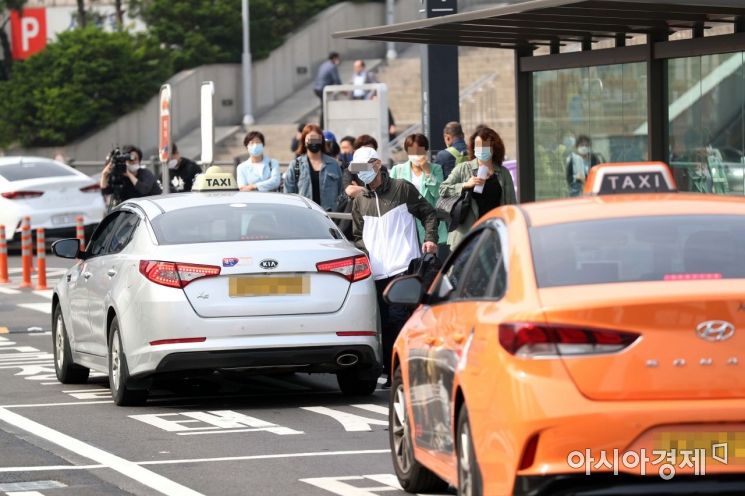 On the first day of mandatory mask-wearing on public transportation, the 26th, citizens wearing masks are taking taxis in front of Seoul Station. Photo by Moon Honam munonam@
[Sejong=Asia Economy Reporter Kim Hyun-jung] There are growing calls to support not only individual taxi drivers but also corporate taxi drivers through the government's 7.8 trillion won 4th supplementary budget (supplementary budget) projects. This is because drivers still have to pay the daily quota even when passengers are scarce, which increases their actual damage and burden.
According to the National Assembly and the Ministry of Economy and Finance on the 20th, taxi drivers who are registered as individual business owners and operate as such are classified as a type of self-employed and are included in the general business support target of the Small Business New Hope Fund, for which the government has allocated a budget of 2.4 trillion won. The amount they can receive is 1 million won as management stabilization funds. However, they must prove the fact of sales decline.
Although the industry is the same, corporate taxi drivers who belong to a company are classified as employees and are not eligible. Emergency Employment Stability Support Fund is also targeted at special employment types (special types) and freelancers, so taxi drivers cannot receive it regardless of whether they are corporate or individual. Of course, they can use emergency livelihood support programs if judged as vulnerable groups or crisis households, but in this case, it must go through the judgment of local governments and the government and is unrelated to their occupation.
As they are excluded from the support targets, voices of concern are emerging inside and outside the political and industry circles. On the 18th, Im Eui-ja, a member of the People Power Party, argued for the necessity of disaster relief funds for corporate taxi drivers at the National Assembly Budget and Accounts Special Committee. According to Rep. Im, the taxi industry saw a 30% decrease in average daily operating income in March and April due to COVID-19, and after social distancing was raised to level 2 and then 2.5 in August, transportation income sharply dropped by about 30-50%.
However, unlike individual taxis, corporate taxis must deposit a fixed daily quota to the company every day, but as passengers sharply decreased, drivers are covering the quota from their salaries because they cannot meet the quota amount. This strange phenomenon causes salaries to be cut the more they go to work. This is because the corporate taxi's profit structure operates in a way that taxi drivers deposit a fixed amount to the company through their operations.
Due to this unique corporate taxi profit structure, among the 1,669 corporate taxi companies nationwide, only 17 companies (1%) have applied for the Employment Retention Subsidy supported by the government to maintain employment. Also, even if they want to change jobs, they cannot receive unemployment benefits due to voluntary unemployment.
Regarding this, Rep. Im said, "This 4th supplementary budget aims to support small business owners whose sales have decreased due to gathering bans and movement restrictions and crisis households exposed to the risk of unemployment, and corporate taxi drivers fall under this category, but the government is ignoring them. Emergency disaster relief funds are even more urgent for corporate taxi drivers in crisis through this supplementary budget," she emphasized.
© The Asia Business Daily(www.asiae.co.kr). All rights reserved.

















